Previous Page Homepage Site Search
Copyrighted Material—All Rights Reserved

| The Accidental Centaur |
| The Rise of the Centaurs |
| Cheiron—Teacher and Mentor |
| The Death of Cheiron |
| The Fall of the Centaurs |
| Bibliography |
| Previous Page |
| Homepage |
| Site Search |
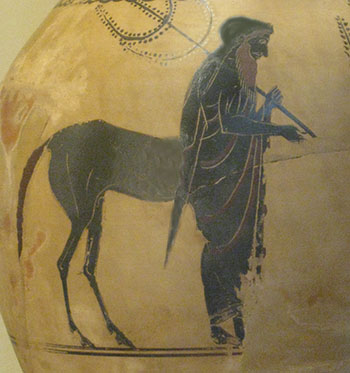
Cheiron was a Centaur ... he had the body of a horse with the torso and head of a man, but Cheiron was not of the race of Centaurs because his parents were not Centaurs. Cheiron was the son of the Titan Kronos and Philyra, a daughter of Okeanos (Ocean). Kronos is often called devious, wily and devising but his relations with Philyra were extraordinarily crafty and conniving. Kronos was with Philyra when his sister-wife Rhea came on the scene ... to avoid Rhea's wrath, Kronos assumed the guise of a horse and Philyra became pregnant with Kronos in that form ... Cheiron was the result of that union.
The actual race of Centaurs didn't arise until the reign of Kronos's son Zeus, which would have been after the birth of Cheiron by an indeterminate number of years. When dealing with the Immortals, elapsed time between generations becomes impossible to calculate. Cheiron was truly one of a kind ... he was unique in every way and although the Centaurs resembled him in physical appearance, Cheiron had no equal. Since the race of Centaurs seems to have been modeled after him, Cheiron might be considered a proto-Centaur. He married a Centaur named Chariklo, but we are not told if they had any children.
Cheiron is consistently referred to as a noble and honored Centaur even though the race of Centaurs is often considered to be crass and brutish. Cheiron was born from the union of two Immortals but he is not still alive ... his immortality was cut short by none other than the ultimate hero, Herakles ... but his death was just like his birth ... accidental.
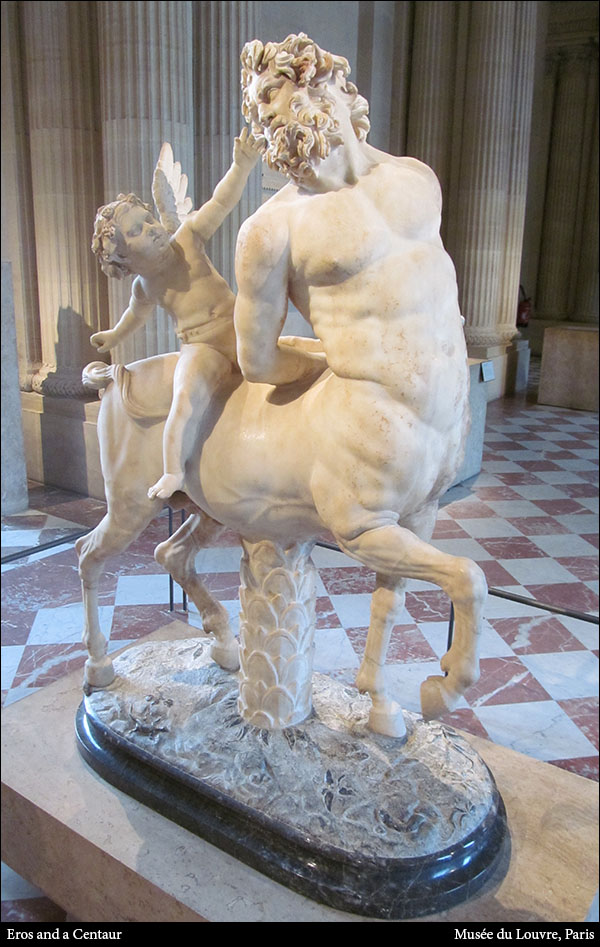
The creation of the Centaurs was a complicated affair. King Ixion of Thessaly was a direct descendant of Okeanos (Ocean) but in spite of his noble heritage, he was not an honest or trustworthy man. He wanted to marry Dia, the daughter of a man named Eioneus, but was unwilling to pay the customary dowry. Eioneus rightly took some of Ixion's mares to force him to honor his responsibilities but Ixion devised a way to have Dia without paying the dowry. He feigned regret for cheating Eioneus and invited his father-in-law to his home to make amends ... when Eioneus arrived, Ixion threw him into a pit of fire.
No mortal man would absolve Ixion of the crime but Zeus, assuming that the errant king had learned his lesson, purified Ixion of his blood-guilt. Ixion was in no way repentant. He repaid Zeus's kindness by trying to seduce Zeus's sister-wife, Hera. Zeus created a counterfeit Hera in the form of a cloud and allowed Ixion to mate with the cloud-woman, Nephele. She and Ixion had a son named Kentauros who became the progenitor of the Centaurs when he mated with the Magnesian mares. Magnesia was located near Mount Pelion and the Centaurs made their homes in the woodlands surrounding the mountain.
For many generations before the Trojan War, the Centaurs were a recognized part of Greek culture. Centaurs were not a common sight in most cities but all Greek citizens knew of their existence and accepted their "differences" without necessarily welcoming the strange beasts into their homes. The exception of course was Cheiron ... he was honored for his contributions to the education and protection of many of the Greek heroes and demigods. Illustrious figures such as Herakles, Ieson (Jason), Achilles, and Apollon's sons Aristaios and Asklepios were all nurtured and educated by Cheiron.
Cheiron was of high moral character and unlike the other Centaurs, sympathetic to the betterment of the human race. Cheiron was praised for his intellectual abilities and became the master of many arts and sciences. He did not hesitate to share his wisdom with worthy students.
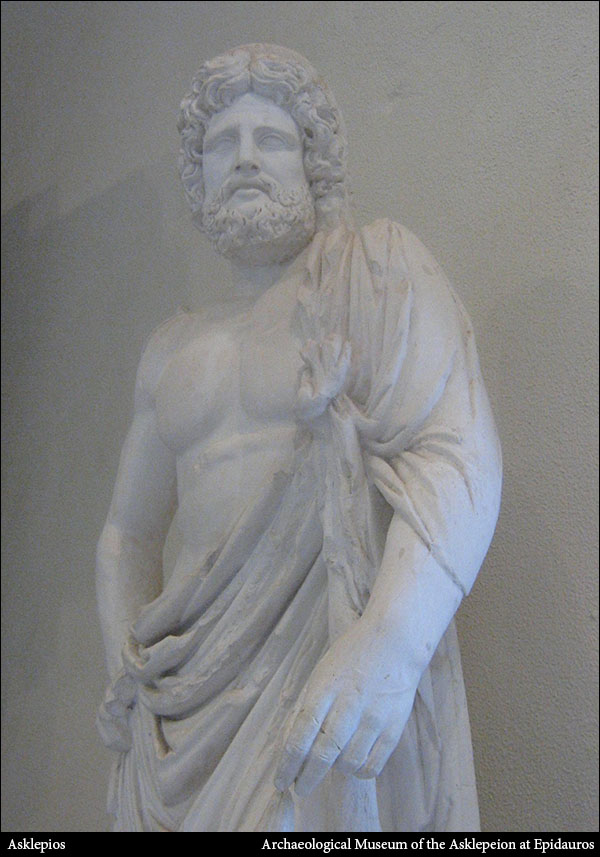
Asklepios was one of Cheiron's most laudable students. Asklepios was a son of the god Apollon and inherited the art of healing from his father. Cheiron helped to refine Asklepios's innate abilities thus making him the most noted physician of all time. Asklepios became so skillful that he was able to bring the dead back to life. Perhaps if Asklepios had learned more humility from Cheiron he would not have been killed for his hubris.
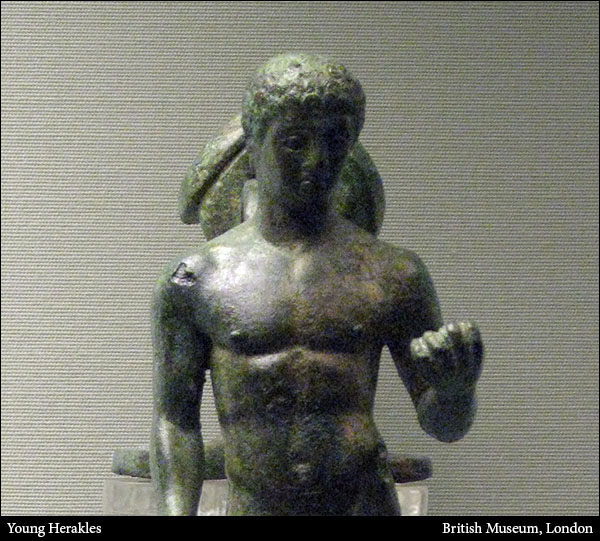
The relationship between Herakles and Cheiron is not clearly described in the ancient texts. We do know that Herakles was a difficult student from the accounts of his fatal attack on his music instructor, Linus. We can assume that Herakles would not have been as brash with Cheiron simply because of Cheiron's strength and size. We can also assume that Herakles first met his cousin and lifelong companion Iolaos while he was a student of Cheiron.
In spite of the education in the arts and sciences given to him by Cheiron, Herakles inadvertently caused Cheiron's death.
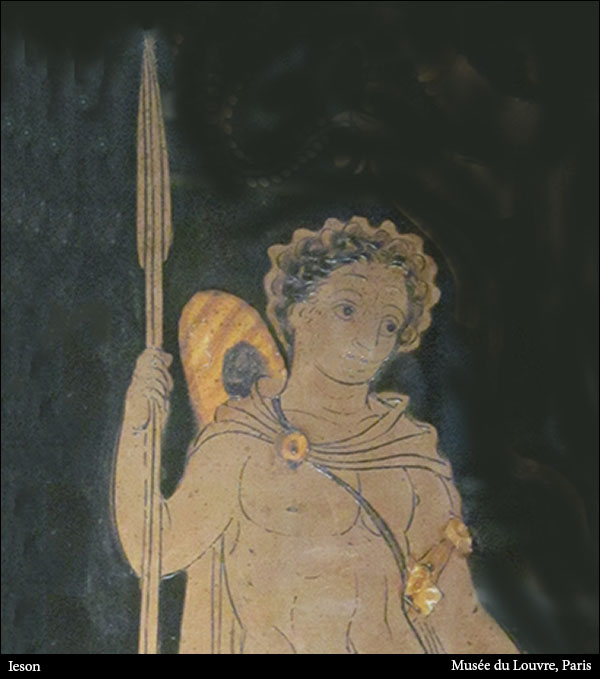
Another of Cheiron's famous students distinguished himself by bringing the Golden Fleece back from the distant land of Kolchis ... that student was of course Ieson.
Ieson's uncle Pelias was an ambitious and unscrupulous man ... he became king of Iolkos by cheating his brother Aeson and threatening Aeson's infant son, Ieson. In order to protect Ieson from ill treatment at the hands of Pelias, Aeson secretly arranged for Ieson to be raised and educated by Cheiron. Ieson was an excellent student and lived with Cheiron until he was a young man.
When Ieson returned to Iolkos, he immediately set off on the Quest for the Golden Fleece, which became one of the most important events in Greek history. Ieson assembled a crew of heroes to man his god-inspired ship, the Argo, and sailed for Kolchis. As the Argo sailed past Mount Pelion, Cheiron, carrying the infant Achilles, was on the shore to bid the Argonauts a safe journey.
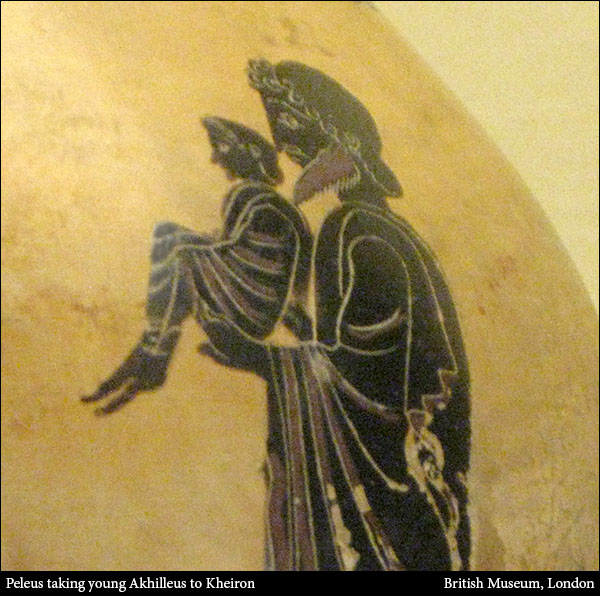
King Peleus taking Achilles to Cheiron.
Achilles was also one of Cheiron's students ... Achilles was placed in the care of Cheiron when he was still an infant. As an adult, Achilles became the most feared and fearless warrior in the Trojan War.
Achilles's goddess-mother Thetis had tried to make her son immortal by bathing him in fire ... when her mortal husband Peleus saw the ordeal Thetis was inflicting on Achilles, he panicked ... he and Thetis exchanged bitter words ... Thetis threw the infant Achilles to the floor and returned to her home under the sea.
Peleus did not want Achilles to lack a proper education so he entrusted Achilles to Cheiron. When Cheiron went to Iolkos to see Ieson and the Argonauts set sail on their Quest for the Golden Fleece, he was given the infant Achilles by Peleus, who was also and Argonaut. That would have been circa 1270 BCE. Since Herakles was a member of the crew of the Argo, there were three of Cheiron's students there that fateful day—Ieson, Peleus, and Herakles.
During the trials of his Fourth Labor (Capturing the Boar of Mount Erymanthos), Herakles and Cheiron were guests of a Centaur named Pholos. As a gesture of friendship, Pholos opened a jar of wine that had been left by the god Dionysos four generations previous, with the instructions that the jar was to be opened when Herakles arrived as a guest.
The smell of the aged wine attracted the neighboring Centaurs and sent them into a frenzy. The violence of the Centaurs and the suddenness of their attack made Pholos hide—Herakles refused to cower. A terrible fight ensued. Some of the Centaurs ripped up pine trees to use as weapons, others threw boulders or brandished firebrands and axes.
The Centaurs were aided by their matriarch Nephele, who sent down a heavy rain to make Herakles slip and fall thus giving the four-legged Centaurs an advantage. But Herakles had an advantage the Centaurs did not suspect ... during his Second Labor Herakles killed the multi-headed Hydra and dipped his arrows in the Hydra's poisonous blood. Using the poisoned arrows, Herakles killed a good number of the Centaurs and forced the rest to flee.
Those killed in the fight included Daphnis, Argeius, Amphion, Hippotion, Oreius, Isoples, Melanchaetes, Thereus, Doupon, and Phrixus. Sadly, Cheiron was also killed in the confusion. When Pholos was burying the dead Centaurs, he was pricked by one of the poisoned arrows and died. Herakles arranged an elaborate funeral for Pholos and the mountain where he was buried became known as Mount Pholoe to honor him.
The Centaurs and the Greeks lived more-or-less peacefully with one another until shortly after the Quest for the Golden Fleece. After that, relations between the Centaurs and the Greeks began to deteriorate until irreconcilable differences led to a full-scale war.
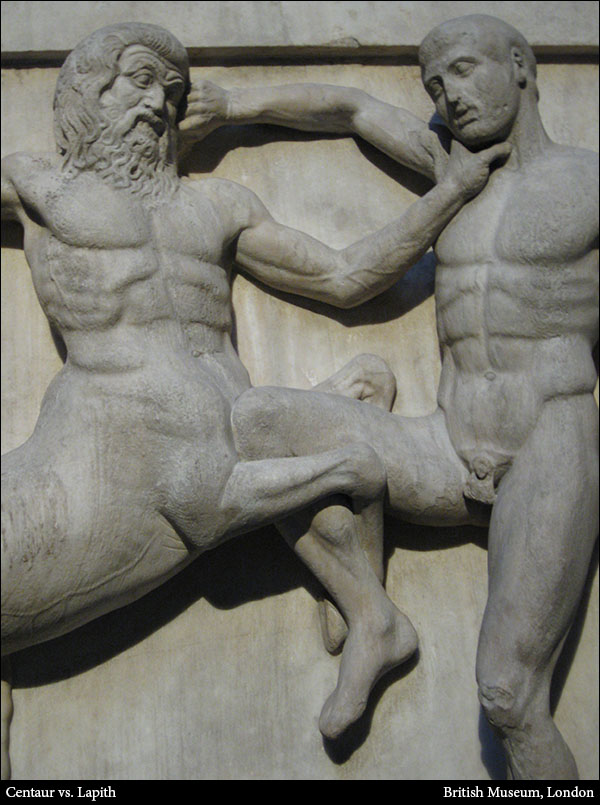
King Peirithoos of the Lapiths was at the center of the dispute with the Centaurs but whether he was a victim or an instigator is not clear. One source suggests that the hostilities began over a land dispute between Peirithoos and the Centaurs.
Peirithoos and the Centaurs were both the spawn of King Ixion of Thessaly but by different mothers. Peirithoos was the son of Ixion's wife, a mortal woman named Dia ... the Centaurs were the "children" of a semi-divine cloud-woman named Nephele. Peirithoos claimed that since he was the legitimate son of Ixion, he was the rightful heir to his father's kingdom. The Centaurs believed that since Peirithoos was their "brother," they were both entitled to an equal share of Thessaly after Ixion died.
The most accepted explanation for the cause of the war between the Centaurs and the Greeks had to do with the disruption of a wedding feast by the Centaurs. The wedding was for Peirithoos and Hippodamia, and the Centaurs were invited guests. The Centaurs became intoxicated and began to harass the Lapith women and finally tried to kidnap Hippodamia. Peirithoos, Theseus, and the Lapith men began to fight with the Centaurs and a bitter war ensued. The Lapiths eventually drove the Centaurs from the vicinity of Mount Pelion. After the war, the Centaurs scattered south and west. One group moved southward to the Peloponnesian Peninsula. Another contingent migrated to the domain of the Aithikes in northwestern Greece, near the Illyrian Mountains. The dispirited Centaurs faded into obscurity and are now assumed to be extinct.
Percepts of Cheiron
The Iliad by Homer
Theogony by Hesiod
Catalogues of Women and the Eoiae
Catalogue of Women
War of the Titans
Homer's Epigrams XIV
Kypria
The Argonautika by Apollonius of Rhodes
Library of History by Diodorus of Sicily
Description of Greece by Pausanias