
| Deukalion |
| The False Sacrifice |
| The Gift of Fire |
| Pandora |
| Prometheus and Io |
| The Age of Prometheus |
| Bibliography |
| Previous Page |
| Homepage |
| Site Search |
Prometheus was the son of the Titan Iapetos and Klymene, daughter of Okeanos (Ocean). His name means Forethought. His brothers are Atlas, Epimetheus, and Menoitios.
The era when Prometheus lived was one of transition. The Titan gods ruled the earth but the children of the Titans ushered in a more benign age for the ancient Immortals and new opportunities for the fledgling mortals on the earth.
Prometheus and his brothers inherited their gentle natures from their mother, Klymene. Their father Iapetos was a Titan and passed along his rebellious nature to his sons.
The Titans were twelve children of Ouranos (Heavens) and Ge (Earth). Their behavior was so outrageous that their father named them Titans, meaning Strainers or Stretchers ... they strained and stretched the bounds of propriety and abused their seemingly limitless powers. One of the most significant accomplishments of the Titans was initiated by Kronos—the creation of the first race of mortal men.
The tyranny of the Titans ended when their children, led by Zeus, rebelled. Kronos was the most powerful Titan, but he was also the most arrogant. His son Zeus united the other children of the Titans as well as the other gods and goddesses who had been disenfranchised by the Titans. A ten-year war ensued. Prometheus sided with Zeus. The conflict became known as the War of the Titans.
Even though Prometheus fought on the side of Zeus, he never had true respect for Zeus. He suspected that the younger gods were like the Titans in that they had no compassion for each other or the mortals on the earth.
Utterly defeated, the Titans were banished to Tartaros (the Pit). Zeus established his throne on Mount Olympos and assumed the title of the Father of Gods and Men. Although Prometheus appeared to be subservient to Zeus, he committed a series of disrespectful acts that provoked the wrath of Zeus.
Several attempts were made to create a suitable mortal race ... all were unsuccessful. Zeus decided to wipe the slate clean and start afresh. He wanted the two races—Immortals and mortals—to live separately but despite his protestations, the Immortals were mating with mortals ... he fashioned a Deluge to solve the problem.
Zeus made no secret of his plans to flood the earth ... he expected no opposition from the Immortals and the mortals were helpless. Prometheus did not voice his objections but began making preparations to save his son Deukalion and Deukalion's wife Pyrrha so they could reseed the human race after the flood. At Prometheus's prompting, Deukalion built a boat capable of surviving the Deluge.
Water covered the earth and then subsided. Deukalion and Pyrrha repopulated the earth by throwing "stones" over their shoulders ... as the stones hit the ground, they became human beings. The stones Deukalion threw became men and those Pyrrha threw became women. The "stones" Deukalion and Pyrrha threw were not ordinary rocks ... they were made of a special clay that had been provided by Prometheus.
Deukalion became the first ruler of men ... he was also the first man to build cities and construct temples to the Immortals.
The subversion of Zeus's will regarding the Deluge was only the first in a series of flagrant acts that would eventually result in severe punishment for Prometheus.
Prometheus's next act of rebellion was a sleight-of-hand designed to make Zeus look foolish ... he offered Zeus a false sacrifice. It was customary to offer the best meat of a sacrificial animal to the gods ... Prometheus thought it would be clever if he could make Zeus accept an inferior portion of meat. He prepared two sacrifices for Zeus ... he made one of fat and bones and the other of the finest meat. After the two sacrifices were wrapped in the animal hide, they appeared to be identical. Knowing all, Zeus saw through the trick but magnanimously controlled his anger. To lessen the insult and turn the tables on Prometheus, Zeus decreed that in the future, all animal sacrifices would be of fat and bones.
Saving the human race from extinction and making the false sacrifice were only annoyances for Zeus, he had much more important concerns on his mind ... he was making plans for reshaping all of creation. After the banishment of the Titans to Tartaros, Zeus took no interest in the human population engendered by Deukalion and Pyrrha ... he apparently intended for them to live as primitives until they died off. Zeus believed that knowledge and divine gifts would only bring misery to the mortals and insisted that Prometheus not interfere with his plans.
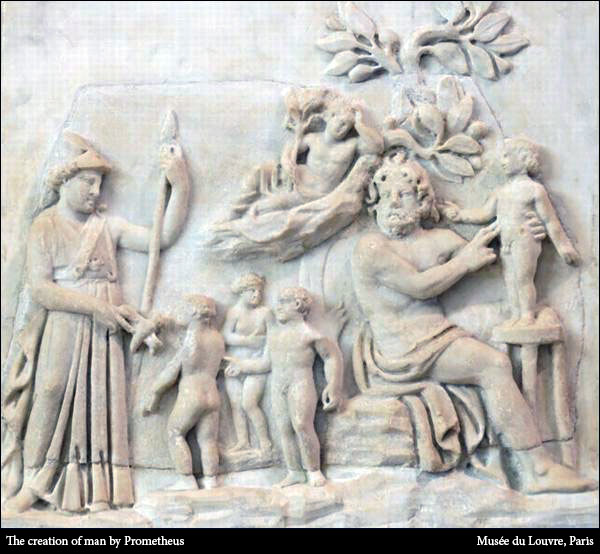
Despite Zeus's warning, Prometheus took pity on the primitive mortals and defied Zeus again. Prometheus gave the mortals all sorts of gifts—brickwork, woodworking, methods for telling the seasons by the stars, numbers, the alphabet (so they could record and remember things), yoked oxen, carriages, saddles, ships, and sails. He also gave them knowledge regarding healing drugs, prophecy, reading signs in the sky, mining precious metals, animal sacrifice, and all forms of art.
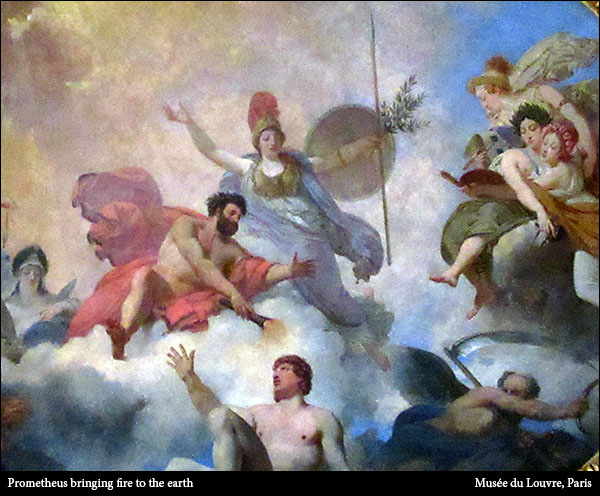
Of all the gifts Prometheus gave to the mortals, fire was by far the most important. The fire was stolen from Zeus ... Prometheus concealed the fire in a fennel stalk and took it from Mount Olympos to the earth below. Men no longer had to fear the night or eat uncooked food ... dark caves became warm homes. In a very brief time (by Immortal standards), culture, art, and literacy began to flourish ... civilization began to change the shape of the land. Zeus was furious!
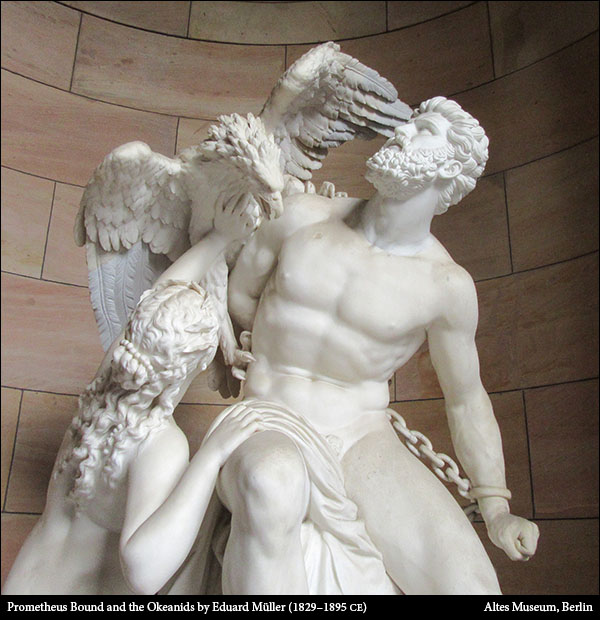
Zeus could no longer tolerate Prometheus's deceptions and disrespect. He ordered the god Hephaistos to shackle Prometheus to a crag, high in the Caucasus Mountains. To compound the punishment, each day Zeus would send an eagle to tear Prometheus's immortal flesh and try to devour his liver. Each night the torn flesh would mend so that the eagle could begin anew at the first light of day.
Prometheus was condemned to suffer on the mountain for thirteen generations of mortal men ... at that time, he would be freed by the son of Zeus, Herakles.
Shackling Prometheus to the mountain was only half the punishment Zeus intended. He devised a subtle form of retribution for the mortals who benefited from the stolen fire by fashioning a hateful thing in the shape of a young girl ... he called her Pandora. Her name means, 'giver of all' or 'all endowed.' Her body was made by Hephaistos ... he gave her form and voice. Athene gave her dexterity and inventiveness. Aphrodite (goddess of love) put a spell of enchantment around her head and Hermes put pettiness in her tiny brain. She was ready for the world.
Zeus gave Pandora to Prometheus's brother, Epimetheus. He had been warned by Prometheus to never to accept gifts from the Olympians, especially Zeus, but when Epimetheus saw Pandora, he was rendered helpless ... he could not resist her and accepted her willingly. When the "gift" was opened, evil and despair entered into this world ... mistrust and disease spread over the wide earth. After Pandora was emptied of her curse, only Hope was left inside ... unreasonable, groundless Hope that transforms the curse of life into a blessing.
And so, Prometheus was destined to suffer at the hands of his own kind ... gods punishing gods. To him, the saddest part of his punishment was the implication that the gods (Zeus in particular) had lost their right to rule because they had lost their compassion.
As Prometheus was hanging, shackled to the rock-face, he spoke to Okeanos (Ocean) and the daughters of the Rivers. They were all shocked at Zeus's excesses but Prometheus warned them not to speak out against Zeus ... he was quite correct when he told them it would do no good ... he said Zeus would soon fall from his throne and they had but to wait for that inevitable moment.
When the Heifer-Maiden Io came upon Prometheus and the daughters of Okeanos, she wanted to know her future. Prometheus, even in his tortured condition, tried to spare the feelings of the poor girl. She had been transformed into a black and white heifer and was cursed to wander the earth, prodded by an evil gadfly sent by the goddess Hera to keep Io from the embraces of Zeus. Prometheus knew Io's future was only slightly better than his but he considered her to be lucky because she was mortal and would eventually die and be rid of her earthly torment. Prometheus, on the other hand, was immortal ... his torment could last forever.
The journey of Io was crucial to the release of Prometheus from his bonds. After her wandering journey to Egypt, Io was returned to her human form and had a glorious son named Epaphos ... his bloodline continued for thirteen generations and from Io's descendants Herakles was born. Just as Zeus had ordained, Herakles climbed the mountain, killed the eagle and freed Prometheus from his shackles ... or so the story goes. However, there is serious doubt as to whether the Herakles who freed Prometheus was descended from Io ... in fact, the Herakles who freed Prometheus predated Io's descendants by tens of thousands of years.
Prometheus is truly an ancient Immortal. As a child of a Titan, his was only the second generation of Immortals to assume human form and this might be the reason why he demonstrated such sympathy for the shivering and frightened men who populated the earth. Prometheus was the same approximate age as the Olympians and Prometheus's sympathetic attitude towards men was also evident in the actions of Demeter, Histia, Poseidon, Athene and also with younger Immortals such as Hephaistos, Artemis, and Apollon.
The time in which Prometheus flourished was after the Titans fell from power and Zeus and the Olympians seized control of all creation. This would have been before mankind had been given fire and before womankind had been created. When Prometheus stole fire from Zeus and gave it to men, there was a twofold punishment: 1) Prometheus was chained to the Caucasus mountains and 2) Pandora, the first woman, was created.
If we use the creation of Pandora as a reference, we might assume she was created no later than 40,000 years ago. Likewise, the gift of fire might be placed at nearly the same point in time. When those things happened, Prometheus was a young adult.
We might also use Prometheus's relationship with Herakles to further determine the age in which Prometheus flourished. However, this correlation might not be as easy to establish as you would suspect.
The Herakles who freed Prometheus from the mountain was not the same Herakles who was the son of Zeus and Alkmene ... he was not the Herakles who was given the Twelve Labors or who accompanied Ieson (Jason) and the Argonauts on the Quest for the Golden Fleece.
There were at least two and possibly three hero-gods named Herakles. To say there were three Herakles' is within the realm of possibility but the number two is more likely and seems sufficient to account for the ancient and traditional deeds attributed to Herakles. The historian Herodotos mentions the probability of an ancient Herakles but Diodorus of Sicily extends the possibility that there were three hero-gods named Herakles. The third Herakles mentioned by Diodorus of Sicily was supposedly born on the island of Krete and was said to be one of the Idaean Daktyls who were named after the mountain on which they lived—Mount Ida—they were best known as metal workers and magicians. This third Herakles would have lived several generations before the traditional Herakles. Diodorus does not specifically say that this Herakles was a son of Zeus.
For the sake of simplicity, we will limit this discussion to an ancient Herakles and the traditional Herakles.
With the passage of time, the exploits of the ancient Herakles and the traditional Herakles have been homogenized to reflect the deeds of one individual. The ancient Herakles was born in Egypt to an unnamed mother and was the one who freed Prometheus from his bondage ... he lived approximately 40,000 years ago. The traditional Herakles was the son of Alkmene and was born circa 1300 BCE.
To add another element to the mystery as to when Herakles freed Prometheus from the mountain, we must consider the fact that when the Argonauts were sailing to the eastern shore of the Black Sea, they distinctly heard and saw the eagle that had been tormenting Prometheus on the mountain. If you will recall, each day Zeus sent an eagle to tear at Prometheus's liver and each night the wounds would heal so the eagle could start afresh each morning.
If the eagle the Argonauts saw was the one tormenting Prometheus, that would mean Prometheus was still chained to the Caucasus Mountains one generation before the Trojan War ... this would have been circa 1480 BCE. Prometheus was chained to the mountain for thirteen generations before Herakles freed him. If we count a generation as thirty years, that would mean Prometheus was chained circa 1970 BCE and freed circa 1480 BCE ... that time frame does not seem to be right ... the possibility that the Argonauts might have been mistaken must be seriously considered.
Using the available facts and trying to be as thoughtful and conservative as possible, it would seem that the time-frame most suited for Prometheus and his defiance of Zeus would have been at the dawn of human civilization or sometime prior to 40,000 years ago.
Theogony
Works and Days
Catalogue of Women
The Argonautika by Apollonius of Rhodes
Library of History by Diodorus of Sicily
Description of Greece by Pausanias