Styx
Στυξ
The Oath River
Styx is one of the daughters of Okeanos (Ocean) and Tethys which means that she is an Okeanid. She and her sisters are only a small portion of the three thousand daughters of Okeanos and Tethys but they were the first born and are called a Holy Company ... Styx is the oldest and most eminent of her sisters.
When Zeus, his brothers and sisters were fighting to gain control of all creation, their primary rivals were the haughty Titans. The war with the Titans was a long and bitter struggle but after ten years, Zeus and the Olympians finally won. During the war, Zeus promised that any Immortal who fought on his side would retain their power and position and those without power or position under Kronos (Cronos) would be rewarded justly. Styx, with her children, were the first to stand with Zeus ... for that reason, Styx is preeminent amongst the Immortals. A tenth part of the waters of Okeanos are allotted to Styx.
Styx and Pallas have three children ... Zelos, Nike, Bia and Kratos (Cratos). Zelos is Rivalry, Nike is Victory, Kratos is Strength and Bia is Force. Styx’s children are forever honored by Zeus and make their home wherever Zeus resides.
Although she is called The Oath River, Styx is actually an Okeanid. The Okeanids and the Rivers are of the same parents but the Okeanids are said to be a Race Apart or a Holy Company. Zeus gave the Okeanids, Apollon and the Rivers the special obligation of having the young in their keeping. Styx is also called The Hateful because she is the body of water in the Underworld over which the souls of the dead are ferried by Charon and by which the Immortals swear their most solemn oaths.
Styx resides near the halls of Hades and Persephone ... she lives apart from the other Immortals in a glorious house with a stone roof supported by silver columns. The messenger goddess, Iris, is the only Immortal to enter Styx’s home. When a dispute erupts on Mount Olympos (Olympus), Zeus sends wind-footed Iris to Styx for a pitcher of water. Any Immortal who pours the waters of Styx, and swears an oath, is solemnly bound to tell only the truth. The punishment for breaking such an oath is one year without ambrosia, nectar or AIR! If that’s not enough, for nine additional years, the oath-breaker is not allowed to attend the festivals or share the company of the other Immortals.
According to the historian Herodotus, Styx came to the surface of the earth in the town of Nonakris (Nonacris) which is in Arkadia (Arcadia) near the town of Pheneus. Styx manifested herself as a small stream trickling from a rock into a pool and surrounded by a dry wall.
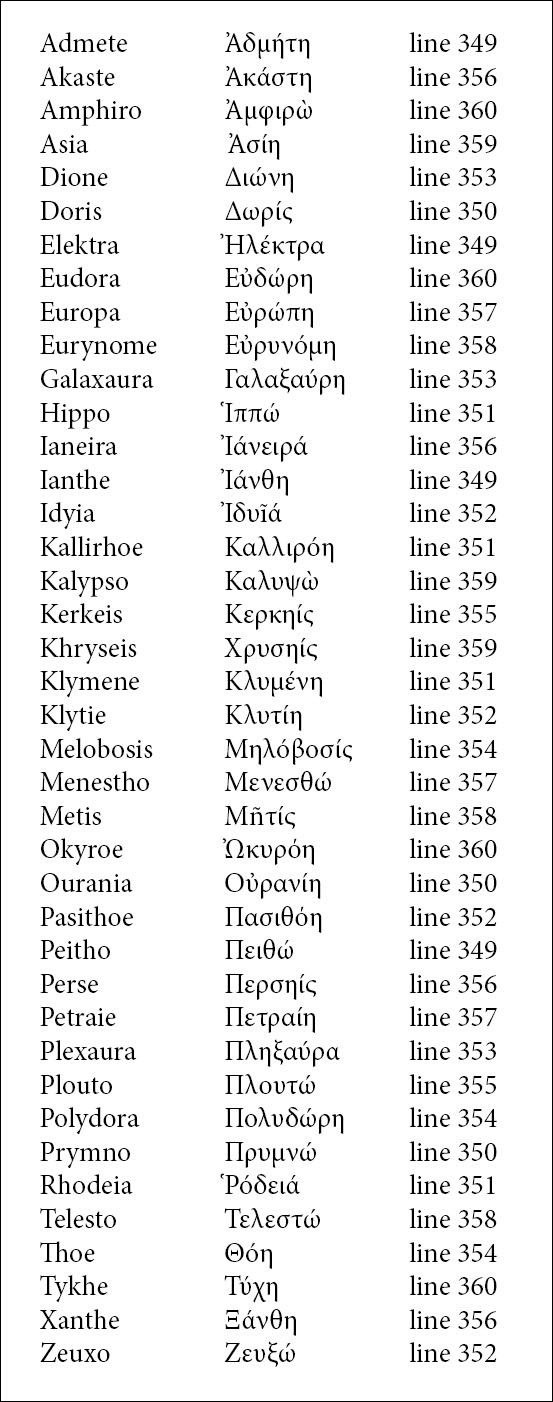
The Sisters of Styx
Theogony, lines 346-361
| Admete |
Αδμητη |
line 349 |
| Akaste (Acaste) |
Ακαση |
line 356 |
| Amphiro (Amphirho) |
Αμφιρω |
line 360 |
| Asia |
Ασιη |
line 359 |
| Dione |
Διωνη |
line 353 |
| Doris |
Δωρις |
line 350 |
| Elektra (Electra) |
Ηλεκτρα |
line 349 |
| Eudora |
Ευδωρη |
line 360 |
| Europa |
Ευρωπη |
line 357 |
| Eurynome |
Ευρυνομη |
line 358 |
| Galaxaura |
Γαλαξαυρη |
line 353 |
| Hippo |
Ιππω |
line 351 |
| Ianeira |
Ιανειρα |
line 356 |
| Ianthe |
Ιανθη |
line 349 |
| Idyia |
Ιδυια |
line 352 |
| Kallirhoe (Callirrhoe) |
Καλλιροη |
line 351 |
| Kalypso (Calypso) |
Καλυψω |
line 359 |
| Kerkeis (Cerceis) |
Κερκηις |
line 355 |
| Klymene (Clymene) |
Κλυμενη |
line 351 |
| Klytia (Clytie) |
Κλυτιη |
line 352 |
| Kryseis (Chryseis) |
Χρυσηις |
line 359 |
| Melobosis |
Μηλοβοσις |
line 354 |
| Menestho |
Μενεσθω |
line 357 |
| Metis |
Μητις |
line 358 |
| Okyroe (Ocyrrhoe) |
Ωκυροη |
line 360 |
| Ourania (Urania) |
Ουρανιη |
line 350 |
| Pasithoe |
Πασιθοη |
line 352 |
| Peitho |
Πειθω |
line 349 |
| Perseis |
Περσηις |
line 356 |
| Petraie (Petraea) |
Πετραιη |
line 357 |
| Plexaura |
Πληξαυρα |
line 353 |
| Plouto (Pluto) |
Πλουτω |
line 355 |
| Polydora |
Πολυδωρη |
line 354 |
| Prymno |
Πρυμνω |
line 350 |
| Rhodeia (Rhodea) |
Ροδεια |
line 351 |
| Telesto |
Τελεστω |
line 358 |
| Thoe |
Θοη |
line 354 |
| Tyche |
Τυχη |
line 360 |
| Xanthe |
Ξανθη |
line 356 |
| Zeuxo |
Ζευξω |
line 352 |
Styx in The Iliad
(listed by book and line from four different translations)
Richmond Lattimore
- 02.755 - ... (the river) Titaressos, who into Peneios casts his bright current; yet he is not mixed with the silver whirls of (the river) Peneios, but like oil is floated along the surface above him; since he is broken from the water of Styx, the fearful oath-river.
-
- 08.369 - Athene: "If in the wiliness of my heart I had had thoughts like his, when Herakles was sent down to Hades of the Gates, to hale back from the Kingdom of the Dark the hound of the grisly death god, never would he have got clear of the step-dripping Stygian water."
-
- 14.271 - So she (Hera) spoke, and Sleep was pleased and spoke to her in answer: "Come then! Swear it to me on Styx' ineluctable water."
-
- 15.037 - Hera: 'Now let Earth be my witness in this, and wide heaven above us, and the dripping water of the Styx, which is the biggest and most formidable oath among the blessed immortals.'
Loeb Classical Library
- 02.755 - ... (the river) Titaressus, who pours his fair-flowing streams into (the river) Peneius; and he does not mingle with the silver eddies of the Peneisus, but flows on over his waters like olive oil; for he is a branch of the water of Styx, the dread river of oath.
-
- 08.369 - Athena: "Had I but known all this in the wisdom of my heart when Eurystheus sent him (Heracles) down to the house of Hades the fastener of the gate, to bring out of Erebus the hound of loathed Hades, then he would not have escaped the steep waters of Styx."
-
- 14.271 - So she (Hera) spoke, and Sleep rejoiced, and made answer saying: "Come now, swear to me by the inviolable water of Styx ..."
-
- 15.037 - Hera: "Now let Earth be my witness and the broad Heaven above, and the down flowing water of Styx, which is the greatest and most terrible oath for the blessed gods ..."
Robert Fagles
- 02.857 - ... (the river) Titaressus that runs her pure crystal currents into Peneus—never mixed with Peneus' eddies glistening silt but gliding over the surface smooth as olive oil, branching, breaking away from the river Styx, the dark and terrible oath-stream of the gods.
-
- 08.422 - Athena: "If only I'd foreseen all this, I and my cunning—that day Eurystheus sent him (Heracles) down to Death, the lord who guards the gates, to drag up from the dark world the hound of grisly Death—he would never have fled the steep cascading Styx."
-
- 14.326 - "On with it!"—Sleep cried (to Hera), thrilled by the offer—"Swear to me by the incorruptible tides of Styx ..."
-
- 15.048 - Hera: "Earth be my witness now, the vaulting Sky above and the dark cascading waters of the Styx—I swear by the greatest, grimmest oath that binds the happy gods!"
Robert Fitzgerald
- 02.901 - Lovely that gliding river (the Titaressos) that runs on into the (river) Peneios with silver eddies and rides it for a while as clear as oil—a branch of Styx, on which great oaths are sworn.
-
- 08.418 - Athena: "Had I foreseen this day that he (Herakles) went down, bidden by Eurystheus, between Death's narrow gates to bring from Erebos the watchdog of the Lord of the Undergloom, he never would have left the gorge of Styx!"
-
- 14.307 - In eager pleasure, Sleep said (the Hera): "Swear by Styx' corroding water!"
-
- 15.044 - Hera: "Earth be my witness, and the open sky, and the oozing water of Styx—the gods can take no oath more solemn or more terrifying ..."
Styx in The Odyssey
(listed by book and line from four different translations)
Richmond Lattimore
- 05.185 - Kalypso: "Earth be my witness in this, and the wide heavens above us, and the dripping water of Styx, which oath is the biggest and most formidable oath among the blessed immortals, that this is no other painful trial I am planning against you (Odysseus) ..."
-
- 10.514 - Circe: "There (the rivers) Pyriphlegethon and Kokytos, which is an off-break from the water of the Styx, flow into Acheron. There is a rock there, and the junction of two thunderous rivers."
Loeb Classical Library
- 05.185 - Calypso: "Now therefore let Earth be witness to this, and the broad Heaven above, and the down-flowing water of the Styx, which is the greatest and most fearful oath for the blessed gods, that I will not plot against you (Odysseus) any fresh mischief to your hurt."
-
- 10.514 - Circe: "There into (the river) Acheron flow Pyriphlegethon and Cocytus, which is a branch of the water of the Styx; and there is a rock, and the meeting place of the two roaring rivers."
Robert Fagles
- 05.205 - Calypso: "Earth be my witness now, the vaulting Sky above and the dark cascading waters of the Styx—I swear by the greatest, grimmest oath that binds the happy gods: I will never plot some new intrigue to harm you."
-
- 10.565 - Circe: "And there into the (river) Acheron, the Flood of Grief, two rivers flow, the torrent River of Fire, the wailing River of Tears that branches off from Styx, the Stream of Hate, and a stark crag looms where the two rivers thunder down and looms."
Robert Fitzgerald
- 05.196 - Kalypso: "My witness then be earth and sky and the dripping Styx that I swear by—the gay gods cannot swear more seriously—I have no further spells to work against you."
-
- 10.570 - Kirke: "Here, toward the Sorrowing Water, runs the streams of Wailing, out of Styx, and quenchless Burning—torrents that join in thunder at the Rock."
Other Text References
Theogony
- line 361 -The Holy Company of daughters brought forth by Tethys and Okeanos (Ocean) included Styx, who is the most eminent of them all.
-
- line 383 - Styx, the daughter of Okeanos (Ocean), was joined to Pallas and bare Zelos (Rivalry), Nike (Victory), Kratos (Cratos) (Strength) and Bia (Force).
-
- line 389 - Just as she had planned Styx and her children live with Zeus because they joined the Olympians in the war with the Titans.
-
- line 397 - Zeus honors Styx because she and her children were the first to come to his assistance when he called for the Immortals to fight the Titans; Zeus appointed Styx to be the great oath of the gods.
-
- line 776 - Near the House of Hades and Persephone, dwells the goddess loathed by the Immortals, terrible Styx, daughter of Okeanos (Ocean).
-
- line 805 - The great oath taken on the eternal and primeval water of Styx was appointed by the Immortals (preceding this entry are the punishments for breaking such an oath).
Hymn to Demeter II
- line 259 - When Demeter was caught bathing a young boy named Demophoon in fire, she swore to the child’s mother by the relentless water of Styx that she was trying to make the boy immortal.
-
- line 423 - Styx was one of the daughters of Okeanos (Ocean) who were playing with Persephone when the young goddess was abducted by Hades (lord of the Dead).
Hymn to Delian Apollon III
- line 85 - Leto swears a great oath by Gaia (Earth), wide Ouranos (the Heavens) and the dropping water of Styx that Apollon will build a fragrant altar and not desert Delos’ island.
Hymn to Hermes IV
- line 519 - Apollon asks Hermes to swear, either by nodding his head or by the potent water of Styx, that he will never steal from him again.
The Argonautika
- 2.291 - Iris promises the sons of Boreas, Zetes and Kalais (Calais), that the Harpies will no longer harass Phineus if they do not use their swords on the winged women, the hounds of mighty Zeus; Iris swears by the waters of Styx, which to all the gods is the most dread and awful oath.
The Histories by Herodotus
- 6.74 - The exiled Spartan Kleomenes (Cleomenes) was trying to raise to Arcadians against Sparta and took the chief men to Nonakris (Nonacris) to make them swear their allegiance to him by the water of Styx; it was a small stream which flowed from a cliff into a pool; a wall of stones runs round the pool.