Previous Page Homepage Site Search
Copyrighted Material—All Rights Reserved

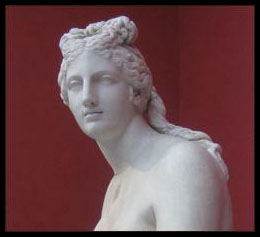
The birth of the goddess of love involved a bewildering and unpleasant series of events. Soon after Chaos gave birth to the primal gods, conflicts arose and immortal blood was spilled ... Aphrodite emerged from the sea amid this violence.
Chaos, the first god, embodied infinite diversity ... his children brought order and stability to the chaotic universe. Ge (Earth) was one of the three primal gods created by Chaos. Ge's siblings, Tartaros (the Pit) and Eros (Love), were instrumental in populating the cosmos, but Ge produced the majority of the subsequent gods and goddesses.
Ge gave Ouranos, her first child, the heavens as his province ... she also took him as her consort. Ge and Ouranos spawned a race of precocious and indulgent gods called the Titans.
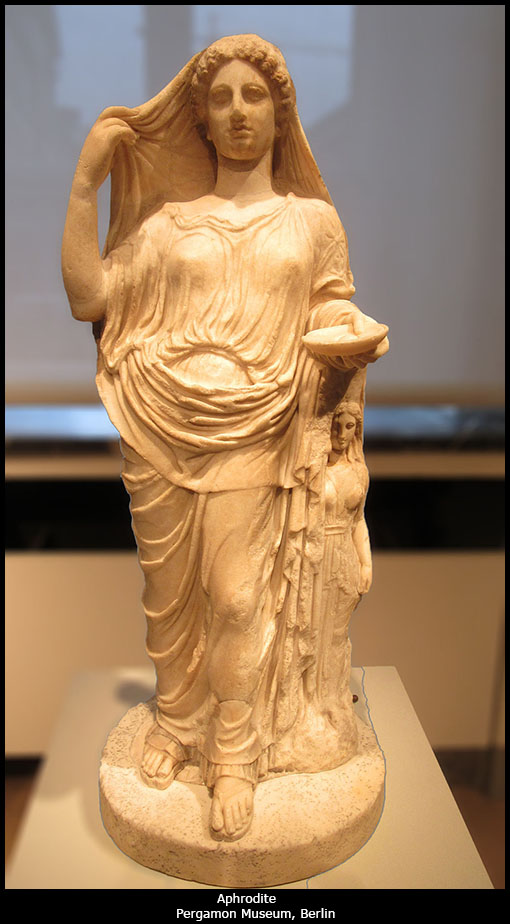
Trouble began when Ouranos aggressively tried to encroach on Ge's authority. Ge begged her Titan children to stop Ouranos. Her youngest son Kronos offered to assist his mother. Ge gave Kronos a sickle made of slate to use as a weapon ... Kronos attacked Ouranos with the sickle and castrated him.
The immortal blood from Ouranos' injury engendered the Giants, the Eumenides (Furies), and the Meliae (Nymphs of the Ash Trees). When the severed flesh from Ouranos' members mingled with the water of the sea, a circle of white foam formed ... Aphrodite emerged from that foam. The name Aphrodite literally means "foam-born."
As if to ensure Aphrodite's destiny as the goddess of love, Eros, the primal god of love, and Himeros, goddess of desire, assisted the modest and lovely goddess as she first stepped ashore on the island of Kythera.
Her next stop was the island of Kypros. In honor of that occasion, Aphrodite became known as the Lady of Kypros, or simply, Kypros. Aphrodite's gentle domain was intended to be the sweetness of love and the whispering of girls, but her adventures and exploits caused as much misery and bloodshed as any Immortal except for Ares, god of war, and the Grim Goddess, Athene.
Kronos and his Titan brothers and sisters reigned until their children rebelled ... the war between the younger gods and the Titans ushered in a new generation of Immortals. The children of the Titans became known as the Olympians and were the first Immortals to consistently resemble human beings. Aphrodite shared authority with the Olympians, but in matters of love, she had dominion over them.
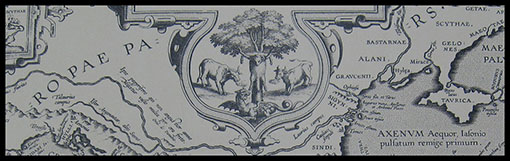
The goddess Hera prompted Aphrodite to become involved in one of the most important events in Greek prehistory, the Quest for the Golden Fleece. The Argonautika by Apollodorus of Rhodes recounts the quest in which the influence of Aphrodite brought a much-needed element of love to an epic adventure.
The Quest for the Golden Fleece took place circa 1280 BCE, one generation before the Trojan War. A golden ram carried a young man and his younger sister on a desperate journey from Greece to the eastern edge of the Black Sea to a place known as Kolchis. The young girl, Helle, fell from the ram's back and drowned. Her older brother, Phrixus, arrived safely in Kolchis and, at the ram's behest, sacrificed the divine beast in the Garden of Ares.
The golden fleece remained in Kolchis for one generation before Hera, queen of the Immortals, chose an exceptional young man named Ieson (Jason) to bring it back to Greece.
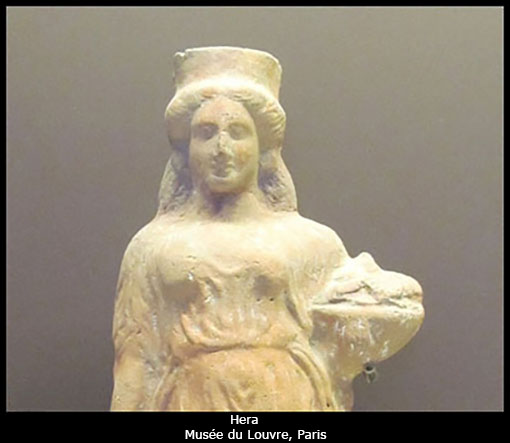
Hera had a twofold agenda: 1) she wanted to reward Ieson for his humility; and 2) she wanted to punish King Pelias of Iolkos for neglecting her due honors. If Ieson could retrieve the golden fleece, he would become king of Iolkos, and Pelias would die disgracefully.
Ieson assembled the greatest heroes in Greece to accompany him on the quest ... the sailors were called Argonauts after their ship, the Argo. The journey to Kolchis was long and difficult as obstacles and dangers of natural and supernatural origin plagued the Argonauts at every turn.
Hera eagerly rallied Aphrodite as well as other Immortals to give assistance to the Argonauts. Soon after leaving their home port of Iolkos, the Argonauts landed on the island of Lemnos. The women of Lemnos had been cursed by Aphrodite because they failed to give the goddess her rightful honors. As punishment, Aphrodite turned the passions of their husbands to foreign women.
When the men brought their lovers home to replace their wives, the women of Lemnos became hysterical and murdered their philandering husbands and their foreign lovers.
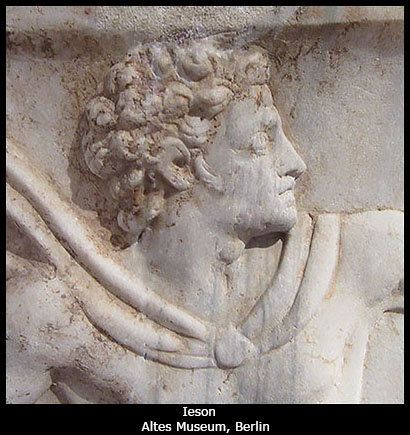
By the time Ieson and the Argonauts arrived on Lemnos, Aphrodite had forgiven the women and demonstrated her mercy by putting desire in their hearts for the new arrivals on their island.
Since the Argonauts were some of the most virile men to ever step ashore on Lemnos, they were exactly what the women needed, and exactly what Aphrodite intended. The Argonauts stayed on Lemnos long enough for Ieson to father two children.
As the Argonauts ventured on, they stopped near Mysia in northern Asia Minor. A young man named Hylas went ashore for fresh water at the Spring of Pegae, which was created when the flying horse Pegasos struck her hoof on the earth.
As Hylas approached the spring, the local Nymphs were gathering to dance to hymns sung for the goddess Artemis. When Hylas leaned forward to dip water from the spring, a Naiad Nymph (Water Nymph) rose to the surface, captivated by Hylas' youthful beauty, which was enhanced by the light of the rising moon.
Aphrodite made the Nymph feel faint and in that distracted frame of mind, she reached up to embrace Hylas ... she put her left hand behind his neck and rose to kiss him while placing her right hand on his elbow and pulling him into the water. Hylas married the Nymph and was never seen upon the earth again.
Before the Argonauts reached Kolchis, they encountered a seer named Phineus who had been blinded for crimes committed against his sons ... he blinded his sons and was thus blinded by the Immortals as punishment. To add to his torment, the winged women known as the Harpies stole most of Phineus' food and then fouled the scraps they left behind.
The Argonauts were the guests of Phineus on the island of Thynia. Phineus treated the Argonauts with hospitality, even though he was wracked with hunger and sadness.
Several of the Argonauts were especially moved by the old man's plight and fought with the Harpies until the goddess Iris intervened and promised that Phineus would no longer be troubled by the "hounds of mighty Zeus."
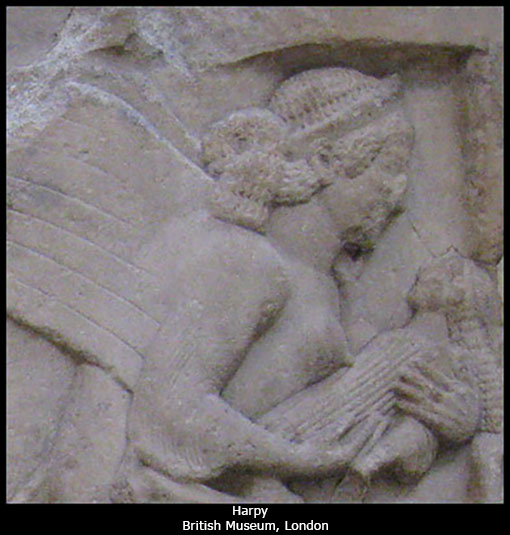
As a seer, the most obvious way for Phineus to repay the Argonauts for their kindness was to give them a prophecy. He told them they could not complete their quest unless they received help from Aphrodite.
Without understanding exactly what Phineus meant, the Argonauts continued their journey thinking they would more likely need the help of Ares because the golden fleece was under the protection of King Aietes of Kolchis, and it seemed likely he would not surrender the sacred artifact without a fight.
When the Argonauts finally reached Kolchis, Hera and Athene were watching anxiously, certain that Ieson could not retrieve the golden fleece without their support. They decided the best way to help Ieson would be to ask Aphrodite for assistance. Their convoluted plan required Aphrodite to persuade Eros to shoot King Aietes' daughter, Princess Medeia, with an arrow of irresistible love for Ieson.
Eros, the primal god of love, was one of the original Immortals born from Chaos at the dawn of time, but he never lost his childlike nature ... he was often called Aphrodite's son in much the same way Aphrodite was called Zeus' daughter, when she was actually many years older than Zeus.
Athene, the virgin daughter of Zeus, had no personal knowledge of love and did not want to discuss such matters with Aphrodite ... Hera agreed to do all the talking. They found Aphrodite on Mount Olympos in the palace of her husband, Hephaistos.
Aphrodite looked upon the two goddesses and mockingly invited them to sit down, asking why two such important goddesses would visit her. Aphrodite's crafty words were not lost on Hera, but she let them go unchallenged ... she told Aphrodite of her sincere desire to help Ieson and the Argonauts.
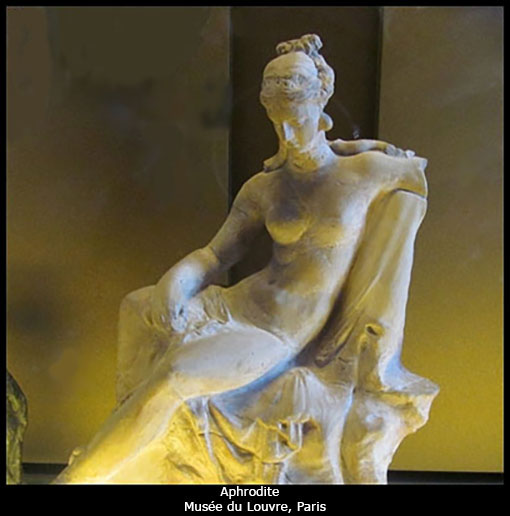
Aphrodite was surprised to see Hera acting so humbly and with such sincerity ... she and Hera had never been allies or confidants ... it was evident that Hera needed help. Aphrodite changed her mocking tone to one of sympathy and offered to help Hera in any way she could.
Hera's request was simple ... she wanted Aphrodite to go to "her son" Eros and persuade him to shoot King Aietes' daughter, Princess Medeia, with an arrow of irresistible love for Ieson. Hera insisted that Aphrodite go to Eros, urging Aphrodite to be patient and not provoke Eros' anger ... Aphrodite agreed to try.
Aphrodite found Eros on Mount Olympos playing dice with a young cup-bearer named Ganymedes ... she scolded Eros for cheating Ganymedes but, remembering her mission, quickly softened her tone. She knew he would help if she offered him a gift, so she promised him a ball that had once been the plaything of Zeus as a child.
"All of gold are its zones and round each, double seams run in a circle; but the stitches are hidden, and a dark blue spiral overlays them all," Aphrodite said. "But if you should cast it with your hands, you will see, like a star, it sends a flaming track through the sky." She told him he could have the ball as soon as Princess Medeia was smitten.
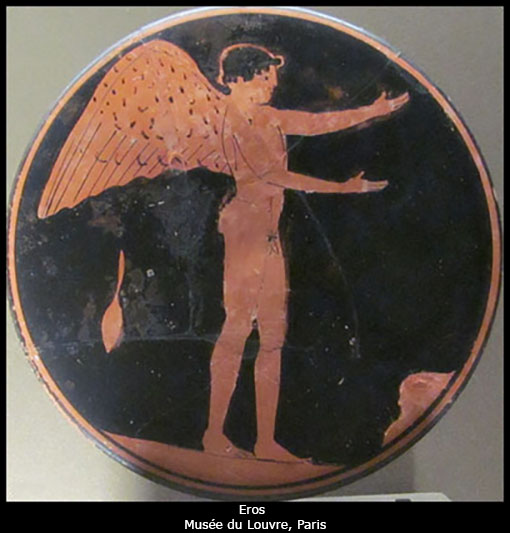
As the situation on Mount Olympos resolved itself, new problems arose for the Argonauts. Ieson was unsure as to how to deal with King Aietes ... should he use persuasion or force? He asked the Argonauts for their advice and as they were debating the issue, a dove fell from the sky and landed in Ieson's lap. The dove had been in the clutches of a hawk but managed to escape. When the hawk swooped down after the dove, the hawk was impaled on the stern ornament of the Argo.
An Argonaut named Mopsos, a seer, correctly interpreted the omen as the fulfillment of Phineus' prophecy whereby the quest for the fleece from the golden ram could only be accomplished with the help of Aphrodite, symbolized by the dove.
Ieson wasn't sure how Aphrodite would come to his assistance, but with a cloak of mist provided by Hera, he proceeded to King Aietes' palace unobserved. As Ieson entered the palace, Hera lifted the veil of mist making it seem as if Ieson appeared "out of thin air" ... Aietes concealed his astonishment with kingly aplomb.
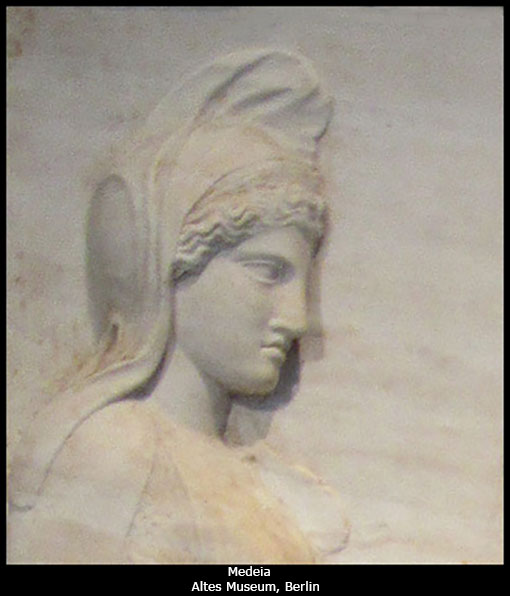
Medeia was in attendance when Ieson entered the king's hall, and when Eros shot her with his golden arrow, she nearly fainted, became pale, then turned red ... she was in love. Ieson's trust in Medeia's love helped him steal the golden fleece from King Aietes ... even though courage and mortal combat were necessary to complete their quest, the Argonauts were ultimately saved by Aphrodite's blessings, even as they made their way home.
The island of Anthemoessa was home to three bird-like goddesses known as Sirens ... children of the Muse Terpsichore and the river-god, Acheloios. Perched above the rocky shores, the Sirens sang hypnotically beautiful songs luring sailors on passing ships to their doom on the jagged rocks encircling the island. With the golden fleece on board, the Argonauts sailed past the island of the Sirens, where Aphrodite saved an Argonaut named Boutes from drowning when, mesmerized by the Sirens' song, he jumped into the sea.
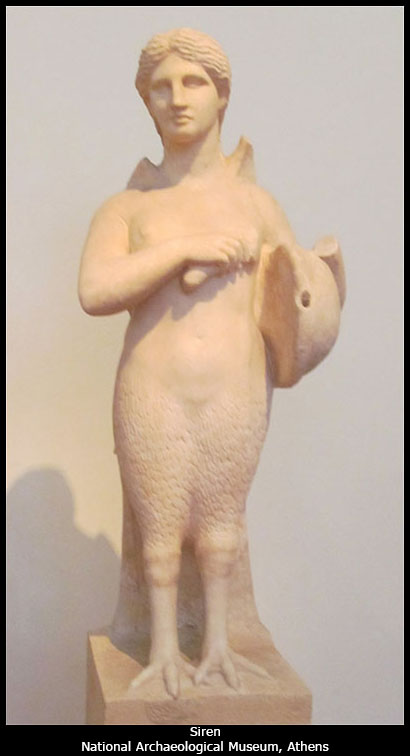
The noted philosopher and mathematician, Aristotle, gave names to the Sirens in his book, On Marvelous Things Heard:
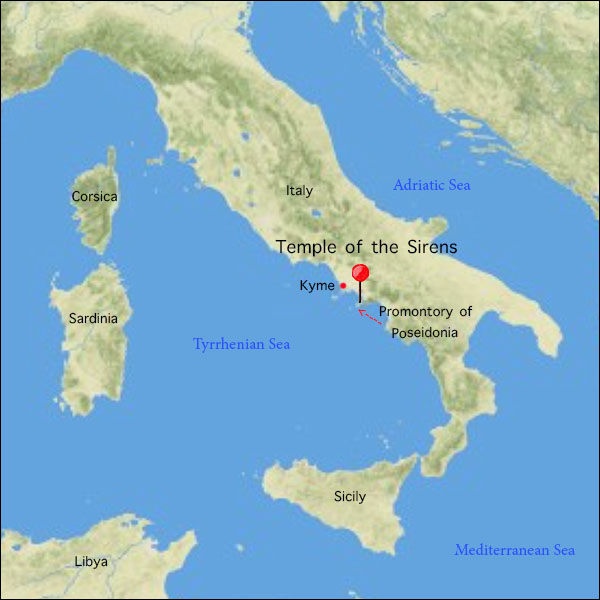
#103 They say that the islands of Seirenusae lie near Italy off the promontory itself near the strait, which lies in front of the place, and separates the strait which surrounds Kyme (Cyme), and that which cuts off the promontory called Poseidonia; on which stands a temple of the Sirens, and they are honored very highly by the inhabitants with sacrifices punctually. In remembrance of their names they call one Parthenope, one Leukonia (Leuconia), and a third Ligeia.
Aphrodite could cast a spell of irresistible love on all mortals and every type of beast. With the exception of three goddesses—Athene, Hestia, and Artemis—the Immortals were also subject to Aphrodite's charms. Aphrodite's enchantments were usually welcome, but she sometimes used her powers to embarrass the other Immortals.
Under the spell of Zeus, Aphrodite dressed in her finest clothing and adorned herself with beautiful jewelry. Enshrouded in an aura of enchantment, she went to the glades of Mount Ida near Troy to seduce Anchises.
When she arrived on the mountain, the beasts of the forest paid her homage ... the wolves fawned on her ... lions, bears, and leopards became docile and followed her ... she put desire in their hearts and they began to mate.
Anchises was as helpless as the woodland beasts when Aphrodite arrived at his humble home. He marveled at her fine clothing and exquisite form ... he had never seen a mortal woman who was so beautiful.
He suspected she was a goddess and asked if she was Leto or Athene or Themis or Aphrodite or one of the Charites (Graces) or a Nymph. Aphrodite denied her divinity and convinced Anchises that she was a mortal maiden who had been sent to him by the will of the Immortals.
Aphrodite told Anchises she had been taken from her home in Phrygia by the messenger-god Hermes and left on Mount Ida. She said she had been dancing at the rites of Artemis with other marriageable girls when Hermes snatched her ... his intention was for her to become the wife of Anchises and bare him many fine children.
Anchises noticed that the fascinating young woman at his door spoke with the same regional accent he used ... Aphrodite brushed his concerns aside by saying she had been raised by a Trojan nurse and learned Greek from her.
Anchises willingly believed the lies because Aphrodite was irresistible ... he took her into his house and made love to her. While Anchises was sleeping in the afterglow of love, Aphrodite stood above him and called his name, waking him from a sound sleep.
When he looked up at her, he trembled in fear because he saw her for the goddess she was and there was no doubt in his mind he would be punished for having loved her. Aphrodite assured Anchises that he would not be harmed because he was destined to become the father of a noble prince of the Trojans who would sire many heirs.
She informed him that their son would be entrusted to the Nymphs of Mount Ida to be raised and would not be given to Anchises until the boy reached a suitable age. Aphrodite also told Anchises their son would be named Aineias, meaning Awful, because Zeus had forced her to love a mere mortal and, even though Anchises was a righteous and handsome man, she found their union to be offensive and beneath her station.
The roots of the animosity between the Greeks and the Trojans might be traced to the incident known as The Judgment of Paris.
Prince Alexandros of Troy was rarely called Paris in the Iliad, but when the artist Peter Paul Rubens (1577–1640 CE) painted The Judgment of Paris, the name Alexandros became marginalized.
We will use the name Alexandros to refer to the Trojan prince and his byname, Paris, when discussing the judgment of the three goddesses.
The Judgment of Paris took place on the slopes of Mount Ida circa 1271 BCE ... the occasion was the marriage of a Nereid named Thetis and Peleus, a mortal man. Being allowed to marry a goddess was a reward for Peleus because of his undying devotion to the gods on Mount Olympos. Being forced to marry a mortal was a punishment for Thetis because she had refused the amorous advances of Zeus ... she was being taught a lesson in humility.

The goddess Hera ensured the wedding was well-attended. One of the most notable Immortals at the wedding was the goddess of discord and strife, Eris, who came not to celebrate the wedding, but to exercise her talent for causing trouble. At the wedding, Eris tossed down a golden apple with the inscription, 'For the most beautiful one.' Zeus' daughter Athene, his wife Hera, and Aphrodite each assumed the prize was intended for them.
When the inevitable conflict arose, Zeus found himself in an awkward position ... someone had to make the decision as to which goddess was the most beautiful. To resolve the dispute, Zeus sent the three obstinate goddesses with the messenger-god Hermes to Mount Ida, near Troy. Paris was chosen to be the judge. Zeus decreed that Paris' judgment would be final.
The drama at the wedding of Thetis and Peleus was simply the first in a coordinated series of events that would culminate with the Trojan War. Zeus was using Aphrodite and the other Immortals to help him rid the earth of the demigods—the children of the Immortals and mortals. Zeus' daughter Helen was used to help perpetuate his plan, but she was not sacrificed in the war or its aftermath.
Aphrodite's son Aineias also survived the Trojan War ... presumably he was allowed to live as a reward for his mother's invaluable assistance in starting the war.
Paris could not escape his destiny ... he had to choose the most beautiful goddess.
Hera had always been the most beautiful goddess on Mount Olympos, so she seemed like an obvious choice. Paris could not ignore the fact that she was the sister-wife of Zeus.
Athene was the virgin goddess of wisdom, and even though she was sometimes called the Grim Goddess, she was quite beautiful by any mortal standard.
Aphrodite, as the goddess of love, possessed legendary charms and enchantments ... Paris should have chosen Aphrodite for those reasons alone. But his choice was based on greed and desire ... beauty had nothing to do with it. Aphrodite told Paris that if he selected her, she would give him the most desirable woman in the world ... the daughter of Zeus, Helen of Argos. Helen's beauty was such that when poets sang about her, she was always compared to a goddess. Even as a young girl, Helen radiated an irresistible gracefulness.
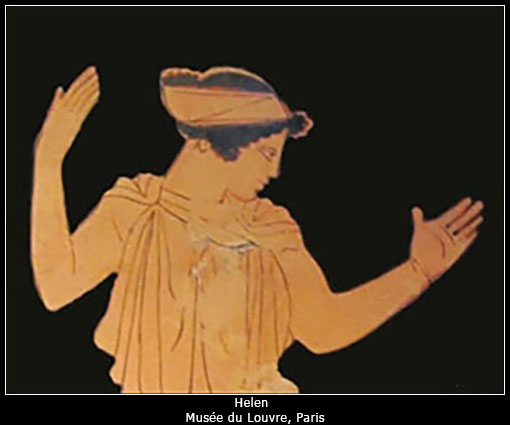
When Helen's father let it be known that he was seeking a husband for Helen, suitors came from all over the civilized world. These were not ordinary men but kings, princes, and heroes. Her father made them all take a solemn oath that they would peacefully abide by his choice and more importantly, they would all come to Helen's defense if she should ever be taken from her husband. Helen's father knew all too well the mesmerizing effect she had on men. Paris chose Aphrodite as the most beautiful goddess because he wanted Helen ... he could not resist the thought of possessing her because Aphrodite placed the desire in his heart.
As part of her plan, Aphrodite arranged for her son Aineias to accompany Prince Alexandros to Helen's home in Sparta. Also, at Aphrodite's contrivance, Helen's husband, King Menelaos, was called away from the city on business soon after Alexandros arrived. With her husband out of the way, Helen was easily enchanted and agreed to leave Sparta and return to Troy with Alexandros.
King Menelaos was an influential man but his brother, King Agamemnon of Mykenai, was the most powerful and respected leader in Greece. Agamemnon readily agreed to help Menelaos retrieve Helen from the Trojans. The call went out for Helen's suitors to fulfill the oath they swore to Helen's father. The response was impressive ... more than a thousand ships sailed to Troy to rescue Helen.
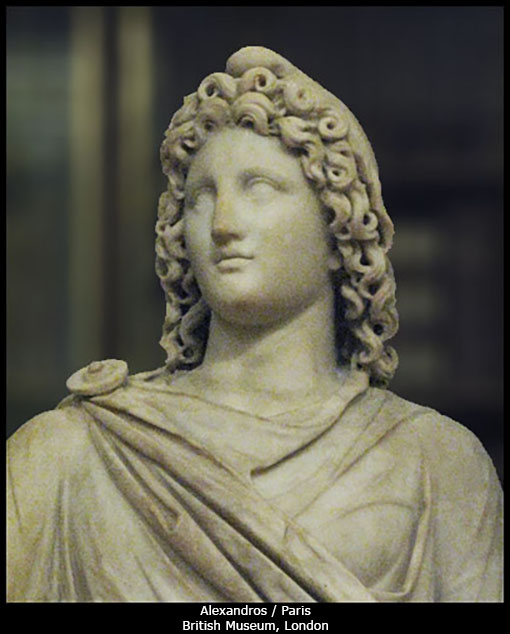
By choosing Aphrodite as the most beautiful goddess, Alexandros rebuffed Hera and Athene ... two goddesses no mortal man could insult without severe consequences. Hera was indeed beautiful, yet she was also very dangerous ... Athene was not called the Grim Goddess without reason.
By the time the Trojan War ended, Alexandros, his family, his friends, and allies were all killed or enslaved. When he was called upon to make his infamous judgment, there was no choice that would not have resulted in death and destruction.
Even though Aphrodite used Alexandros in the most callous and selfish way, she still seemed to have genuine affection for the handsome young man. When the Achaian Greeks arrived at Troy to tear down the walls, Aphrodite comforted Alexandros, even though she knew full well he was doomed.
The Trojan War was, of course, not Aphrodite's fault, but her participation in the Judgment of Paris was only her first contribution to the bloodshed that followed. Her son Aineias fought for the Trojans and his pride always propelled him into the thick of the fighting ... Aphrodite did her best to protect him.
She also protected Alexandros ... he too was a proud man ... he did not deny the fact that his impulsive behavior brought the Achaian Greeks to Troy, but he would not surrender Helen, and thus stop the war, or shirk his responsibilities as a warrior.
The epic poem the Iliad by Homer begins near the end of the tenth and final year of the Trojan War. A truce was enacted when Prince Alexandros proposed a one-on-one fight with Menelaos, Helen's Greek husband, to decide the outcome of the war.
Prince Hektor of Troy and Achaian commander Agamemnon readily agreed. Sacred oaths were invoked ... it would be a winner-take-all confrontation whereby if Menelaos won, the Trojans would surrender Helen and her possessions; if Alexandros won, the Greeks would withdraw and leave Troy unharmed. The Trojan and Achaian soldiers watched anxiously as the two men assumed their fighting stances.
Alexandros threw his spear, but it did not pierce Menelaos' shield. Menelaos retaliated with a spear-cast that penetrated Alexandros' shield and tunic but did not reach his skin. Menelaos drew his sword and struck Alexandros' helmet with such force the sword shattered into four pieces. Enraged, Menelaos pounced on Alexandros and wrestled the young prince to the ground ... he grabbed the horsehair plume of Alexandros' helmet and began to drag him through the dirt.
Aphrodite restrained herself as long as she could, but when she saw that Alexandros was seconds away from death, she swooped down invisibly and cut the helmet chinstrap. Menelaos cursed as the helmet came loose in his hand ... he tossed Alexandros' helmet to the nearby Achaian soldiers and scrambled to regain his spear. Anticipating Menelaos' renewed attack, Aphrodite covered Alexandros in a mist, whisked him from the battlefield and put him safely in his apartment inside the Trojan citadel.
Menelaos was the apparent victor, but questions lingered about the outcome until a Trojan ally named Pandaros shot an arrow at Menelaos. Pandaros' arrow struck Menelaos in the midsection and would have been fatal if Athene had not deflected the arrowhead ... she wanted the war to continue, but she did not want Menelaos to be seriously injured. The truce abruptly ended, and the gruesome war resumed.
With Alexandros safely in his apartment, Aphrodite donned the disguise of an old woman and went to Helen, who had been watching Alexandros and Menelaos fight from the city walls. The goddess urged Helen to go to Alexandros and comfort him. Helen recognized Aphrodite's divinity and asked why she was trying to beguile her. Helen berated the goddess for her meddling and told her to take Alexandros for herself if she cared so much for his happiness. Aphrodite was not accustomed to being questioned or disobeyed by a mortal ... she threatened Helen with divine hatred if the headstrong woman continued to be impudent. Helen trembled in fear when she realized her life could get more painful if she continued to taunt the powerful goddess. Shielded by Aphrodite and thus unseen by the other Trojan women, Helen humbly went to Alexandros as she had been ordered.
As the fighting continued, Aphrodite kept her son Aineias from harm. Watching the war from Mount Olympos, Zeus rebuked Hera and Athene for not protecting Menelaos and the other Achaians as fiercely as Aphrodite protected Aineias. Athene was not pleased to hear that Zeus thought Aphrodite was more warlike than herself ... she flew to Troy and chose one of the best Achaian soldiers to do her bidding—Diomedes, son of Tydeus.
Athene put courage in Diomedes' heart and marked him with a star-bright flame that emanated from his armor as he charged into the thick of the fighting ... the Trojans either gave ground or died. The archer Pandaros watched as Diomedes hacked his way through the Trojan ranks. Praying to the gods, Pandaros shot an arrow, which lodged itself in Diomedes' shoulder. Diomedes' charioteer removed the arrow and Diomedes resumed his rampage.
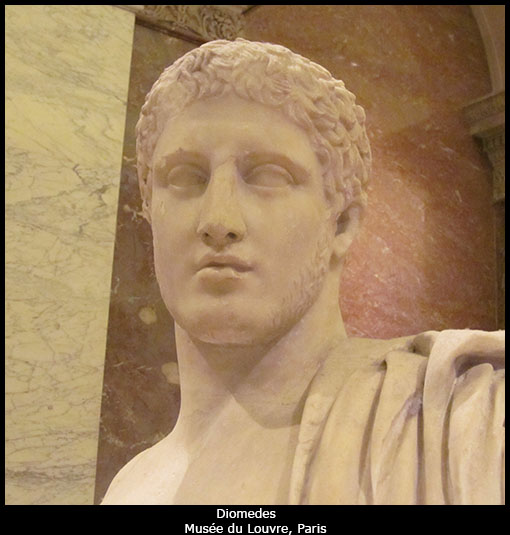
Pandaros did not see the goddess Athene ministering to Diomedes ... removing his pain and infusing valor in his heart. Athene also lifted the mist from Diomedes' eyes so he could see the otherwise invisible Immortals on the battlefield. She told him to avoid all the Immortals except Aphrodite, adding that if he encountered Aphrodite, he was to stab her.
Aineias and Pandaros mounted Aineias' chariot and charged to where Diomedes was meting out death to the hapless Trojans. Pandaros leapt from the chariot and challenged Diomedes, resulting in the archer's quick and undignified death. Aineias dismounted the chariot and took a protective stance over the body of Pandaros.
In spite of the injury to his shoulder, Diomedes hefted a boulder no normal man could lift and threw it at Aineias ... the boulder hit Aineias on his side, crushing the bones of his hip. Diomedes instructed his charioteer to take the reins of Aineias' horses and lead them back to the Achaian encampment. Watching the confrontation with growing concern, Aphrodite swooped down and covered Aineias with her robe.
Diomedes saw Aphrodite clearly and stabbed her as Athene had commanded ... his bronze spear slashed through the delicate robe and cut the immortal flesh of Aphrodite's wrist. The ichor poured darkly on her perfect skin. Ichor was the juice, not blood, that flowed through the veins of the Immortals. Aphrodite cried out in pain and lost her tenuous hold on Aineias.
Apollon saw the outrageous turn of events and rushed to assist Aphrodite. It should be mentioned that the Greek god Apollon is often confused with the Roman god of the sun, Apollo. Apollon helped Aphrodite regain her footing and stood guard over Aineias. The goddess Iris also assisted Aphrodite as she withdrew.
Diomedes, meanwhile, shamelessly bragged about his prowess.
"Back away from the fighting and carnage, daughter of Zeus," Diomedes exclaimed.
"Are you not satisfied that you mislead women ignorant in the ways of war?"
Aphrodite was too distracted by the pain of her injury to respond to Diomedes' insult.
"If you continue to interfere in the fighting," Diomedes snarled, "I can promise that in the future you will cower even when you hear others speak of warfare."
Athene had given Diomedes the ability to see the gods on the battlefield so he could clearly see Apollon standing over Aineias ... Diomedes heedlessly charged at Aineias intent on killing him as he lay helpless in the dirt. Apollon hit Diomedes and knocked him backwards. Unperturbed, Diomedes charged again ... Apollon slammed him again. After Diomedes' fourth charge, Apollon had seen enough ... he berated Diomedes, warning him not to continue his ill-conceived recklessness. Diomedes humbly withdrew.
To avoid further injury to Aineias, Apollon created a doppelganger (a counterfeit Aineias) to stay on the battlefield while the real Aineias was transported to Pergamon in Mysia where the goddesses Artemis and Leto could tend to his injury.
With Aineias safely out of harm's way, Iris assisted Aphrodite as they made their way to the edge of the battlefield where they found Ares, god of war, next to his chariot ... his spear leaning against a cloud. Aphrodite fell to her knees and begged Ares for the use of his chariot ... he willingly agreed.
Aphrodite and Iris flew to Mount Olympos where the goddess Dione tended Aphrodite's wound. The pain and ichor were wiped away with a touch from Dione's hands, but Aphrodite's humiliation lingered. To lessen Aphrodite's embarrassment, Dione told her about the time Zeus' son Herakles shot Hera in the chest with a triple-barbed arrow and how Herakles likewise wounded Hades, lord of the dead, as he was gathering corpses from a battlefield.
Dione in turn wanted to emphasize the fact that all Immortals were vulnerable to injury and pain. She recounted the horrific ordeal of the mighty god Ares when he was imprisoned for thirteen months by Ephialtes and Otos, the gigantic sons Aloeus.
Dione's conversation with Aphrodite was not private. Dione openly accused Athene of encouraging Diomedes to attack Aphrodite ... Athene was delighted when she saw Aphrodite's stunned reaction. The other gods and goddesses in attendance tactfully remained silent, but Athene could not contain her eagerness to further humiliate Aphrodite and aggravate Zeus.
"Kypros has been encouraging the Achaian women to follow in the ways of the Trojans, whom she now professes to love," Athene said mockingly. "Perhaps she scratched her delicate hand on a golden broach while comforting one of the well-dressed Achaian women."
Zeus was accustomed to Athene's tactlessness and let her comments go unchallenged. His feelings towards Aphrodite were more sympathetic.
"No, my child, the works of violence are not for you," he said comfortingly. "Rather concern yourself only with the lovely secrets of marriage. Leave war-craft to those more suited to the task, such as Athene and Ares."
It was good advice but not a commandment ... Aphrodite frequently returned to the fighting.
The Immortals were divided as to which side they supported during the Trojan War, but they managed to cooperate when they were away from the fighting. Hera was an ardent supporter of the Achaian Greeks, whereas Aphrodite fought for the Trojans. Hera approached Aphrodite on Mount Olympos and asked for her assistance in seducing Zeus. Aphrodite readily agreed to help ... she made a love-charmed corset that Hera could conceal beneath her robe.
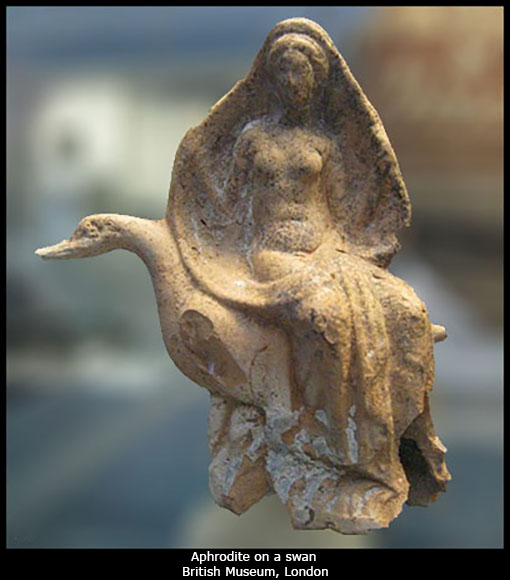
It's odd that Aphrodite would help Hera in that way because Hera's intention was to distract Zeus so the god Poseidon, lord of the sea, could rampage through the Trojan defenses ... this could potentially threaten Aineias and Alexandros, whom Aphrodite protected.
Wearing Aphrodite's love charm, Hera found Zeus on the highest peak of Mount Ida watching the fighting at Troy. Hera pretended to be disinterested in the progress of the war and casually lingered until Zeus was obviously falling under the enchantment of the love charm. Zeus began to brag about his romantic conquests, comparing each of his lovers with Hera. Finally, overcome with desire, Zeus made love to Hera and collapsed into an exhausted slumber. He was awakened by the bellowing of Poseidon on the battlefield ... Zeus, although furious, did not blame Aphrodite ... he blamed Hera.
The fighting at Troy escalated to new levels of brutality ... the battlefield was awash with Immortals. Athene attacked Ares and knocked him to the ground ... he fell thunderously. Athene laughed and taunted him because he was seriously injured and unable to stand.
"You have yet to learn that I am more powerful than you," Athene sneered. "Even your mother, Hera, devises evil against you because you deserted the Achaians and gave aid to the Trojans."
Aphrodite saw Ares as he lay moaning in the dirt and knelt to help him. Hera saw what was happening and told Athene to teach the "dog-fly" a lesson. The goddess Athene reacted swiftly ... she hit Aphrodite on the breast, knocking her to the ground.
"This will be the fate of all who help the Trojans when they fight against the armor-clad Achaians," Athene announced to all the gods and goddesses nearby. "If Aphrodite and Ares had stayed out of the fighting, Troy would already be in ruins and this war would be over."
One of the defining events marking the inevitable end of the Trojan War was the death of Trojan Prince Hektor at the hands of Achilles. An obsessive revenge drove Achilles to the edge of madness. With Hektor's corpse tied behind his chariot, Achilles dragged the body around the walls of Troy. To further the humiliation, Achilles would also drag Hektor's body through the Achaian encampment.
Aphrodite tended Hektor's body so it would not be disgraced ... she chased the dogs from the corpse and anointed Hektor's body with immortal oils so it would not be torn or mutilated by Achilles' rough treatment.
The honors bestowed on Achilles by Zeus and the other Immortals ended abruptly at the hands of Prince Alexandros and the god Apollon.
The Achaians and Trojans had endured ten years of bitter fighting with the loss of thousands of soldiers, but the death of Achilles ushered in the final round of carnage.
The Achaian Greeks used the famous Trojan Horse to gain entrance to the city. They built a giant Wooden Horse and concealed their best fighters inside. They then took their fleet to a nearby island where they could not be seen by the Trojans. The trick worked ... the Trojans thought the Greeks had finally given up and returned to their homes, and that the Wooden Horse was a peace offering in the form of a tribute to Poseidon, lord of the sea. Over the objections of the seer Laokoon, the Wooden Horse was brought inside the city and became thereafter known as the Trojan Horse. At that point, the slaughter of the Trojan citizens began. Prince Hektor's infant son was thrown from the city walls ... Hektor's wife and countless other women and children were taken as slaves.
Aphrodite's lover Anchises and their son Aineias were among the few Trojan men to survive the war. When the Achaian Greeks were inside the city and the fall of Troy was imminent, Aineias went to his residence to save his family and his elderly father. Carrying Anchises on his back and leading his wife and children through the chaotic streets, Aineias was recognized by the murdering and pillaging Achaians. The Greek soldiers who saw the courageously tragic scene were compelled to step aside to let a true hero pass unchallenged.
Anchises died soon after the fall of Troy and was buried in Arkadia at the foot of a mountain that came to be known as Mount Anchisia. The Romans believed that Aineias made his way to Italy, where he laid the foundations of what would eventually become the Roman Empire.
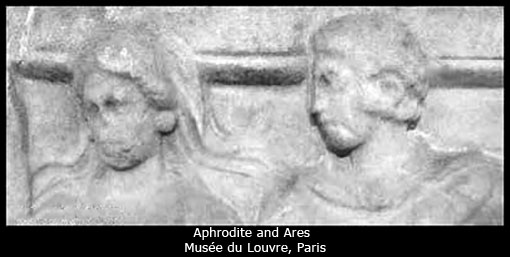
Aphrodite and Ares were never married, but their love affair was notorious and fruitful. Ares, god of war, was the son of Zeus and Hera, whereas Aphrodite was born from the flesh and blood of Ouranos, the grandfather of Zeus and Hera. Aphrodite was three immortal generations older than Ares.
Aphrodite and Ares both assisted the Trojans during the Trojan War. Aphrodite wanted to protect her son Aineias, but the reasons Ares chose to fight on the side of the Trojans were not as clearly defined. The soldiers in both armies frequently prayed to Ares for courage and strength yet, when Ares entered the fray, he fought for the Trojans.
Aphrodite and Ares had three children—Harmonia, Phobos, and Deimos ... Harmony, Panic, and Terror.
Phobos engendered cowardly panic when he walked among men. The presence of Deimos caused mind-numbing fear and when provoked, sheer terror. Zeus' son Herakles carried a shield with an image of Deimos prominently emblazoned as the centerpiece.
Harmonia became very important in the development of Greece and, in particular, the city of Thebes. She married Prince Kadmos of Tyre after he settled in Boeotia and founded Thebes. Kadmos had been led to Thebes by a prophecy from Apollon, so the city was blessed and destined to achieve greatness.
Harmonia had four daughters and one son ... Ino, Agaue, Autonoe, Thyone, and Polydoros. When Thyone became Zeus' lover, her name changed to Semele.
The marriage of Kadmos and Harmonia prompted Aphrodite to give Harmonia a golden necklace, which had been designed and crafted by the artificer of the Immortals, Hephaistos ... it was called "The Necklace of Harmonia" until its reputation became sullied.
As the story goes, Harmonia gave the necklace to her son Polydoros ... it was passed from father to son until it came into the possession of Polyneikes, the son of Oedipous. Polyneikes and his brother Eteokles had a dispute as to who should be king of Thebes after the self-imposed exile of their father.
The two young princes agreed to share the kingdom, but Eteokles took the throne by trickery, forcing Polyneikes to raise an army to reclaim his inheritance. Polyneikes used the necklace as a bribe to cunningly enlist the help of a notable warrior named Amphiaraus. Polyneikes gave the necklace to Amphiaraus' wife, Eriphyle. She willingly accepted the necklace and beguiled Amphiaraus into joining Polyneikes' army. Amphiaraus was fatally wounded during the battle at Thebes ... the necklace was then derisively called "The Necklace of Eriphyle."
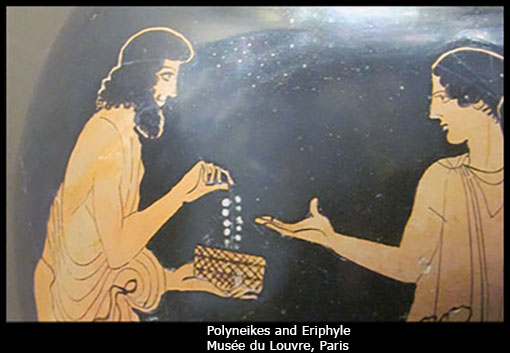
Lying on his deathbed, Amphiaraus made his son Alkmaeon swear to take revenge on Eriphyle for her treachery. Alkmaeon gained possession of the necklace by killing his mother, bringing down a curse that would follow him to his grave. He married Alphesiboea, daughter of Phegeus and gave the necklace to her as a wedding present.
As the curse became more debilitating and his health deteriorated, Alkmaeon left Alphesiboea ... he settled on a shoal of the Acheloios River, and took Kallirhoe, a daughter of the river-god Acheloios, as his new wife. Kallirhoe "conceived a passion" for the necklace, prompting Alkmaeon to ask Alphesiboea for the return of the heirloom. Alphesiboea's brothers, Temenus and Axion, killed Alkmaeon for his temerity and dedicated the necklace at the temple of Apollon at Delphi. The necklace was allegedly stolen from the temple by a tyrant of Phokis, and after that, the priceless artifact was lost from the historical record.
While Aphrodite and Ares were enjoying each other's company and having children, Aphrodite was actually married to another god, Hephaistos. In the Odyssey by Homer, the singer Demodokos tells the story quite eloquently.
The affair between Aphrodite and Ares was not common knowledge but it was certainly no secret. It seems strange that Hephaistos would be unaware of Aphrodite's infidelity, but he had no idea of what was happening until the god Helios (Sun) told him of the affair. Hephaistos immediately began plotting his revenge.
As the master of mechanisms, Hephaistos could build structures and devices that seemed to have a life of their own. He went to work with his usual application of practicality and attention to detail. Hephaistos devised clever fastenings that would enclose his bed and thus ensnare the lovers in an unbreakable trap. Aphrodite and Ares suspected nothing and were trapped before they knew what was happening ... try as they might, there was no escape. Hephaistos called the other Olympians to witness the scene, and as reimbursement for Aphrodite's infidelity, he demanded that his gifts of courtship be returned.
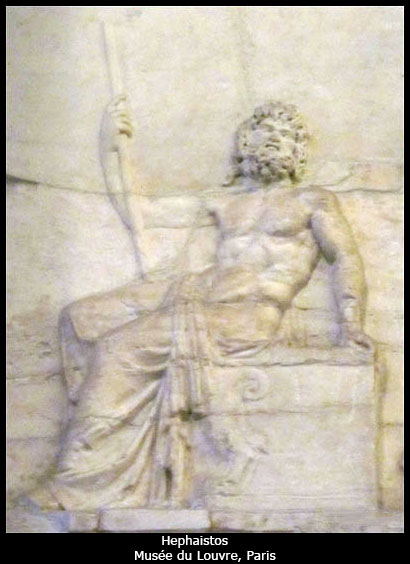
An agreement was reached whereby Ares promised to pay Hephaistos for his role in the adultery ... Ares' uncle Poseidon offered to pay the adulterer's damages if Ares defaulted. Satisfied he would be paid for his embarrassment, Hephaistos released the shamed lovers from their bonds. Aphrodite fled to the island of Kypros where she was bathed by the Charites (Graces).
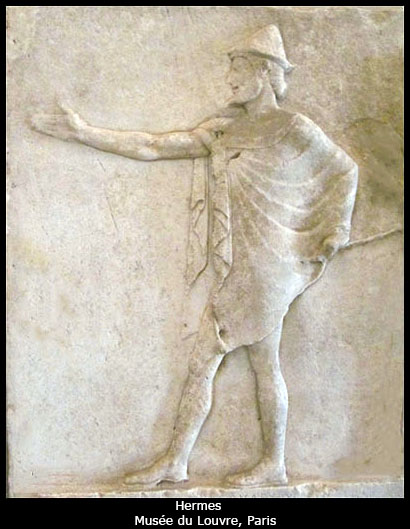
The gods Apollon and Hermes watched the spectacle with amusement. Apollon asked Hermes how he would feel in such a situation. Hermes answered that he would suffer three times the number of bonds if only he could share the bed of Aphrodite the Golden.
Hermes, who was traditionally symbolized by an erect phallus, did in fact share the bed of Aphrodite and their child was both masculine and feminine ... they named the child Hermaphroditus, taken from the combination of the names Hermes and Aphrodite.
Aphrodite was the quintessential goddess, and Hermes was the personification of virility. It stands to reason that a daughter born to Aphrodite would be endowed with a body that was beautiful and delicate. Likewise, a son born to Hermes would be expected to be vigorous and manly. As it turned out, the child of Aphrodite and Hermes had the characteristics of mother and father ... named Hermaphroditus, the child had the genitals of a man and a woman.
Aphrodite and Hermes earned reputations that engendered fear as well as respect ... for that reason the acceptance and adulation of Hermaphroditus was deemed to be prudent by the ancient Greeks.
There are conflicting stories about the life and death of Adonis but every story revolves around Aphrodite.
A young woman named Myrrha, or perhaps Zmyrna, offended Aphrodite in what must have been a very serious way. The punishment was so extreme one must assume the transgression was horrific. Aphrodite caused Myrrha and her father, King Kinyras of the island of Kypros, to engage in carnal activities and Adonis was the result of their union.
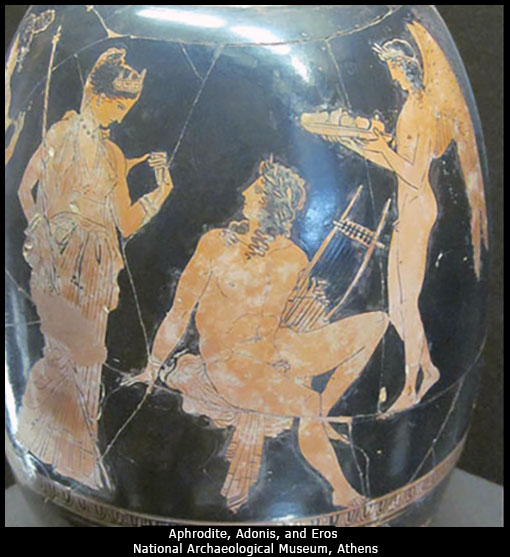
At this point, the story of Adonis is unclear, with three possible outcomes.
First—Myrrha was turned into a myrrh tree and Adonis was born from this tree. He grew to be a handsome young man and Aphrodite fell in love with him. The sap oozing from the myrrh tree was thought to be Myrrha's tears.
Second—Aphrodite put Adonis in a chest and sent him to the Underworld. When Zeus discovered Adonis' fate, he had sympathy for the charming young man and allowed him to live half of each year with the goddess Persephone in the Underworld and the other half with Aphrodite on the earth's surface.
Third—Adonis was raised by Nymphs and met Aphrodite while he was hunting. Her affection for him was short-lived because he was killed by a wild boar sent by Ares. This version holds that from the blood of Adonis sprang the red rose.
Of the countless kind and loving things Aphrodite did for young women, she was unable to help the daughters of Pandareos—Kameiro and Klytie.
Pandareos was a conspicuously overindulgent man. His excesses prompted the Immortals to kill him and his wife, leaving their daughters Kameiro and Klytie as orphans. Regardless of Pandareos' crimes, his daughters were innocents, and their plight did not escape the notice of the more sympathetic Immortals. Aphrodite fed the girls cheese, honey, and wine; Hera gave them beauty and wisdom above all other women; Artemis gave them stature; and Athene schooled them in works thought to befit women.
In order for the young women to have happy marriages, Aphrodite ascended Mount Olympos to ask Zeus to bless them. But during Aphrodite's absence, Kameiro and Klytie were carried off by the Snatchers (spirits of the whirlwind) and given to the Furies. The plight of the young women turned out to be the opposite of what Aphrodite intended.
The family of King Tyndareus of Sparta paid a bitter price when he incurred the wrath of Aphrodite. The poet Hesiod described the many trials King Tyndareus had to suffer, but it seems that he brought most of his troubles upon himself.
His woes began when he neglected Aphrodite during a sacrificial ceremony and after that, a series of misadventures plagued his life. King Tyndareus was married to a beautiful woman named Leda, but she was also the consort of Zeus. With Zeus, Leda had three children—Kastor, Polydeukes, and Helen. With Tyndareus, Leda had two daughters—Klytemnestra and Timandra.
As sons of Zeus, Kastor and Polydeukes earned the right to be called the Dioskuri, meaning "sons of God." They lived wild and adventurous lives, but compared to their sisters, they were exemplary children. Kastor and Polydeukes both died at an early age.
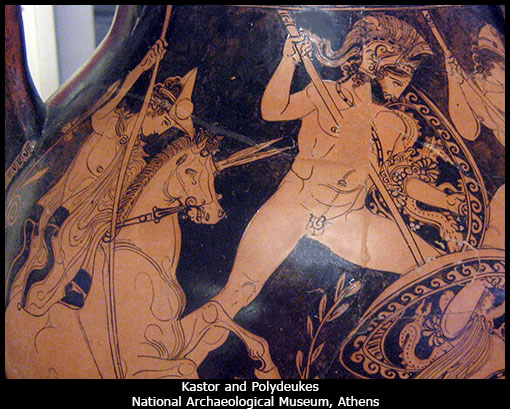
As Helen watched the fighting from the walls of Troy, she looked in vain to find her brothers among the combatants. The Trojan War began circa 1250 BCE, so Kastor and Polydeukes were dead before the war began. Helen was of course the scapegoat for the Trojan War, but Klytemnestra and Timandra became notorious for their own machinations. Timandra was not as infamous as her sisters, but the desertion of her husband, King Echemos of Arkadia, was disgraceful. Klytemnestra became one of the most despised women in Greece when she murdered her husband, Agamemnon. Ten years of brutal warfare at Troy had not prepared Agamemnon for the cruel fate Klytemnestra meted out when he returned to his home at Mykenai.
Expecting a hero's welcome, Agamemnon was instead attacked and killed by Klytemnestra and her lover, Aegisthus. Odysseus, another hero of the Trojan War, had a conversation with the disembodied spirit of Agamemnon at the entrance to the Underworld. Agamemnon's spirit bemoaned the fact that as he lay dead on the palace floor, Klytemnestra didn't have the decency to close his mouth or his eyes ... she robbed him of his life as well as his dignity in death. Klytemnestra's wickedness and infidelity were so scandalous that when she was murdered by her son Orestes, he was put on trial and acquitted of all guilt.
The final element of Aphrodite's curse on Tyndareus was the suicide of his wife, Leda. One can assume that the grief caused by the death of her sons and the disgraceful behavior of her daughters became too much for her to bear ... no one knows exactly how Leda's death was accomplished.
The names by which Aphrodite was known were diverse and expressive. Variations of her name were used to honor her, but also used to define her relationship with her worshipers.
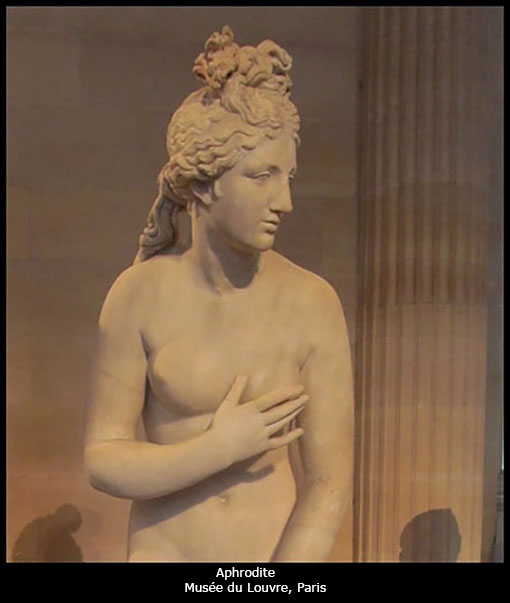
Surnames, what are now hereditary last names, were important in ancient Greece because they defined specific aspects of the immortal gods and goddesses. Surnames were placed after the proper name to be indicative of the temperament or influence of each Immortal ... for example, Aphrodite Pandemos is literally Aphrodite of All the People, but the name is usually translated as Aphrodite Common.
Aphrodite Akraia—Of the Height
Aphrodite Alosedne—Sea-Born
Aphrodite Ambologera—Postponer of Old Age
Aphrodite Amphipolos—The Busy One
Aphrodite Amyklaean—Beside the Amyklaean God, i.e. Apollon
Aphrodite Anadyomene—From the Sea
Aphrodite Apaturus—Deceiver
Aphrodite Apostrophia—Rejecter
Aphrodite Areia—Warlike
Aphrodite Doritis—Bountiful
Aphrodite Epistrophia—She who turns men to love
Aphrodite Erykine—Restrainer
Aphrodite Euploia—Fair Voyage
Aphrodite Kataskopos—Spy
Aphrodite Limenia—Of the Harbor
Aphrodite Machanitis—Devisor
Aphrodite Melainis—Of the Black Night
Aphrodite Migonitis—Physical Union
Aphrodite Morpho—Shapely
Aphrodite Nikephoros—Bringer of Victory
Aphrodite Nymphia—Bridal
Aphrodite Olympian—Of Olympos
Aphrodite Ourania—Heavenly
Aphrodite Pandemos—Common (of all the people)
Aphrodite Pontia—Of the Deep Sea
Aphrodite Praxis—Action
Aphrodite Symmachia—Ally
In order to signify Aphrodite's dominion over various places, the inhabitants would refer to her as the primary goddess of those areas ... for example, on the island of Kypros (Cyprus) she may be called, The Kyprian or simply Kyprian.

Ephesian—Of Ephesus
Erykinian—Of Mount Eryx
Knidian—Of Knidos
Koliad—Of Kolias
Kretan—Of Krete
Kyprian—Of Kypros
Kytherean—Of Kythera
Paphian—Of Paphos
Persian—Of Persia
Syrian—Of Syria
Tauropolian—Of Tauris
Alitta—Aphrodite's Arabian name
Mitra—Aphrodite's Persian name
Mylitta—Aphrodite's Assyrian name
Venus—Aphrodite's Roman name
Aphrodite is often confused with the Roman goddess of love, Venus. The Roman Pantheon was not established until hundreds of years after the Trojan War, and Aphrodite was perhaps several thousand years old when she fought at Troy.
As far apart as they are in time, the title "goddess of love," which is shared by Aphrodite and Venus, in no way equates the two goddesses for other reasons. When one reads about the exploits of Venus in the Aeneid by Virgil, written between the years 29–19 BCE, one encounters a trickster goddess with a cruel nature. Aphrodite was often fierce, but she was never cruel.
The geographer Strabo mentioned a curious fact about Aphrodite concerning the people of Phanagoreia, a city on the peninsula separating the Black Sea from Lake Maeotis (Sea of Azov). During the War with the Giants, Aphrodite enlisted the assistance of Herakles to prevent the Giants from harming her. She would lure the Giants, one by one, into a cave where Herakles was hidden. Once inside the cave, Herakles would murder the Giant using "treachery." In recognition of this event, the people of Phanagoreia began worshiping Aphrodite Apaturus, meaning Aphrodite the Deceiver. (Strabo Geography 11.2.10)
Aphrodite took Phaethon, the son of Eos (Dawn) and Kephalos, and made him the keeper of her shrine.
When Phaethon was a young boy, he was very handsome and full of childish thoughts ... Aphrodite was attracted to him and seized him ... she made Phaethon a divine spirit and the keeper of her shrine by night. It's not clear where the shrine was located and whether Phaethon became immortal or just retained the divine spirit of his mother, Eos.
The Skythians lived in an area northwest of the Black Sea on the lower courses of the Borysthenes (Dnieper) River.
The historian Herodotos (circa 484–425 BCE) reported that the female Amazon warriors and a variety of nomadic people lived in Skythia. Herodotos described the inhabitants as only slightly civilized and resistant to any form of foreign influence. He also stated that the Skythians were like the majority of Greeks in that they despised menial labor, preferring the art of war to any trade or profession.
The Skythians learned the art of divination from Aphrodite. The ritual involved twisting and untwisting the bark of the linden tree while uttering oracles inspired by Aphrodite.
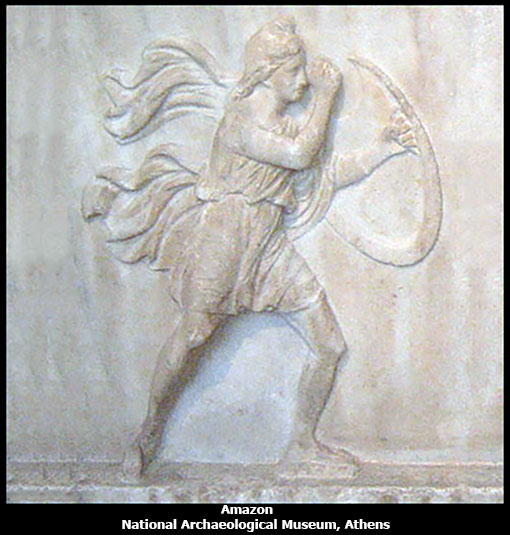
The influence of the five heavenly bodies, known as the planets, provided an interesting field of study for the ancient Greeks. The planet Aphrodite was important because of its relative brightness, and because it alternated between being visible near the horizon in the morning and in the evening.
The Greek astronomers and astrologers called the planets "Interpreters" when speaking of them as a group. The names of the heavenly bodies were changed to suit the Romans and, with the exceptions of Earth (Terra Mater), Moon (Luna), and Sun (Sol), we still use the Roman designations.
The Greek names were: Helios for Sun, Hermes for Mercury, Aphrodite for Venus, Ge for Earth, Ares for Mars, Zeus for Jupiter, and Kronos for Saturn. The Greek word for the moon was mene (μηνη) but Selene was the Greek goddess of the moon.
According to the authors Diodorus of Sicily (late first century BCE) and Pausanias (fl. 160 CE), the people of Lampsakos worshiped the god Priapos because he was the son of Aphrodite and Dionysos, a son of Zeus.
Lampsakos was located on the Asian side of the Hellespont, now known as the Dardanelles Strait. Priapos' name was associated with satyrs thus indicating his virility. Satyrs were riotous woodland deities who were attendant on Dionysos and represented in artwork as part-human, part-horse, and sometimes part-goat.
The worshipers believed Priapos was present wherever goats and sheep were pastured or where there were swarms of bees. His influence was evident when men under the influence of wine would find the members of their bodies tense and inclined to the pleasures of love, thus combining the gifts of Dionysos and Aphrodite.
Betting a kingdom on the outcome of a wrestling match might seem foolhardy, especially if you're betting against the ultimate hero, Herakles. Herakles was required to perform his famous Twelve Labors at the behest of King Eurystheus of Mykenai. On his way to Mykenai after the completion of his Tenth Labor, Taking the Cattle of Geryon, Herakles stopped on the island of Sicily. He was welcomed by the Nymphs of the island who created hot springs so Herakles could refresh himself after his arduous travels. Herakles circled the island and eventually came to the kingdoms of King Butas and King Eryx in northwestern Sicily.
King Butas had been Aphrodite's lover ... she named their son Eryx. Attaining a suitable age, Eryx was given his own kingdom, which he named after himself. He built a temple to his mother on a nearby mountain, likewise named Mount Eryx.
Eryx met Herakles when the hero was traveling around Sicily. The two proud demigods decided to test their strength with a wrestling match but they could not agree on a suitable wager. Herakles wanted Eryx to forfeit his land if he lost. If Eryx won, Herakles promised to surrender the cattle he had just "taken" from Geryon. At first, Eryx thought the arrangement was unfair, but Herakles explained that if he did not return to Mykenai with the cattle he would lose his chance to achieve immortality. For that reason, the cattle were virtually priceless.
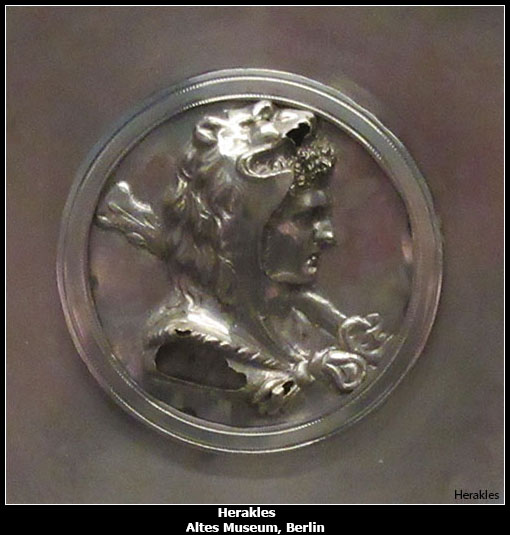
Eryx agreed that the terms of the wager were fair, and the two began to wrestle. In the end, Herakles won the match and took Eryx's land. Herakles had no practical use for a kingdom in Sicily so he gave it to the local people on the condition that, when asked, they would willingly surrender it to a descendant of Eryx. Many generations later, Dorieus the Lakedaemonian claimed his inheritance ... he became ruler of Eryx and built the city Herakleia.
The temple of Aphrodite on Mount Eryx was on a precipitous peak but that did not inhibit worshipers from frequenting the shrine. One notable and valuable contribution to the temple was a flawlessly lifelike golden ram made by the master craftsman Daedalus while he was a refugee on Sicily. The events described above occurred one generation before the Trojan War. After the war, Aphrodite's son Aineias visited the temple and added his own embellishments.
The island of Rhodes was named after Rhodos, a daughter of Poseidon, lord of the sea. Prior to Rhodos, a secretive race of wizards known as the Telchines inhabited the island. They were renowned for their supernatural abilities, such as changing their physical appearance at will and influencing the weather.
Rhodos' mother, Halia, was the sister of the Telchines, and one might assume she too had supernatural powers. It's not unusual for such unique women to attract the attention of the gods. Poseidon mated with Halia and had six sons and one daughter, Rhodos. Whereas Rhodos was worthy of adoration, her brothers were insolent and arrogant ... perhaps that's why they were unnamed in the ancient literature.
Sailing from the island of Kythera to Kypros, Aphrodite wanted to stop on the island of Rhodes, but Poseidon's sons would not let her drop anchor. The goddess lashed out and inflicted them with madness. In their deranged state of mind, they forced themselves on Halia and committed acts of violence against the Rhodians.
Poseidon would not tolerate such outrageous behavior ... he buried his sons alive and they became known as "Eastern Demons." Halia was so shamed and distraught by the crimes committed by her sons, she threw herself into the sea. Whether by Poseidon's intervention or by some other means, Halia became an immortal creature of the sea, thereafter known as Leukothea. The Rhodians honored her with ceremonies commemorating her sacrifice and suffering.
The traveler-historian Pausanias wrote about a curious statue he saw of Aphrodite while traveling on the Peloponnesian Peninsula circa 160 CE.
In the sanctuary of Aphrodite Morpho (Shapely) at Sparta, she sat wearing a veil and had fetters on her feet. Pausanias was told that King Tyndareus of Sparta put the fetters on the statue to punish Aphrodite for the curse of infidelity the goddess placed on Tyndareus' three daughters—Helen, Klytemnestra, and Timandra. Pausanias thought the idea of punishing the goddess by putting fetters on her statue was simple-minded and silly.
Aphrodite created the Selemnos River to ease the suffering of a heartbroken shepherd. The Selemnos River flowed into the Korinthian Gulf near the city of Patrae on the northern-central portion of the Peloponnesian Peninsula. The source of the Selemnos River was near the city and spring named after the Sea-Nymph, Argyra.
A handsome young shepherd named Selemnos pastured his flocks near the spring. Captivated by love, Argyra would rise from the sea and lay beside Selemnos. But as time passed, Selemnos began to age and Argyra lost her desire, until she finally deserted him completely. Selemnos descended into melancholy and was consumed by an illness described as "love-sickness." Aphrodite had sympathy for Selemnos and mercifully transformed the dejected old man into a river, but his sadness was not diminished. Aphrodite went one step further and blotted out Selemnos' memory so he no longer mourned for his lost love.
Aphrodite has had many priestesses, but Hero was by far the most famous. She served the goddess in her temple in Sestos on the European side of the Hellespont, now called the Dardanelles Strait.
Hero fell in love with a young man named Leander who lived on the Asian side of the Hellespont, in Abydos. Each night Leander would swim across the Hellespont to be with Hero ... the distance across was almost one mile (1.3 kilometers). Hero would use a lamp, or fire, to serve as a beacon so Leander could find her in the dark. One cloudy night he became disoriented and drowned. Inconsolable in her grief, Hero killed herself.
The Aphrodisia was a festival held in honor of Aphrodite Pandemos during the month of Hekatombaion, approximately the third week of June to the third week of July of our calendar. The surname Pandemos means "Common" or "Of All the People."
Cities such as Korinth and Athens as well as the islands of Delos and Aigina enthusiastically celebrated the Aphrodisia. The festivities were led by the local courtesans and all citizens were invited to participate. Normally, the rites of Aphrodite conducted by free-women were rather solemn but the courtesans, with their open and uninhibited sexuality, transformed the Aphrodisia into a lively and erotic celebration of the gifts of the goddess of love.
The temple of Aphrodite Ourania (Heavenly) in the city of Askalon in ancient Syria is thought to be the oldest shrine to the goddess on earth.
When the Skythians invaded what we call the Middle East, they marched through Syria ... most of the soldiers did not plunder or harm the Syrians, but some of them looted the ancient temple of Aphrodite Ourania. Aphrodite afflicted the soldiers and their descendants with a disease that caused loss of virility ... generally called the "female sickness." The Skythians call victims of this illness Enareis—that is, hermaphrodites or men-women.
No one could escape the influence of Aphrodite, no matter how fast they ran ... Atalanta was a perfect example of that fact.
Atalanta, a famous virgin huntress, distinguished herself during the Kalydonian Hunt as the first to wound the fierce boar the goddess Artemis unleashed on the people of Kalydon as punishment for the irreverent behavior of King Oineus.
The king's son Meleagros organized a band of renowned hunters to kill the boar and Atalanta was included in that elite group ... she was awarded the boar's hide for her skill and bravery.
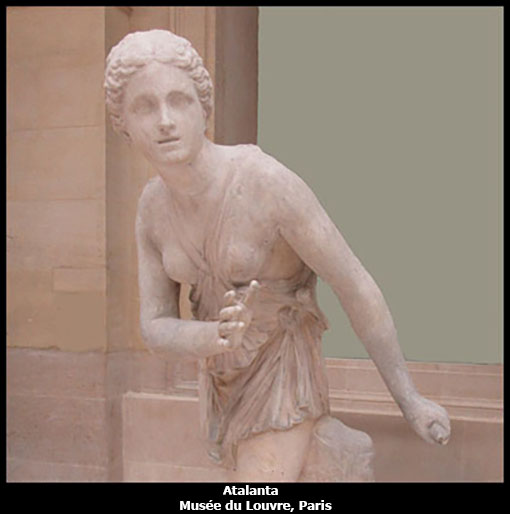
Atalanta vowed that she would only marry a man if he could beat her in a foot race ... she had no intention of getting married and assumed that with her athletic prowess she could defeat any man who raced against her.
A young man named Hippomenes, or perhaps Meilanion, fell in love with Atalanta and accepted her challenge. Aphrodite wanted Atalanta to be married so the goddess used her wiles to accomplish that seemingly impossible feat. Aphrodite gave Hippomenes three golden apples that came from the Garden of the Hesperides. These were no ordinary golden apples, they were of divine creation and irresistible to any mortal female. Hippomenes was instructed to place the golden apples on the racecourse so Atalanta would be tempted to stop and collect them. The trick worked just as Aphrodite intended. When Atalanta stopped for the enchanted apples, Hippomenes gained an advantage Atalanta could not overcome. Hippomenes won the race, and Atalanta became his wife.
Aphrodite was instrumental in the creation of the first woman, Pandora. The name Pandora means "all-endowed" because, at the command of Zeus, she was given gifts from the Olympian gods and was thus endowed by all.
Pandora's genesis is traced to an incident involving the Rebel-God Prometheus and his all-powerful cousin, Zeus. Methodically testing Zeus' patience with acts of defiance, Prometheus finally exceeded Zeus' forbearance by giving fire to the men of the earth ... a benefit Zeus had deliberately withheld. An appropriate punishment was needed for Prometheus as well as the men of the earth. Zeus decided to punish Prometheus in a harsh and demonstrative way ... he chained the Rebel-God to a mountainside for thirteen generations of mortal men.
The punishment Zeus envisioned for the men of the earth required a subtle and devious plan. The earth was only inhabited by men ... there were no women. Men enjoyed lives untarnished by illness or hardship ... it was an age of innocence. Zeus not only wanted to plunge the world into sorrow and despair, he wanted the men to willingly embrace their own destruction. The creation of Pandora would achieve that purpose.
Zeus commanded the Olympian gods and goddesses to create a woman. Hephaistos molded Pandora's body from earth into the likeness of a modest young girl ... Athene taught Pandora the skills of weaving and gave her dexterity ... Aphrodite put a mist upon her head to engender longing and desire ... Hermes gave her treachery and shamelessness ... the Charites (Graces) and Peitho (Persuasion) gave her necklaces of gold ... the Horai (Hours) put a halo of flowers on Pandora's head.
Pandora needed a mate. Zeus turned his attention towards Prometheus' brother, Epimetheus. Prometheus warned Epimetheus not to accept gifts from Zeus, but when Epimetheus saw Pandora cloaked in Aphrodite's mist, he could not resist her charms. Epimetheus accepted Pandora without realizing she would be unleashing untold evils on the world. The idyllic life of men ended the moment Epimetheus embraced Pandora.
The poet Hesiod documented the story of Pandora in his poem Works and Days, circa 750 BCE. He seems to have appreciated "women" but distrusted "womankind." He wrote, "For a man wins nothing better than a good wife ..." but added, "The man who trusts womankind, trusts deceivers."
The surname Areia was used for Aphrodite in Lakonia and is usually translated as "Warlike." A more literal translation of Areia might be appropriate since this deals with the Spartans, who were more akin to Ares, god of war, than Aphrodite.
The traveler-historian Pausanias saw an ancient wooden statue of Aphrodite surnamed Areia, which was the only reference to Aphrodite with that surname in the ancient literature. A literal translation of Areia would be "menace" or "threat" ... the Spartans could have considered Aphrodite a threat to their warlike cultural values, as opposed to an inspiration in battle.
The Charites, known as the Graces or Charities, were the only Immortals who might be classified as Aphrodite's companions. Their names are Aglaia (Splendor), Euphrosyne (Festivity), and Thalia (Rejoicing).
The Charites wove Aphrodite's garments and tended to her every need ... they danced with Aphrodite and other goddesses on Mount Olympos. Just as their names imply, they were the incarnation of grace and charm.
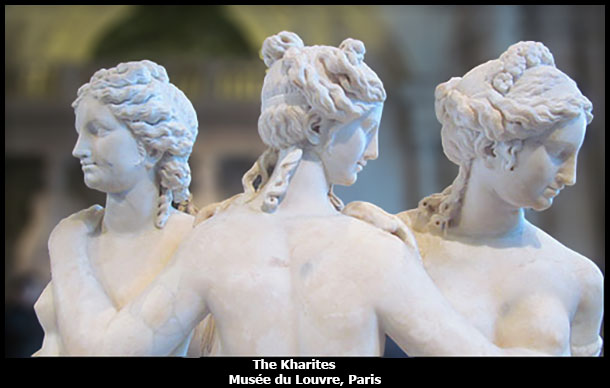
The Charites trace their lineage to none other than Zeus, the father of gods and men, and his mistress Eurynome. Zeus was a son of the Titans, Kronos and Rhea. Zeus' authority was absolute on earth as well as on Mount Olympos. Eurynome was an Okeanid, one of the three thousand daughters of Okeanos (Ocean) and Tethys.
A curious incident in the Iliad by Homer portrays the goddess Hera suggesting that Hypnos, god of sleep, marry Pasithea, "one of the younger Charites." Pasithea was otherwise not mentioned as one of the Charites by other poets.
The poem Theogony by Hesiod, for example, states that Eurynome and Zeus had "three fair-cheeked daughters" ... not four.
The garments the Charites wove for Aphrodite were not described in detail. Considering the makers and the recipient, one must assume they were exquisite.
In addition to the clothing the Charites made for Aphrodite, they wove a crimson robe that became an important element in the Quest for the Golden Fleece. Apollonius of Rhodes, author of the Argonautika, provided tantalizing information about the robe.
Ieson, the leader of the quest, came into possession of the crimson robe on the island of Lemnos. He marveled at the beauty of the robe and found its texture irresistible to the touch.
Queen Hypsipyle of Lemnos told Ieson the robe had been fashioned by the Charites for Dionysos, a son of Zeus, while he was on the island of Dia with Ariadne, daughter of King Minos of Krete. The robe emitted a fragrance reminiscent of the wine and ambrosia Dionysos and Ariadne shared when he wore the robe.
Dionysos gave the robe to his son, King Thoas of Lemnos ... Thoas gave the robe to his daughter Hypsipyle, and she gave the robe to Ieson as a token of her affection.
Ieson used the crimson robe on two occasions—nce to summon the goddess Hekate and again to lure Prince Apsyrtos of Kolkhis to his death. The crimson robe passed from the historical record when Ieson returned to Greece.
Aphrodite is perhaps the best known of the Greek Immortals. She has been called upon for millennia to intercede in matters of love because she can give profound meaning to simple gestures of affection and inspire men and women to make bold sacrifices for the ones they love.
Aphrodite makes it possible for us to rise above our fatal humanity and experience the timeless, yet transitory, gift of true love. In the final reckoning there is only love ... Aphrodite's gift to humanity.
The Iliad by Homer
The Odyssey by Homer
Theogony by Hesiod
Works and Days by Hesiod
Catalogues of Women and Eoiae
Catalogue of Women by Hesiod
Shield of Herakles by Hesiod
Hymn to Demeter
Hymn to Pythian Apollon
Contest of Homer and Hesiod
The Histories by Herodotos
Description of Greece by Pausanias
Library of History by Diodorus of Sicily
Odes of Pindaros
The Geography by Strabo