Previous Page Homepage Site Search
Copyrighted Material—All Rights Reserved


| The Judgment of Paris |
| Eris at Troy |
| The Children of Eris |
| Bibliography |
| Previous Page |
| Homepage |
| Site Search |
Eris is the daughter of black Nyx (Night). Her influence can be felt in every quarrel, feud, and disagreement on the face of the earth and even on the heights of Mount Olympos. Known to be untrustworthy by the Olympian gods, they are careful not to provoke her ... she is justifiably feared and respected for the eternal and unrelenting strife she can engender.
As the daughter of Nyx, Eris is the sister of Nemesis (Divine Retribution), Geras (Old Age), Philotes (Friendship) and Apate (Deceit). Of the daughters of Nyx, Eris is perhaps the most frightening because of her subtlety. Nemesis is a powerful goddess, but she only acts when Zeus commands retribution or punishment. Geras is only frightening to those who allow old age to make them fear the future. Philotes is a goddess who needs to be embraced with caution because unwise friendships can be emotionally and financially costly ... as Philip, father of Alexander the Great, supposedly said, "Cheat young men with dice and old men with oaths of friendship." Apate can cause frustration but compared to Eris, her deeds are quite petty.
The poet Hesiod is credited as the author of Theogony, the definitive work on the lineage of the Greek Immortals. In another of his poems, Works and Days, Hesiod explains that there are actually two goddesses named Eris ... "one is praised when men understand her; the other is blameworthy" ... Hesiod explains that strife and discord can serve as positive motivators ... it's when we allow our hardships and disagreements make us do things we regret that the negative aspects of Eris are manifested.
The roots of the animosity between the Achaian Greeks and the Trojans might be traced to one defining moment ... that incident has become known as The Judgment of Paris, but a more appropriate name would have been The Judgment of Alexandros.
Prince Alexandros of Troy was sometimes called Paris in the Iliad by Homer, but now the name Alexandros has been essentially forgotten ... the name Paris has supplanted that of Alexandros because modern artists and poets seem to prefer the name Paris for its simplicity and uniqueness.
The Judgment of Alexandros took place on the slopes of Mount Ida just prior to the Trojan War, i.e. prior to 1250 BCE. The "Judgment" was an offshoot of the marriage of the Nereid Thetis and a mortal man named Peleus. Being allowed to marry a goddess was a reward for Peleus because of his undying devotion to the gods on Mount Olympos. Being forced to marry a mortal was a punishment for Thetis because she refused the amorous advances of Zeus ... she was being taught a lesson in humility.

The above depiction of the Judgment of Alexandros clearly shows Alexandros seated with Hermes looking over his shoulder. Athene, Hera and Aphrodite are to the right with Eros (primal love) watching from the top of a column behind them. The goddess standing on the rock outcropping in the upper left is undoubtedly Eris ... she seems pleased with the results of her handiwork.
The goddess Hera made sure the wedding was well attended. Eris did not want to celebrate ... she wanted to cause trouble. She tossed down a golden apple with the inscription, 'For the most beautiful one.' Naturally, Hera, Athene, and Aphrodite all assumed the prize was for them. The intended conflict escalated into a bitter argument. Zeus instructed his son Hermes to escort the three obstinate goddesses to Mount Ida so Trojan Prince Alexandros (Paris) could make the final decision as to which goddess deserved the golden apple. Alexandros was placed in a very difficult position but that's exactly what Zeus intended.
The drama unfolding at the wedding of Thetis and Peleus was simply the first step in a coordinated series of events that would culminate with the Trojan War. Zeus was using Eris and the other Immortals to help him rid the earth of the demigods, i.e. the children of Immortals and mortals. His own daughter Helen was used to help perpetuate his plan, but she was not sacrificed in the war or its aftermath.
Alexandros could not escape his destiny ... he had to choose the most beautiful goddess, but which one should he choose?
Hera had always been the most beautiful goddess on Mount Olympos ... he could not ignore the fact that she was the sister-wife of Zeus ... she seemed like an obvious choice.
Athene was the virgin goddess of wisdom and even though she was sometimes called the Grim-Goddess, she was quite beautiful by any mortal standard.
Aphrodite was the goddess of love ... her charms and enchantments were legendary ... Alexandros should have chosen Aphrodite for those reasons alone, but his choice was based on greed and desire ... beauty had nothing to do with it. Aphrodite promised Alexandros that if he selected her, she would give him the most desirable woman in the world ... she would give him the daughter of Zeus ... she would give him Helen of Sparta.
Alexandros immediately understood the implications of Aphrodite's promise. Helen's beauty was beyond compare ... when poets sang about her, she was always compared to a goddess ... and rightly so. Even when she was a young girl, her grace would make men swoon. When her father let it be known that he was seeking a husband for Helen, suitors came from all over the civilized world—not ordinary men—Helen's suitors were the finest specimens of manhood to walk the earth. Her father made them all take a solemn oath that they would peacefully abide by his choice and more importantly, they would all come to Helen's defense if she should ever be taken from her husband. Helen's father knew all too well the hypnotic effect she had on men.
Alexandros chose Aphrodite as the most beautiful goddess because he wanted Helen ... the apple Eris used to start the conflict between Hera, Athene, and Aphrodite was the seed for ten long bloody years of war ... the Trojan War was one of Eris' finest accomplishments.
During the Trojan War, Eris rode into battle on the side of the Trojans with her equally frightful companion, Ares (god of war). She is more generally known for the less deadly forms of conflict—political strife, personal contention, rivalry and wrangling—but the potential for evoking her deadly nature is ever present.
Eris would appear frail and small as she entered the fighting but as she strode through the carnage, she would get larger and larger until her head would brush the heavens. She hurled cruelty and hatred down on the fighting men ... she would groan with pleasure as she watched the melee ... her countenance was so dreadful the timid Immortals kept their distance. Eris was called the Lady of Sorrow as she fought alongside Apollon and Ares in the defense of Aphrodite's beloved son, Aineias.
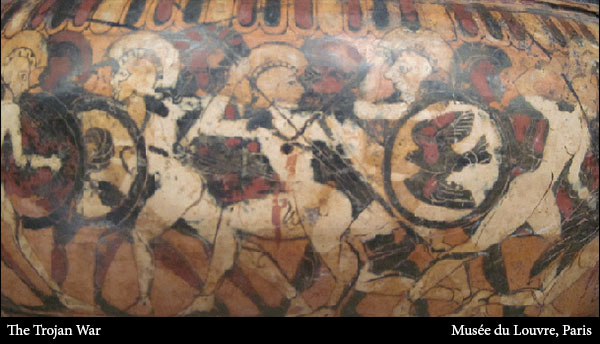
One of the more dramatic moments of the Trojan War was when Achilles' companion Patroklos was killed while wearing Achilles' armor. Trojan Prince Hektor stripped Achilles' armor from Patroklos' dead body and Zeus fitted the glorious armor to Hektor's body. Seeing Prince Hektor in Achilles' armor, the Trojans imagined that they had achieved a significant advantage but in reality, they had provoked a murderous rage in Achilles' heart that could only be assuaged with the blood of countless Trojans.
Before he could begin his rampage, Achilles needed new armor. His mother Thetis went to Hephaistos, smith of the gods, for Achilles' new armor. The divine armor was animated and alive with a variety of scenes from everyday life ... some scenes were peaceful but since the shield was for the most vicious fighter in the world, the majority of the scenes were extremely violent. One of the bloodiest depictions on the shield was of Eris walking through the battle carnage, stained with blood, carrying a wounded man and an unwounded man in her arms and dragging a dead man by his feet ... Eris was fighting with Kydoimos (Confusion) and Kera (Black Fate) as they dragged away the corpses of the men who had fallen in the animated battle on the shield.
It's interesting to note that of all the children of Nyx, Eris is the only one to have children of her own. The children of Nyx seem to be "forces of nature" that manifest themselves without invocation ... the children of Eris are a Who's Who of the darker aspects of human behavior.
In the poem Theogony by Hesiod, Eris' children are listed without elaboration because their names more or less say it all.
| Algea | Ἂλγεα | Pains | line 227 |
|---|---|---|---|
| Amphillogias | Ἀμφιλλογίας | Disputes | line 229 |
| Androktasias | Ἀνδροκτασίας | Manslaughters | line 228 |
| Ate | Ἂτην | Blindness/Ruin | line 230 |
| Dysnomia | Δυσνομίην | Lawlessness | line 230 |
| Horkos | Ὅρκον | Oath | line 231 |
| Hysminai | Ὑσμίνας | Fightings | line 228 |
| Lethe | Λήθην | Forgetfulness | line 227 |
| Limos | Λιμόν | Starvation | line 227 |
| Logos | Λογόυς | Words | line 229 |
| Machai | Μάχας | Battles | line 228 |
| Momos | Μῶμος | Blame | line 213 |
| Moeras | Μοίρας | Destinies | lines 217 & 904 |
| Neikea | Νείκεά | Grievances | line 229 |
| Phonoi | Φόνους | Murders | line 228 |
| Ponos | Πόνον | Hardship | line 226 |
The Iliad by Homer
Theogony by Hesiod
Works and Days by Hesiod
Shield of Herakles by Hesiod
Kypria
Description of Greece by Pausanias