
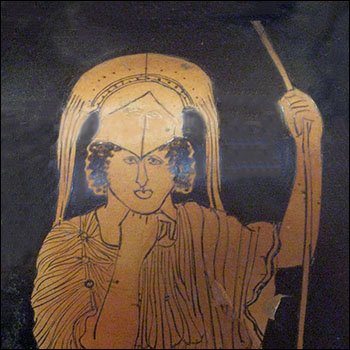
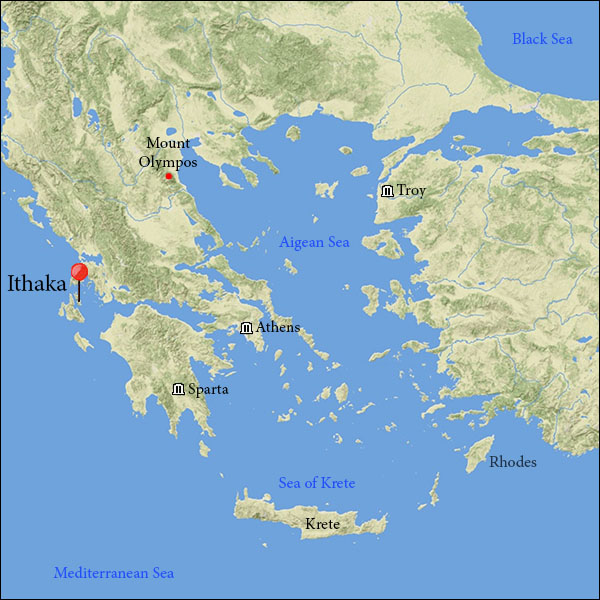
King Odysseus of the island of Ithaka earned a place in annals of Greek prehistory as an invaluable commander in the Trojan War and an intrepid adventurer on his miraculous voyage home after the war. Whereas the Iliad by Homer chronicled the Trojan War, the Odyssey, also by Homer, was the story of Odysseus' adventures after he and his comrades left Troy and sailed home ... only Odysseus survived the journey.
Born on the relatively small island of Ithaka, located 20 miles (32.2 kilometers) off the western coast of the Greek mainland, Odysseus was the son of King Laertes and Queen Antikleia. Odysseus became king when his elderly parents retired to the countryside to lead quiet lives. His mother Antikleia died while Odysseus was fighting in the Trojan War but he was briefly reunited with her when he went to the entrance to the Underworld ... but we'll get to that later.
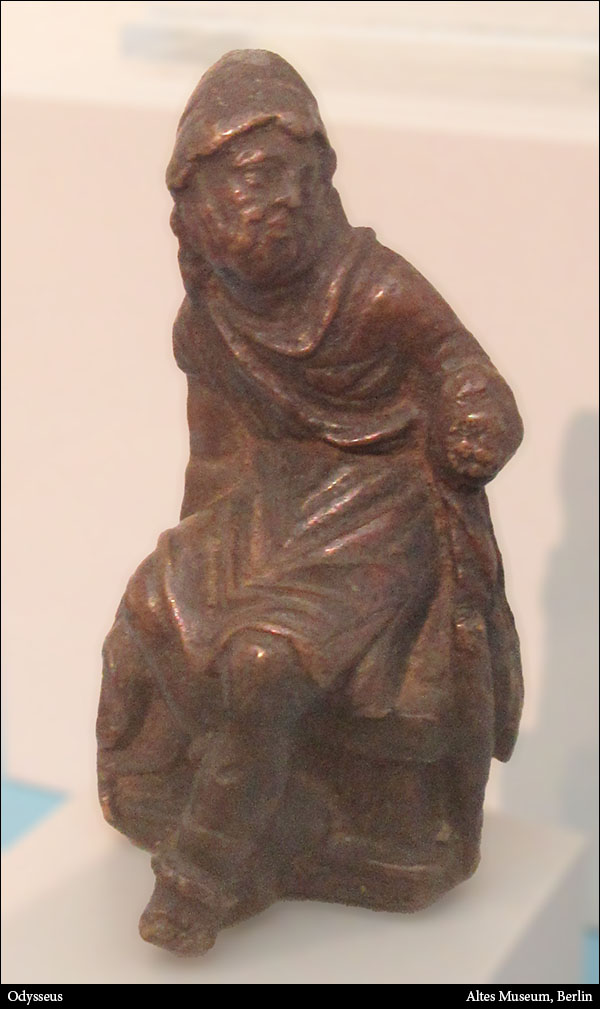
Odysseus was descended from the god Hermes, messenger of the Immortals, but he was a mortal man ... a remarkable man but mortal, nonetheless. Outspoken and sincere, fierce and proud, Odysseus exemplified bravery tempered by wisdom. He had the distinction of being one of the soldiers hidden in the famous, yet vaguely described, Trojan Horse.
The Trojan War was a turning point in the history of Greece and the cultures of the Aigean Sea ... the Age of Heroes was over and the Age of Iron was just beginning. The life of Odysseus also changed dramatically during the Trojan War, which began circa 1250 BCE. We don't know exactly how old Odysseus was when he went to Troy but we can assume he was in his mid-twenties ... that would make him old enough to become a respected king before departing for the Trojan War.
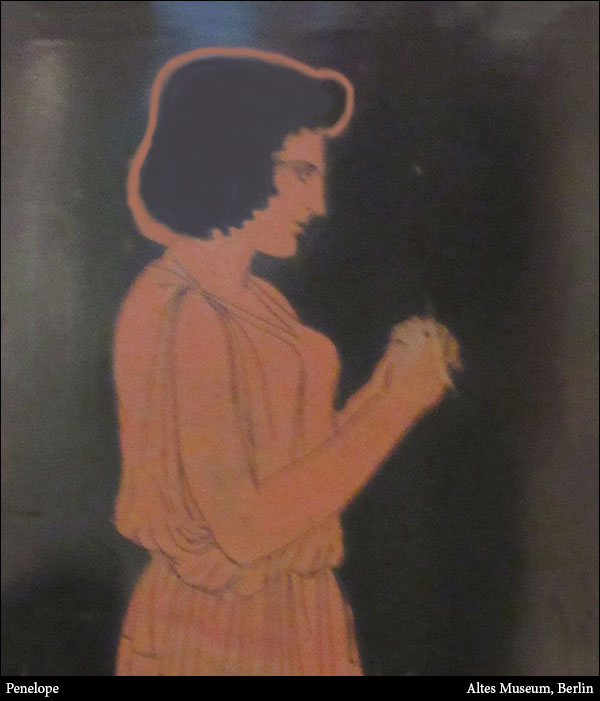
Odysseus' wife Penelope had just given birth to their son Telemachos when the Trojan War began. The war lasted ten years and Odysseus' journey home took another ten years. During his twenty-year absence, his son grew to manhood and his wife was besieged by suitors wanting to marry her and claim Odysseus' kingdom.
Odysseus was by no means a simple or one-dimensional man ... we are given hints in the fragmented Epic Cycle that he actually feigned madness to avoid having to go to Troy but once there, Odysseus became one of the most committed leaders of the Achaian army. He was willing to fight or negotiate as the circumstances dictated.
We get glimpses of Odysseus in the Iliad and his role in the defeat of Troy but his true nature comes to light in the Odyssey as he tries desperately to make his way home while being tormented by the lord of the sea, Poseidon.
The soldiers in the army laying siege to Troy were called Achaians, Argives, and Danaans ... we normally refer to them simply as Greeks, even though, strictly speaking, the inhabitants of Troy were also Greeks.
The generally accepted cause of the Trojan War is that a political dispute brought the Greeks of Asia Minor into conflict with the Greeks of the Balkan Peninsula. The crux of the dispute was the abduction of Helen, the wife of King Menelaos of Sparta, by Prince Alexandros (Paris) of Troy. Menelaos and his brother King Agamemnon of Mykenai launched a thousand ships to force Helen's return. Superficially, that is a viable answer however, the underlying reason for the war was that the Olympian gods wanted to end the Age of Heroes by killing a significant number of the demigods. The demigods were the children of Immortals and mortals. The Trojan War was an expedient way to achieve that end.
Upon arriving at Troy, Odysseus and Menelaos went into the city to negotiate the return of Menelaos' wife, Helen ... their objective was to avert an all out siege. They were taken to King Priam where Odysseus made a sincere plea to Priam and his advisers. Priam was sympathetic to their request but in the end, took the advice of his councilors and refused to return Helen ... when he was urged to kill Odysseus and Menelaos, Priam decided that such a cowardly act would only serve to outrage the Immortals and inflame the Achaians. One of the counselors of King Priam who advised the king to kill Menelaos and Odysseus was a man named Antimachos. He did not realize that his hasty advice would come back to haunt him. In the tenth year of the war, Agamemnon encountered Antimachos' sons Peisandros and Hippolochos on the battlefield and killed them ... they begged Agamemnon for mercy but he recognized the two young men and reminded them that their father had shown no mercy for his brother and Odysseus.
When tempers flared in the Achaian council meeting, Odysseus addressed the soldiers and leaders to calm them. As he spoke, the goddess Athene invisibly stood beside him and compelled the rowdy men to listen. Odysseus was one of the few men at Troy who could speak frankly with Achilles, the most feared man in either army. Achilles was proud and headstrong but he considered Odysseus a good friend and an able fighter. When Agamemnon and Achilles argued and could not come to terms, Agamemnon sent Odysseus as his spokesman to try and reason with Achilles. Although Achilles would not give up his anger towards Agamemnon, he still treated Odysseus with respect.
Another incident involving Odysseus was the encounter with a Trojan spy named Dolon. The Trojans had a victorious day on the battlefield and Trojan Prince Hektor was anxious to know if the Greeks were discouraged and preparing to withdraw. He asked for a volunteer to secretly go to the Greek camp as a spy. Hektor promised to give the volunteer the chariot and horses of Achilles after the Greeks were defeated. A brave but foolish man named Dolon stepped forward and accepted the job but he made Hektor swear a solemn oath that he would fulfill his word and give the chariot and horses of Achilles as a reward.
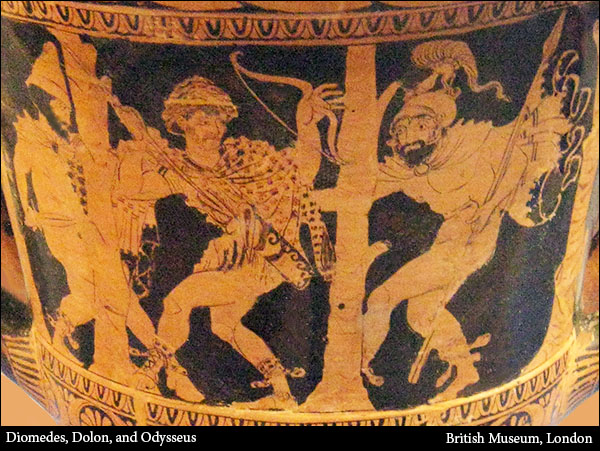
On the other side of the battlefield, the Greek commander-in-chief Agamemnon wanted to send two spies into the Trojan camp to assess their intentions and strength. Odysseus and Diomedes were chosen for the task. After the decision had been made, the goddess Athene sent a heron to fly above them to show her approval. While crossing the no-man's-land between the encamped armies, Odysseus and Diomedes saw Dolon coming their way very quickly. The two men hid until Dolon ran past and then raced to catch him. Their intention was to force him towards the Greek encampment and not let him escape back to the Trojan camp or to the city. Dolon was a fast runner but Athene put determination in Diomedes' heart and swiftness in his legs. Diomedes shouted at Dolon to stop and then threw his spear just above Dolon's shoulder. Dolon stopped and fell to his knees. He begged Diomedes to spare his life and said his wealthy father would pay a large ransom for the return of his only son. Odysseus calmed Dolon with some sly words and made him reveal the situation at the Trojan camp. Dolon told Odysseus that some Thracian troops had just arrived and their commander Rhesos had golden armor and the finest horses on the battlefield. After Odysseus finished questioning Dolon, Diomedes drew his sword and as Dolon begged for his life, chopped off his head. Diomedes attacked Dolon with such speed and violence Dolon's head was still speaking when it hit the ground.
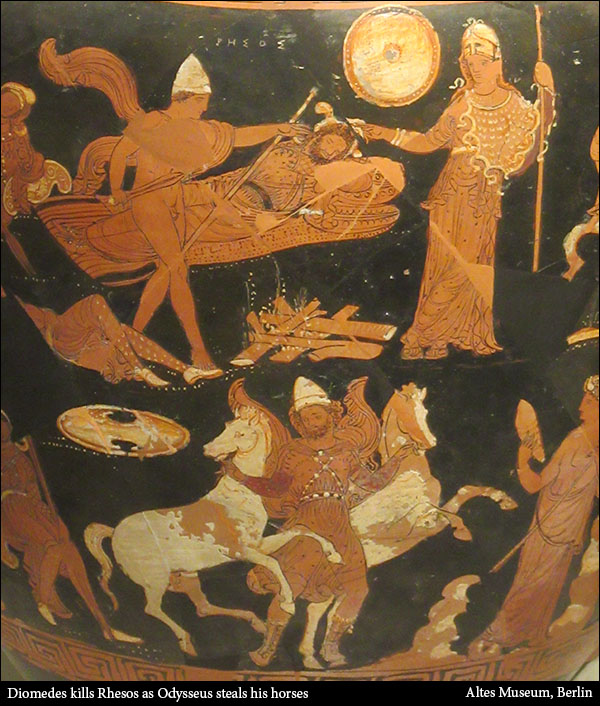
Odysseus stripped Dolon of his gear and left it by his corpse. The two spies continued on towards the Trojan camp where they easily found the Thracians and devised a plan where Odysseus would steal the magnificent horses of Rhesos while Diomedes killed as many of the sleeping Thracians as he could. Diomedes killed twelve Thracian soldiers and then pulled their bodies out of the way so he and Odysseus could lead the horses away without stepping in the blood and gore. Lastly, Diomedes killed the Thracian commander Rhesos. Their task completed, the two heroes fled back to the Greek encampment with the beautiful white horses and the gear they had stripped from Dolon. When they reached their camp, Odysseus held Dolon's armor aloft and dedicated it to his protector, Athene.
Odysseus was one of the fiercest warriors at the siege of Troy. His reputation for being a crafty and savvy negotiator was eclipsed by his reputation as a man of action and ferocity. Odysseus was never one to hold back in battle but he was also cautious as to when and where to fight. When Achilles' companion Patroklos was killed, Achilles wanted to charge into the Trojan battle lines with no thought of rest or food. Even though Achilles was one of the most dangerous men in the world, Odysseus stood up to him and insisted that the army needed to rest before they engaged the Trojans again. Achilles accepted Odysseus' counsel and brooded all night so he could have the right amount of hatred and savagery when he finally went out to fight the Trojans.
After Achilles had his share of killing and revenge for the death of his companion Patroklos, funeral games were held so the soldiers could expend their grief. When the competition for wrestling was announced, the first to step forward was Telamonian Aias. Second only to Achilles, Aias was the largest and most feared man at Troy. When Odysseus stepped up to wrestle Aias, the assembled soldiers were amazed. To give perspective to the situation we must remember the scene where King Priam and Helen were watching the fighting from the walls of Troy. King Priam mused that he was surprised that Odysseus was such a small man and still at the forefront of the fighting. When Odysseus and Aias squared off to wrestle, everyone expected Odysseus to lose but as the fighting went on, it became obvious that Odysseus was as good with his bare hands as he was with a spear or sword. To everyone's surprise, Odysseus struck Aias behind the knee and toppled the monstrous man to the ground. Even so, Odysseus could not lift or pin Aias. Achilles called the competition a tie and ended the fight. Odysseus had held his own against the second largest man at Troy.
One of the last major conflicts at Troy occurred when Achilles was killed. The struggle for the body of Achilles and his armor evoked some of the fiercest fighting of the Trojan War. When Patroklos was killed wearing Achilles' original armor, Achilles' mother Thetis went to the god Hephaistos for new, divine armor. The new armor was so bright that Achilles' own soldiers could not look directly at it. Achilles was conspicuous on the battlefield because his armor sparkled like a bright star as he slaughtered his way through the Trojan ranks. Despite his god-made armor, Achilles was finally killed by Alexandros (Paris) with the help of the god, Apollon.
Everyone wanted Achilles' dead body. The Trojans wanted it to humiliate the Achaians by desecrating Achilles' corpse ... the Achaians wanted it to honor the death of their best man by retrieving his body and giving him a proper funeral. Telamonian Aias and Odysseus were the two most important men responsible for saving the body of Achilles and his armor from the Trojans. After countless deaths and hours of fighting, Odysseus managed to hold back the Trojans while Aias carried Achilles' body back to the Achaian camp. A bitter quarrel erupted between Aias and Odysseus as to who deserved Achilles' armor but it was finally awarded to Odysseus. Aias was so distraught he killed himself. Years after the end of the war, Odysseus encountered the "shade" of Aias at the entrance to the Underworld but Aias had still not forgiven Odysseus and refused to acknowledge him.
Before the war could end, Achilles' son Neoptolemos was needed to complete the will of the Immortals. Odysseus was sent to the island of Skyros to retrieve Neoptolemos. Odysseus gave Neoptolemos Achilles' armor and the final assault on the city began.
The Trojan War lasted ten years. The fighting was continuous. The Achaians would pillage neighboring islands and cities to maintain their supplies while the Trojans used their allies to resupply their troops and food. The war seemed destined to continue indefinitely unless the Achaians changed their strategy.
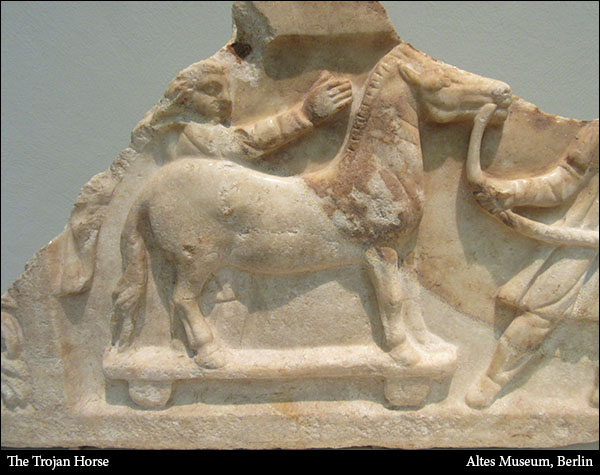
The walls of Troy were impervious to frontal assault and there were no Trojans willing to betray their friends and families by opening the city gates for the enemy. After ten years of brutal fighting, a clever plan was devised that would compel the Trojans to open their gates and let their conquerors inside the city. A Wooden Horse was designed by a man named Epeios and filled with the best Achaian fighters ... Odysseus was one of the men inside the horse. The Wooden Horse was assembled and left within sight of Troy. The Achaian army boarded their ships and retreated to the nearby island of Lemnos and secretly waited for the signal that the Wooden Horse had been taken inside the city.
Some of the Trojans thought the Wooden Horse was a symbol of peace and a tribute to the goddess Athene ... others thought the Wooden Horse was a trick and should be burned where it stood. The Trojan seer Laokoon tried to warn King Priam that the Wooden Horse was a trick and not a peace offering but Poseidon (lord of the sea), who was clearly on the side of the Achaians, sent one of his giant sea-serpents to kill Laokoon and one, or both, of his sons. Priam assumed Laokoon was killed because he was giving false prophecy and gave orders for the Wooden Horse to be brought inside the walls of the city.
Helen had been the wife of Trojan Prince Alexandros (Paris) for ten years and had developed sympathies for the Trojans even though she was a Spartan. She knew the temperament of the attacking Greeks all too well and was hesitant to trust them. Motivated by her doubts, Helen walked around the Wooden Horse three times imitating the voices of the wives of the men she thought most likely to be hiding inside. A soldier named Antiklos almost answered Helen's call but Odysseus forced him to remain silent by getting Antiklos in a strangle hold.
The Trojans were ecstatic. They believed they had survived ten years of fierce fighting and were now ready to accept the Achaians' peace offering. After a day and night of celebration, the Trojans collapsed into a state of exhaustion. The soldiers inside the Wooden Horse emerged from hiding and fell upon the unsuspecting Trojans. Once the gates of the city were opened, the entire Achaian army entered the city where they killed or enslaved almost every Trojan citizen. As one final act of brutality, Odysseus killed Astyanax, the infant son of Prince Hektor and his wife, Andromache. The Trojan War was over.
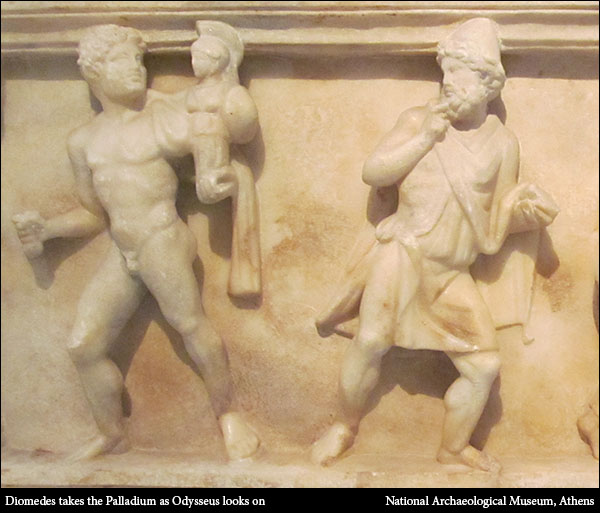
Amid the chaos of the final battle at Troy, Odysseus and Diomedes rescued the statue of Athene—the Palladium—from her temple inside the burning city. The Trojans claimed they had made a duplicate of the Palladium and the statue Odysseus and Diomedes took was not authentic. Considering Athene's hatred for the Trojans and the protection she afforded Odysseus and his family, we might conclude that the Trojan account as to the fate of the Palladium was not accurate.
Despite his support for the Achaians at Troy, Poseidon, lord of the sea, developed an abiding hatred for Odysseus but Zeus would not let Poseidon kill Odysseus or prevent his eventual homecoming. Athene protected Odysseus at Troy, but after he left Troy, she had to be careful not to further inflame Poseidon and make Odysseus' plight worse. Athene's influence became subtler but her constant guidance of Odysseus and his son Telemachos proved invaluable.
To give a full account of Odysseus' adventures on his ten-year voyage from Troy to Ithaka would require a complete retelling of the Odyssey so I will only give a few highlights of his trials and tribulations. I sincerely suggest that you read the Odyssey for the fascinating details of this epic saga.
Troy was in ruins and the plunder had been distributed amongst the Achaians. Odysseus did not anticipate any problems on his voyage home, but his expectations were soon dashed when his twelve ships were blown off course and he was forced ashore on the island of the Cyclopes. Odysseus' men beached their ships in a natural harbor and when Eos (Dawn) arrived, they feasted on goats the Nymphs had driven from the hills to where the sailors were camped. Odysseus and his men could see smoke from distant hearth fires but did not know who the inhabitants of the land might be.
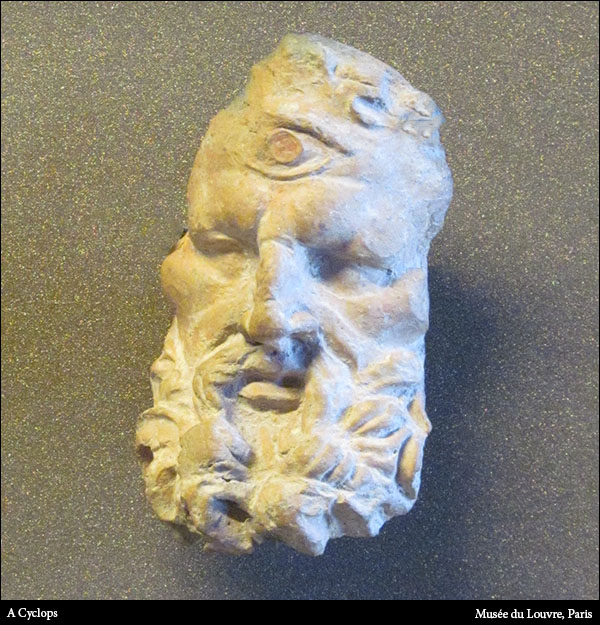
The following day, Odysseus sailed down the coast to seek out the natives. He came to a place where he could see a cave with goats and sheep in a fenced yard. In the distance he could see a monstrous man herding flocks. Odysseus took twelve crewman and went ashore to investigate. Odysseus suspected that the monster-man would be wild and lawless, so he took some food and a skin of very strong wine to offer as gifts. They found the cave of the monster-man well stocked with cheese, milk and pens full of lambs and kids. Odysseus' companions wanted to steal the food and make a hasty retreat back to their ship, but Odysseus decided to wait for the monster-man to return. He hoped the barbaric looking man would be civil enough to offer gifts of hospitality.
As the monster-man came closer, it became obvious to Odysseus and his men that they were looking at a Cyclops ... a "wheel-eyed" giant with one eye in the center of his forehead. He was the largest of all the Cyclopes, his name was Polyphemos—the son of Poseidon and the Nymph Thoosa.
Returning to his cave, Polyphemos made such a ruckus that Odysseus and the twelve sailors retreated into the shadows and hid. They watched as the wheel-eyed man separated the male from the female livestock and herded the females inside. He then rolled a giant stone in front of the cave entrance and began to milk the sheep and goats. When he finished his chores, the Cyclops lit a fire ... that's when he saw Odysseus and the other men hiding in the recesses of the cave. He asked if they were pirates or traveling on business. Odysseus, in his most eloquent style, told the Cyclops of their plight and asked for the hospitality any god fearing man (or monster-man) would provide. The Cyclops said he was better than the gods and would offer no hospitality.
At that moment, Polyphemos snatched up two of the sailors and dashed them on the floor, spilling their blood and brains ... he proceeded to eat them. Odysseus and the other men helplessly cried out to Zeus for mercy but Polyphemos was oblivious to their lamentations and laid down to sleep. Odysseus thought of pulling his sword and attacking Polyphemos but then realized that if the Cyclops died, the trapped sailors could not move the giant stone that sealed the cave. Odysseus waited for dawn and hoped for an opportunity to escape certain death.
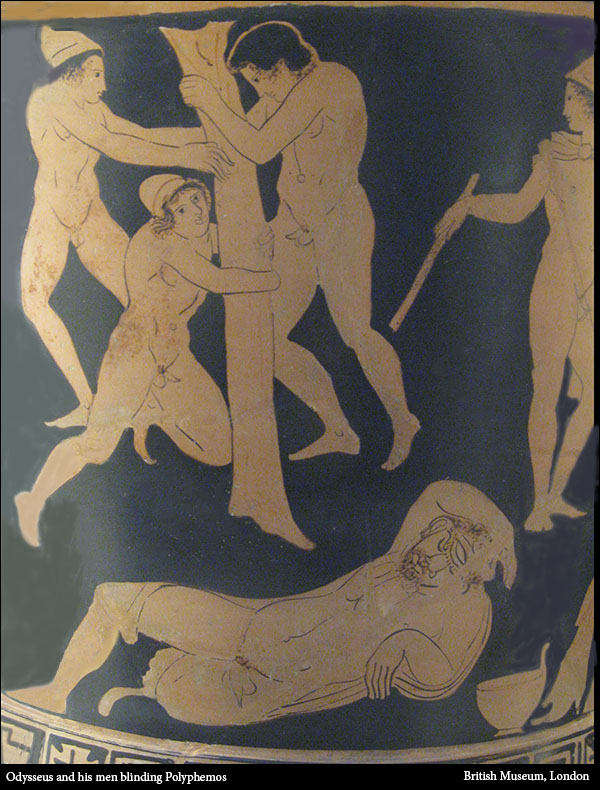
Polyphemos awoke and went about his morning chores ... when he finished milking his goats and sheep, he killed and ate two more of Odysseus' men. He then moved the giant stone at the entrance of the cave and went outside to tend his flocks. Polyphemos replaced the stone, trapping Odysseus and the eight surviving men inside the cave. Odysseus began to devise a plan of escape. He took a large tree trunk that was in the cave and sharpened one end and hardened the point with fire. The sailors drew lots ... four men were chosen to help Odysseus wield the tree-sized spear when the proper time came to attack Polyphemos.
Polyphemos returned to the cave and brought his entire flock, males and females, inside for the night. He tended to his milking chores and then effortlessly killed and ate two more sailors. Odysseus boldly filled a bowl with the potent wine he had brought along ... he offered the wine to Polyphemos. The Cyclops took the wine and drank it down. The wine had been a gift to Odysseus and was so strong it had to be watered down with twenty portions of water in order to make it suitable for any civilized man to drink. Polyphemos explained that Cyclopes made wine but the wine Odysseus had given him was surely made where nectar and ambrosia flow in abundance. He asked for more wine and after three bowls, tried to engage Odysseus in conversation. He asked Odysseus what his name was and promised to give him a guest-gift in exchange for the wine. Odysseus cleverly said his name was Nobody (Οὔτις). Polyphemos said he would eat Nobody after he had eaten the other men and that would be his guest-gift.
Polyphemos passed out from the wine and vomited bile and meat on the cave floor. Odysseus and his men heated the point of the tree they had sharpened in the fire and poised it in front of Polyphemos' eye. As the men pushed the searing point of the tree into Polyphemos' eye, Odysseus used his weight to spin the giant spear so it would penetrate as deeply as possible. Polyphemos awoke with a scream and pulled the deeply imbedded point from his ruined eye. His cries drew the attention of the neighboring Cyclopes and they converged at the cave entrance and asked why Polyphemos was screaming in the night. "Nobody is trying to kill me," Polyphemos answered. The other Cyclopes returned to their homes thinking that Polyphemos was suffering from madness. They urged him to call upon his father Poseidon for help.
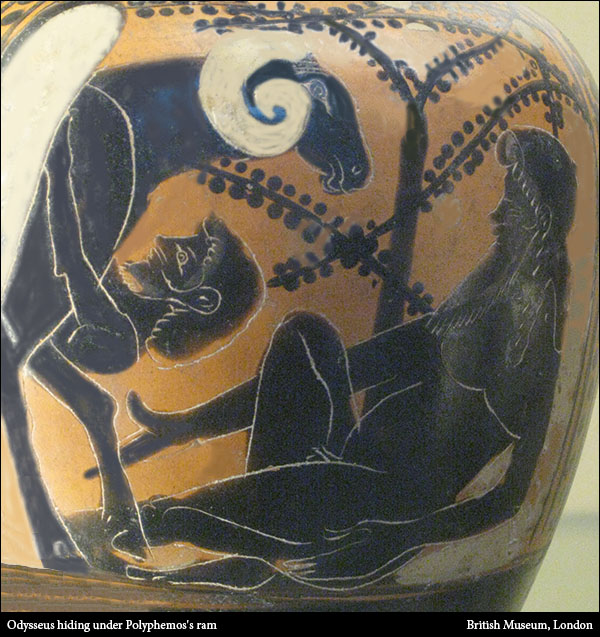
Odysseus instructed the six remaining men tie three rams abreast and then strapped each man to the belly of the center animal. He chose the largest ram in the flock for himself and hid beneath it in a similar manner. When dawn arrived, Polyphemos opened the cave entrance and carefully felt the backs of all the sheep as they went outside. The men under the tethered sheep were safely outside when the ram carrying Odysseus came to the entrance. Polyphemos recognized the ram by its thick, luxurious fleece and wondered why the noble beast was the last to leave the cave. Polyphemos assumed the ram was mourning the injury to its master's eye ... he assured the ram that he was going to kill and eat Nobody for the foul deed.
Safely outside the cave, Odysseus untied the other men and proceeded to drive Polyphemos' flocks to the ships. Odysseus signaled the men to quietly load the animals onboard so Polyphemos and the other Cyclopes would not hear them. When the ships were a little distance from the shore, Odysseus could not contain his pride and anger, he called out to Polyphemos and said the wrath of the gods had been justly administered and that good men had been the instrument of divine retribution. Polyphemos lifted a stone the size of a mountain peak and blindly threw it at the ships. The stone grazed Odysseus' ship and the wave it created pushed it back to the shore. The men rowed frantically to get the ship back to the open water before Polyphemos could hurl another bolder. When they were twice the previous distance from the shore, Odysseus again wanted to taunt the blinded Cyclops. The other sailors tried to restrain Odysseus but his proud heart would not be silent. He shouted to Polyphemos that he was Odysseus, the sacker of cities from the island of Ithaka, and that he should have killed the evil Cyclops instead of just blinding him.
Hearing Odysseus' name, Polyphemos realized that his blinding had been foretold by a prophet. He had always been on the lookout for a man named Odysseus, but he had been tricked by clever words and missed the prophetic signs. Polyphemos raised his arms to heaven and called upon his father to bring down vengeance on Odysseus, kill all his men, bring turmoil to his household and delay his homecoming for many years. Poseidon heard his son's plea and made it all come to pass.
Rounding the Cape of Malea at the eastern tip of the Peloponnesian Peninsula, Odysseus' small fleet was blasted by Boreas (North Wind). The gale winds drove the ships past the island of Kythera and continued to push them off course for nine days. On the tenth day they landed on the island of the Lotus Eaters.
Thankful to find an island with food and water, the crew gathered provisions for their continued voyage. Odysseus thought it prudent to send three men to explore the island. One of the men was a herald ... it was his task to make contact with the natives and announce the presence of peaceful visitors to the island. The Lotus Eaters were not dangerous in the usual sense because they ingested an addictive lotus plant that made them lethargic and simpleminded. The men of Odysseus' scouting party mingled with the Lotus Eaters and were offered the honey-sweet fruit of the lotus. The men quickly became forgetful of their mission and did not return to the ships.
Odysseus searched the island and found his men in a state of lotus-induced bliss ... he was forced to drag the weeping men back to the ships where they were tied to the rowing benches to prevent their escape. Odysseus immediately ordered his ships to sea so they could escape the island of the Lotus Eaters.
One of the most important encounters Odysseus had on his journey home from Troy was with the Dread Goddess, Kirke (Circe), the presiding Nymph of the island of Aiaia. The daughter of Helios (Sun) and the Okeanid Perse, Kirke was best known as the mistress of drugs and potions.
Surviving one desperate situation after another, Odysseus and his dispirited crew went ashore on Aiaia hoping to find food and water. Odysseus sent twenty-three men to explore the island. As the men walked from the beach, they could hear sweet singing from Kirke's home in a forest glen. Wild lions and wolves came, wagging their tails, to greet the strangers ... the creatures had been rendered docile by Kirke's concoctions.
The unsuspecting sailors were charmed by Kirke's beauty and haplessly drank the potions she offered as refreshment. As Kirke's vile drugs took effect, she touched each man with her wand ... the once virile men began to change shape and were soon fully transformed into swine. Kirke herded them into pens and tossed pig-food on the ground before them.
Eurylochos was the only man to escape from Kirke without being turned into a swine ... he ran back to the ships and told Odysseus what had happened ... he urged Odysseus to set sail immediately and abandon the other men before they were all bewitched by the Dread Goddess ... his warnings unfortunately took on an air of cowardice ... Odysseus almost killed him for it.
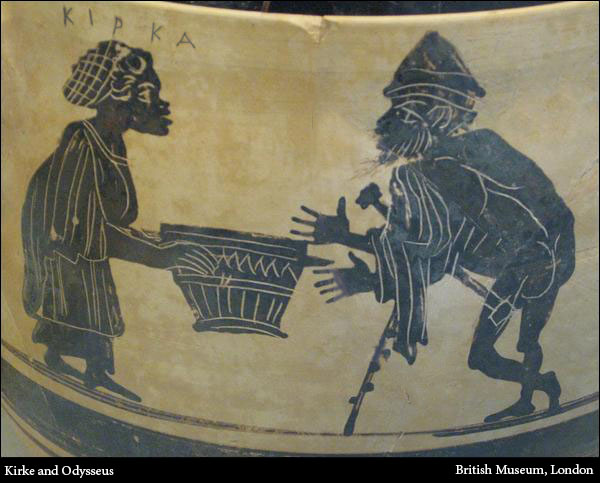
Committed to saving his animalized crewmen, Odysseus decided to go to Kirke's palace alone. Cautiously treading the trail through the forest, Odysseus met the god Hermes in the guise of a young man. Hermes told Odysseus that it would be possible to entrap Kirke and free his companions if he obeyed the god's orders. Hermes reached down and pulled a plant called 'moly' from the ground and explained that mere mortals found it difficult to dig it up but he, as a god, could do all things. Hermes explained that when Kirke offered Odysseus one of her dreadful potions he was to secretly put the 'moly' in the concoction to render it harmless ... to complete the spell, it would be necessary for Kirke to touch Odysseus with her wand ... at that moment, Odysseus was to draw his sword and hold the goddess hostage until she released Odysseus' men from their animal forms. Odysseus took the 'moly' from Hermes and went boldly into Kirke's palace.
Kirke welcomed Odysseus thinking that he was another victim ... she offered him one of her loathsome potions and he took it willingly ... she did not see him put the protective 'moly' into the goblet. When Kirke thought the drugs had taken effect, she tried to strike Odysseus with her wand. The touch of the wand was supposed to complete the animal transformation process but Odysseus drew his sword and sprang upon her before she realized what was happening. The astonished Kirke surrendered instantly. She released the twenty-two pig-men from their cages and ceremoniously anointed them with another of her potions. The men were restored to their human shape but were taller and more handsome than before.
Demonstrating her benevolent and nurturing attributes, Kirke provided the weary sailors with every comfort her divinely built palace could offer. Kirke drew Odysseus aside and secretly told him that his journey would now take him into some very dangerous places. She did not want the other men to know because she did not want them to be afraid of things they could not alter or avoid. Kirke told Odysseus that he would eventually have to go to the entrance of the House of Hades (lord of the dead) and consult with the soul of the blind seer Teiresias the Theban ... only then could he understand how to appease Poseidon and be allowed to return to his home and family.
According to Kirke's instructions, in order to reach the entrance to the Underworld, Odysseus and his crew would be required to sail the treacherous waters between the precincts of the man-eating, six-headed Skylla and the ship-devouring whirlpool Charybdis. She warned Odysseus that he could survive the passage but she also warned him not to be too bold and accept whatever fatalities the two supernatural creatures inflicted on his crew.
Before leaving Aiaia, one of Odysseus' men, Elpenor, was capering on the roof of Kirke's palace and fell to his death. In his haste to leave the island, Odysseus failed to give Elpenor the proper funeral rites. This oversight would require a return to Aiaia.
Skylla and Charybdis lived on opposite sides of the Straits of Messenia between Italy and Sicily. Skylla was a six-headed, snake-like monster that swooped down to snatch sailors from the decks of passing ships. Charybdis was a whirlpool that alternately sucked-down and spewed-out the waters of the straits to destroy passing ships.
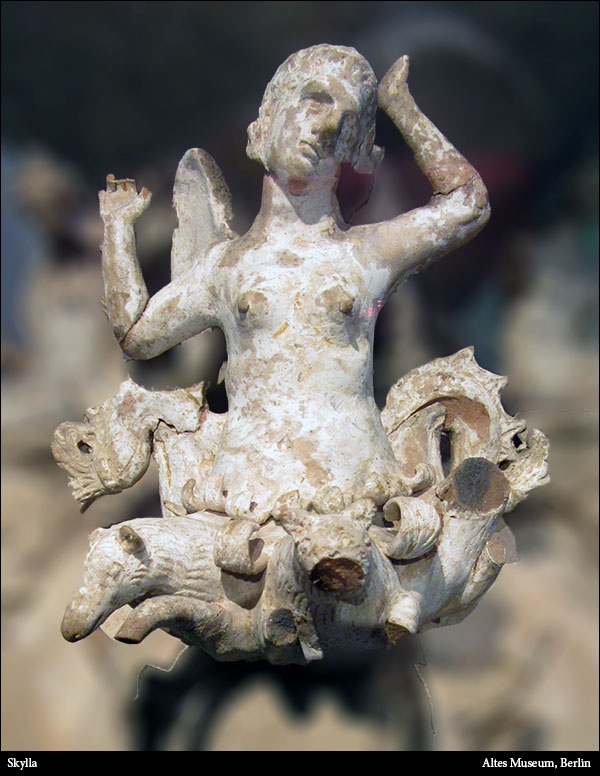
Approaching the precincts of Skylla and Charybdis, Odysseus and his brave crew gave Charybdis a wide berth and sailed near Skylla's rocky abode. Odysseus put on his finest armor and stood on the deck of his ship with two spears at the ready ... he intently scanned the rock-face for any sign of the dreaded beast. Despite his vigilance, Odysseus was still taken by surprise. While Charybdis kept their attention with her gushing and sputtering, Skylla swooped down unseen and snatched up six crewmen. Their legs and torsos were dangling from Skylla's mouths as she lifted them to her cave to eat them. They screamed for Odysseus and begged for help but he stood helpless on the deck with the rest of the terrified crew. Odysseus said it was the most pitiful scene his long-suffering eyes had ever seen. Reluctantly accepting the loss of his crewmembers, Odysseus sailed on to face the next peril.
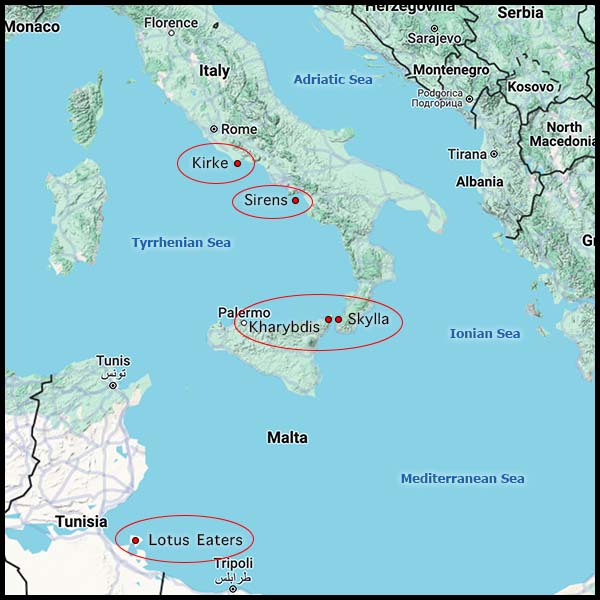
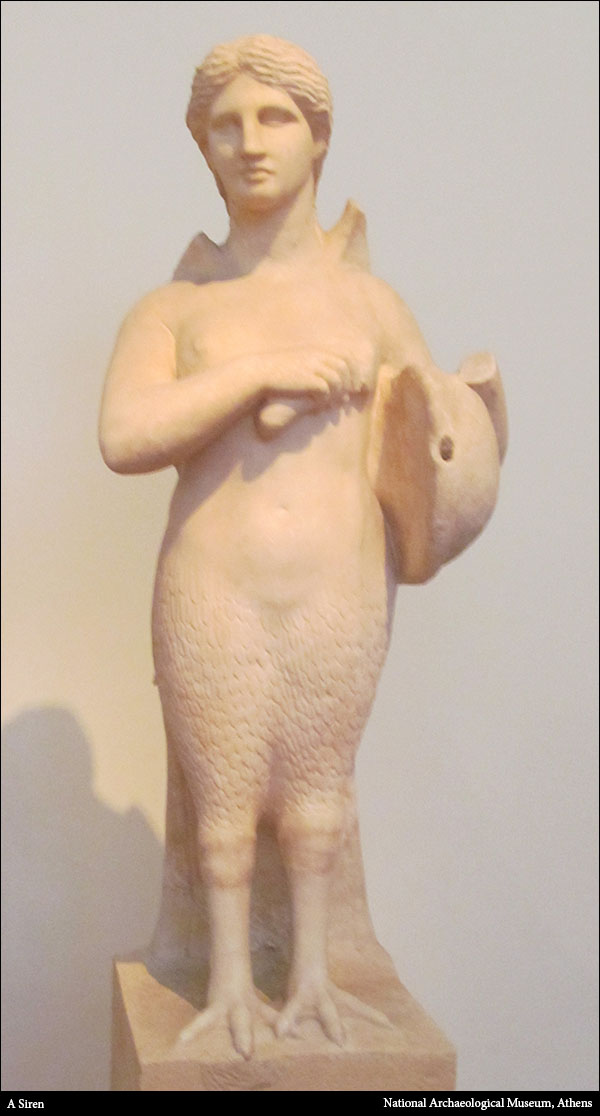
Odysseus could only reach the entrance to the Underworld by sailing past the island (or islands) of the Sirens. Kirke warned him that anyone who heard the song of the Sirens was doomed to sail heedlessly to their death on the rocky beach and mingle their bones with the unfortunate sailors who had proceeded them.
Kirke told Odysseus to put melted wax in the ears of his crew so they could sail past the island of the Sirens and not be lured by their irresistible song. She also told him that if he wished to hear the Sirens, he should not put wax in his ears and have his men tie him to the ship's mast. She said he should instruct his men that no matter how he pleaded, they were not to untie him until the ship was well out of earshot of the Sirens. In this way, Odysseus was able to safely sail past the island of the Sirens and become the only mortal to hear their seductive song and live.
The poet Homer was the first to document the existence of the Sirens in the Odyssey (book 12, lines 36–54). He stated there were two Sirens but did not give their names. Centuries later, the noted author Aristotle told of three Sirens and gave their names as Parthenope, Leikonia (Leiconia), and Ligeia. The name 'Siren' has survived into modern times becoming synonymous with deceitful women or an irresistible summoning. Their name in Greek implies something hot or scorching and is thus associated with the Underworld.
The Sirens were the daughters of the river Acheloios (Acheloius), the son of Okeanos (Ocean) and Tethys. The mother of the Sirens is alternately listed as the Muse Melpomene and Sterope, daughter of Atlas. The Argonautika by Apollonios of Rhodes, named the island of the Sirens Anthemoessa, i.e. Isle of Flowers.
Following Kirke's elaborate directions, Odysseus and the remaining members of his crew reached the entrance to the Underworld. Hades, lord of the dead, and his bride Persephone did not acknowledge Odysseus' presence but surely knew he was there and tolerated his presence.
Odysseus prepared an elaborate blood-sacrifice and waited, fully armed, for the denizens of the House of Hades to show themselves. The first departed soul to approach the pit of blood was Odysseus' crewman, Elpenor. He begged Odysseus to return to Aiaia, burn his body and place his oar over his burial mound. Odysseus promised to do so.
Elpenor had taken Odysseus by surprise and distracted him from his primary mission ... he needed to speak to the dead prophet Teiresias. Odysseus steeled himself and swore that until Teiresias approached the sacrificial blood, he would rebuff all comers. His resolve was sorely tested when the pitiful 'shade' of his deceased mother Antikleia approached the blood ... he made her retreat.
The disembodied spirit of Teiresias finally appeared out of the gloom. He recognized Odysseus and addressed him by his name and lineage. Teiresias asked Odysseus to sheath his sword and move away from the pit of sacrificial blood. Odysseus withdrew and waited as Teiresias hungrily drank his fill of blood.
Teiresias was willing to help Odysseus but warned that the success of his voyage home would be decided on the island Thrinakia, the sacred island of the god Helios. If Odysseus and his shipmates could endure their hunger and not kill the herds Helios kept on the island, they would live to see their homes. If, however, any of Helios' animals were killed, death would overtake all the guilty men.
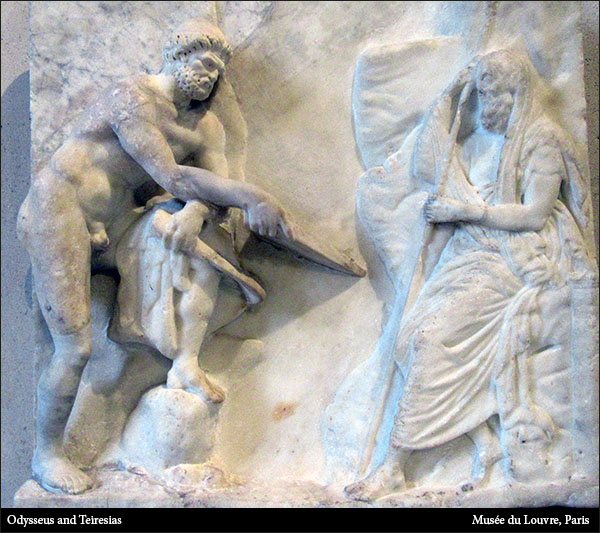
Teiresias said Odysseus would encounter his final obstacle when he returned to his home and found his palace invaded by men trying to take his wife and wealth. If Odysseus prevailed, he would live the rest of his life with nobility and die with dignity.
Antikleia had been waiting near the blood pit but didn't drink any blood until Teiresias receded back into the gloom. Sated with blood, she was able to converse with Odysseus. She told him that his wife Penelope, his son Telemachos, and his father Laertes were alive and awaiting his return. When Odysseus asked why she died, she said she died of grief because he had not returned from Troy.
Odysseus also met the disembodied spirit of Herakles ... the 'real' Herakles was of course with the other Immortals on Mount Olympos. Herakles and Odysseus shared the distinction of going to the House of Hades alive and then returning to the land of the living.
One recurring theme in the Iliad and the Odyssey is the armor of Achilles ... divine armor forged by the god Hephaistos and stained with the blood of countless heroes. Achilles died at Troy wearing the god-made armor, prompting a furious fight with the Trojans for possession of Achilles' body. Odysseus and Telamonian Aias played a crucial role in that fight. After they retrieved Achilles' body, Aias thought he deserved the armor, but it was awarded to Odysseus, either by drawing lots or by a consensus of the Achaian soldiers. Odysseus saw the shade of Aias in the Underworld but Aias refused to acknowledge Odysseus' presence because he was still angry about not getting Achilles' armor.
Odysseus saw a variety of departed souls and engaged several of them in conversation ... kings, queens, maidens, soldiers ... respected and disgraced.
Tyro—Odysseus spoke to Tyro, daughter of Salmoneus, when she came to drink the blood of the sacrificial animals. She had been the wife of Cretheus, son of Aeolus, but fell in love with the river-god Enipeus. Poseidon, lord of the sea, disguised himself as Enipeus and made love to Tyro while concealing them behind a mountainous dark wave. Tyro conceived two sons by Poseidon—Neleus and Pelias. To her husband Cretheus she bore Aeson, and Pheres, and Amythaon.
Antiope—Addressing Odysseus, Antiope, daughter of Asopus, boasted she had been the lover of Zeus, with whom she bore Amphion and Zethus, the extraordinary demigods who built the walls of Thebes in Boeotia.
Alkmene—Odysseus saw, but did not speak, to Alkmene, wife of Amphitryon. Zeus took the guise of Amphitryon and made love to Alkmene and she bore Herakles as a result of that union.
Megara—Odysseus saw Megara, daughter of Kreon. She was the was married to Herakles. Odysseus does not mention that Herakles murdered the children he had with Megara.
Epicaste—Odysseus saw the ill-fated Epicaste, wife and mother of King Oedipus of Thebes in Boeotia. Not realizing husband had been killed by her exiled son Oedipus, Epicaste married Oedipus and had four children. Discovering her unforgivable transgression, Epicaste hanged herself and went to the House of Hades in disgrace.
Chloris—Odysseus knew Chloris' son Nester because they both had gone to Troy with Agamemnon. Chloris was the youngest daughter of Amphion, son of Iasus, who once ruled Orchomenus of the Minyae. Married to King Neleus of Pylos, Chloris was the mother of three sons, Nestor, Chromius, Periclymenus. She and Neleus had one daughter, Pero.
Leda—Odysseus saw Leda, the wife of King Tyndareus of Sparta. Leda was the mother of Helen, Klytemnestra and Timandra but Odysseus only mentioned Leto's sons Kastor and Polydeukes because they were favored by Zeus and, although dead, allowed to take turns on the surface of the earth and in the House of Hades.
Iphimedeia—Odysseus encountered the shade of Iphimedeia, the deceased wife of Aloeus. She had been the consort of Poseidon, lord of the sea, and bore him two magnificent sons, Otos and Ephialtes. Second only to Orion, Otos and Ephialtes were the largest and most handsome men to ever walk the earth. Both boys were killed by Apollon when they tried to scale Mount Olympos by piling Mount Pelion atop Mount Ossa.
Odysseus also saw Phaedra, Procris, Maera, Clymene, hateful Eriphyle and beautiful Ariadne, daughter of King Minos of Krete.
Odysseus managed to sustain his bravery until he sensed the presence of Persephone scattering the anxious souls ... he lost his resolve and hastily retreated before the dreaded queen of the dead could materialize and seize him.
True to his word, upon returning to Kirke's island, Odysseus retrieved the body of Elpenor and gave the fallen crewman a proper burial.
We are not told how long Odysseus lingered on Kirke's islands but he was there long enough to foster three sons—Agrios, Latinos, and Telegonos. Kirke's Naiad handmaidens cared for Odysseus' men and provided for their every need while they stayed on Aiaia.
When it came time to leave, Kirke drew Odysseus aside and repeated the stern warning Teiresias gave Odysseus at the entrance to the Underworld ... he should avoid the island of Thrinakia because it was sacred to Helios (Sun) ... she told him great danger awaited anyone who landed on Helios' island but she knew her warning was in vain ... Odysseus' hardships and sorrows were far from over ... knowing his sad fate, Kirke simply gave him a favorable wind and sent him on his way.
The island of Thrinakia is sacred to Helios because he keeps his herds of cattle and fat sheep there ... the sacred beasts are not for human consumption.
Odysseus tried to obey Kirke's warning about avoiding Thrinakia but unfavorable winds forced his ships ashore. Odysseus warned his crew that under no circumstances were they to kill any of the sheep or cattle on the island ... he carefully explained that the animals were the property of Helios and if they incurred the wrath of Helios as well as Poseidon's, they would never be able to return to their homes.
Helios had placed the Nymphs Lampetia and Phaethousa on Thrinakia to guard his herds ... they were the daughters of the Nymph Neaira and Hyperion and therefore step-sisters of Helios. They saw the sailors arrive and watched them closely.
Odysseus and his crewmen waited patiently for the winds to become favorable so they could sail on their way but the winds would not allow it. As the days wore on, patience grew thin as hunger made the men more and more irritable. One crewmember in particular was outspoken and belligerent towards Odysseus and his seemingly callous injunction against eating the abundant animals all around the ships. Eurylochos, the same man Odysseus nearly killed for his cowardly behavior on Kirke's island, goaded the men into killing some of the animals in Helios' herd ... the sacrilege was justified by promises to build a temple for Helios when they returned to Ithaka.
Their promises would never be fulfilled. Lampetia and Phaethousa were quick to inform Helios that his sacred herds had been defiled ... the punishment for such an act was, and still is, death. Since Odysseus did not participate in the sacrilege, his life was spared ... all the rest died.
Kalypso (She Who Conceals) is a Nymph who lives on the island of Ogygia. By the time Odysseus reached Ogygia he had lost his ships and all his companions had been killed.
Odysseus was utterly without hope when Kalypso found him washed ashore on her island. His rugged good looks and noble character soon affected the lonely goddess and she fell in love. Odysseus stayed with Kalypso for seven years, but they were long, sad years for Odysseus. He resigned himself to the fact that there was no escape from the island, but he still constantly longed for his wife and son. Kalypso offered Odysseus immortality and eternal youth if he would stay with her but he refused ... he wanted to go home.
During their time together, Kalypso and Odysseus had two sons—Nausithoos and Nausinoos. Perhaps they had a third son named Telegonos but he might have been the son of Kirke and not Kalypso.
Just as Poseidon was determined to punish Odysseus, the goddess Athene was always looking for ways to help the intrepid hero. When she reminded Zeus that Odysseus had been on Ogygia for seven years, Zeus sent Hermes with a message for Kalypso ... she was to allow Odysseus to leave ... furthermore, she was to give him the assistance he needed to build a seaworthy craft.
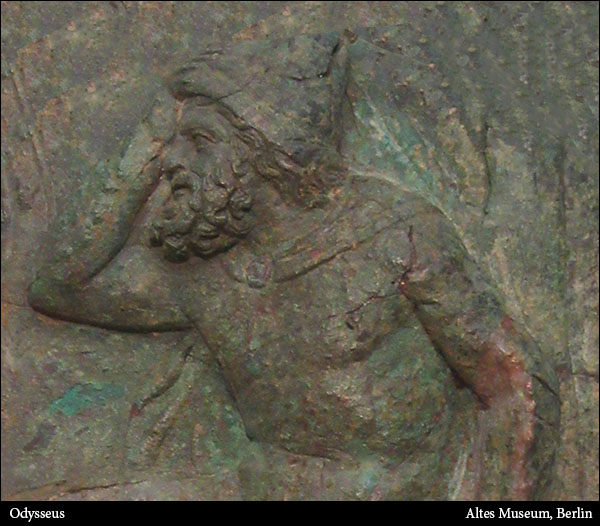
Hermes arrived on Kalypso's island and was given a warm welcome ... he and Kalypso drank nectar and ate ambrosia. Finally, he told her of his mission and gave her Zeus' command. At first Kalypso was indignant ... she reminded Hermes of the many gods and goddesses who had taken mortal lovers and wondered why she could not keep Odysseus. Hermes told her that Zeus was adamant ... she must help Odysseus leave Ogygia and she was not permitted to use her charms to detain him.
Kalypso accepted her fate and agreed to let Odysseus leave unhindered. Odysseus was a cautious man because he had endured so much trickery at the hands of the Immortals ... he did not believe Kalypso would actually help him. To insure her sincerity, Odysseus made Kalypso swear a great oath on the waters of Styx that she meant what she said and was not trying to deceive him. Styx was called the Oath River because swearing on her waters was the most binding oath an Immortal could make. Kalypso swore the oath and gave Odysseus the tools he needed to build a seaworthy raft. When it came time for him to leave Kalypso, true to her loving nature, gave Odysseus provisions and sent him on his way with a fair wind to speed him home.
After leaving Kalypso and her island, Odysseus relied on the wind to guide him in the right direction but when Poseidon realized that Odysseus was on the open sea again, he struck the waters with his trident and whipped the wind into a gale. Odysseus' small raft was battered and splintered until he had only a few timbers to keep him afloat.
As Odysseus floundered in the raging sea, the goddess Leukothea saw his plight and took mercy on him. In the form of a gannet, Leukothea rose from the sea and perched on the wood shards on which Odysseus was clinging and spoke to him. Odysseus listened to the immortal seabird without responding. Leukothea told Odysseus that although Poseidon had given him a harvest of evils, he was destined to survive. She told him to abandon the remnants of his raft, shed his soggy clothing and swim for the island of the Phaiakians. She then offered Odysseus her veil and told him to tie it around his chest ... she assured him that the veil would keep him afloat until he reached the safety of the shore. Leukothea told him that when he reached the island, he was to untie the veil and throw it back into the sea but to turn his face away as he did so. Having spoken, Leukothea plunged back into the heaving sea.
Odysseus decided to stay with the remnants of his raft for as long as possible because the island Leukothea mentioned was still very far away. Regardless, Poseidon drove a crashing wave against Odysseus and the remaining pieces of the raft were torn apart. Odysseus was left with one beam, which he mounted as if he were riding a horse. He stripped off his clothing and tied the veil Leukothea had given him around his chest. He plunged into the water and started swimming as hard as he could for the distant island.
Poseidon saw Odysseus in the water and was pleased with himself. He whipped his steeds into action and left Odysseus to suffer. After Poseidon departed, Athene quieted the storm-winds and sent them to sleep, except for Boreas (North Wind) which pushed Odysseus towards the distant island of the Phaiakians. At dawn of the third day, Odysseus was very close to the island, which was called Scheria. As Odysseus got nearer, the island appeared to be surrounded by cliffs with jagged rocks protruding into the violent surf. The water near the cliff-face was very deep and at one point Odysseus was thrown high up against the rocks. Athene again saved Odysseus by putting a thought in his mind. Guided by Athene's "inkling," Odysseus grabbed the rock-face as he was slammed against it and was left clinging to the rocks when the wave receded. The next wave tore him from the rocks and swept him back out beyond the breakers. He began to swim around the island until he finally came to the mouth of a sweet-running river.
Although he did not know the name of the river, Odysseus addressed the god of the river and asked for mercy. The river heard Odysseus' prayer and stayed his currents, stopped the waves from breaking and allowed Odysseus to get safely into the outlet of the river. After Odysseus was able to rest and get his breath, he unfastened the veil Leukothea had given him and threw it into the current where a great wave carried it into Leukothea's hand. Odysseus was exhausted but still cautious. Not wanting to go too far into the forest, he crawled into some dense underbrush near the river and covered himself with leaves. Athene shed sleep on his tired eyes and he slept.
Athene still had work to do before Odysseus could return to his home on Ithaka. Odysseus had no knowledge of the Phaiakians but having come ashore on their island, he was destined to receive their assistance. Athene did not want to make her presence known to Odysseus or the Phaiakians so she took the guise of a young Phaiakian girl and entered the dreams of the daughter of the king and queen of the Phaiakians, Princess Nausikaa.
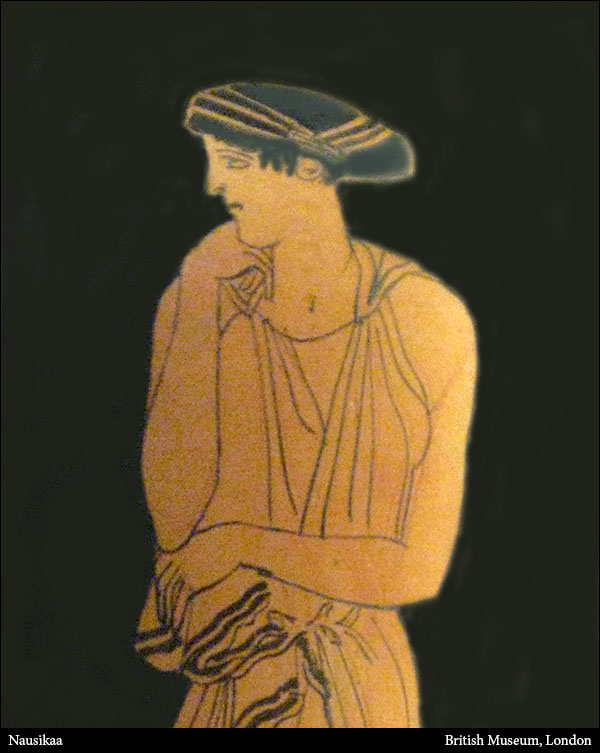
Nausikaa slept in an elaborate bedchamber with four handmaidens nearby. Athene came into the room like a breath of air and stood above Nausikaa's head. The goddess gave Nausikaa a divine dream where she likened herself to a girl named Dymas because she was Nausikaa's friend and of the same age.
In the dream, Dymas (Athene) scolded Nausikaa for being heedless of her parents. Dymas reminded Nausikaa that she was of marrying age, and yet her beautiful garments were unwashed. Dymas urged the sleeping girl to rise at the break of day and go to the river to wash her clothes.
The following morning, Nausikaa greeted her father King Alkinoos and asked for a wagon and mules so she could go to the river and wash her clothes. She also promised to wash the clothes of her three unwed brothers so they would look their best when they attended the dance. King Alkinoos agreed because he understood his daughter's unspoken desire to make herself attractive so she could impress an eligible suitor.
King Alkinoos ordered his slaves to prepare a sturdy wagon with a box on the back for the clothing. Queen Arete gave Nausikaa food and wine as well as olive oil so Nausikaa and her handmaidens could bathe while they were at the river. Nausikaa took the reins, struck the mules with the whip and with the handmaidens following the wagon, led the way.
When the girls arrived at the river, they unhitched the mules and set about washing the clothing. After laying the clothes out to dry and eating their meal, the young girls played ball. Looking as graceful as the goddess Artemis or a wood Nymph, Nausikaa lead the girls in song.
Athene had arranged for Nausikaa to be at the river at precisely that time so the laughter of the playful girls would awaken Odysseus. He thought he heard the voices of Nymphs but still fearing that he might be in a lawless land, emerged from the underbrush like a lion, with only a twig of leaves covering his nakedness.
Odysseus looked so wild and filthy the handmaidens fled in terror. Athene put courage in Nausikaa's heart. She stood where she was and allowed Odysseus to approach her. He did not kneel before her but was awed by her beauty and wondered if she was a mortal girl or a goddess ... she resembled the goddess Artemis in stature and form. Seeing the kindness in her eyes, Odysseus told Nausikaa of his journeys and the troubles he had endured on his quest for his home. Listening to him speak, Nausikaa correctly judged Odysseus not to be a bad man or lacking in understanding the ways of the gods and men.
Nausikaa called to her handmaidens and reminded them that the Phaiakians were dear to the Immortals and no one had ever been allowed to come to their island with hostility. She instructed them to bathe Odysseus in a sheltered part of the river but due to his modesty, Odysseus insisted that he wash himself. The handmaidens left him a cloak and tunic, and olive oil to anoint his weathered body.
When Odysseus finished bathing, Athene made him appear taller and stronger. She made his hair flow with curls and shed grace upon his head and shoulders. Nausikaa saw how magnificent Odysseus looked and secretly told her handmaidens that this noble stranger had come to them by the will of the Immortals, perhaps even to become her husband.
After Odysseus had eaten his fill, Nausikaa told him to accompany her back to the city and to the palace of her father. She instructed Odysseus to follow behind the wagon until they reached the city wall but that he should not accompany her into the city, otherwise the commoners might see the strange man and say rude, offensive things about her. She told Odysseus to turn aside at the city wall and wait in the Grove of Athene until she had time to reach her father's palace. She told Odysseus he would have no trouble finding Alkinoos' palace but warned him not to go directly to her father when he entered. Nausikaa told Odysseus that her mother, Queen Arete, would be sitting at the hearth in the Great Hall and he should go directly to her and clasp her knees. By gaining the favor of the queen, Nausikaa assured Odysseus he would be given any assistance he needed.
Odysseus was feeling better than he had felt in many days. He followed behind Nausikaa as she drove the wagon towards the city and turned aside when they reached the Grove of Athene. Once inside the sacred precinct, Odysseus prayed to Athene as Atrytone, child of Zeus of the aegis, because he knew who his protector had been. The goddess was pleased with Odysseus but still did not want to reveal herself because she did not want to rekindle the wrath of Poseidon against Odysseus. When Odysseus left the sacred grove and ventured into the city, Athene put a mist around him so the Phaiakians could not see him.
Entering the city, Odysseus encountered a young maiden carrying a pitcher and began to question her. The young maiden was Athene in disguise. She called him father and cautioned him against making eye contact with the Phaiakians they passed or questioning them, knowing full well that the mist prevented them from seeing him. Athene, as the young maiden, told Odysseus of the heritage of the Phaiakians and particularly of Queen Arete. She said the queen was held in high regard and settled disputes even among the men of the island. She told Odysseus to be bold when he entered the palace and to seek out Queen Arete for assistance.
When Odysseus entered the palace he was still shrouded in mist. He walked past the Phaiakian men in their council and went directly to Queen Arete. Athene dissolved the mist and everyone was astounded to see the strange man kneeling before the queen. Odysseus praised the queen's heritage and begged her to grant him conveyance to his home. Having said his piece, Odysseus sat humbly in the ashes of the fireplace.
Queen Arete and King Alkinoos welcomed Odysseus and arranged for a celebration to be held in his honor. Athene assumed the guise of King Alkinoos' herald and went through the city encouraging everyone to attend. Odysseus wept when he heard songs about the Trojan War because he remembered his companions and friends who went to the war but never returned. Athene induced the Phaiakian men to bestow gifts on Odysseus and make preparations for a ship to carry him to Ithaka.
As Odysseus was making his final preparations to leave Scheria, Nausikaa approached him and reminded him that she had saved his life and hoped he would remember her with gratitude. Odysseus replied that he would always pray to her as a god because she had given him life.
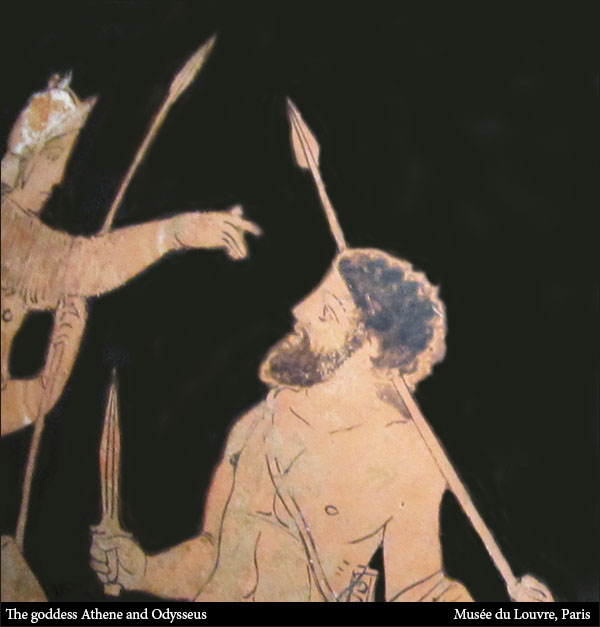
The Phaiakian ship was fast as thought and sailed directly to Ithaka. Odysseus was asleep when they arrived so the Phaiakian sailors left him on the beach with the many gifts King Alkinoos and the other Phaiakians had given him. When Odysseus awoke he was somewhat dazed but the goddess Athene assured him that he was indeed home. He hid the Phaiakian gifts in a nearby cave of the Nymphs and walked towards the settlements of the island. Athene disguised Odysseus as an old and tattered man so he could travel and observe without being recognized.
It had been twenty long years since Odysseus left Ithaka and he had no idea what to expect when he finally saw his wife Penelope and his son Telemachos again. Telemachos had been an infant when he left and Odysseus did not know if the boy was still alive or if his wife had remarried. Odysseus had suffered so many disappointments he was prepared for anything but just being on his home soil again gave him boundless hope.
The first person Odysseus encountered was his swineherd, Eumaios. The kindly old man invited the disguised Odysseus to eat and rest in the manner suitable for greeting strangers and guests. Odysseus was pleased to hear Eumaios speak of his long absent master with respect and longing. He told Odysseus that Penelope was still unmarried and Telemachos was a fine young man. He also told Odysseus about the indulgent and overbearing suitors who had moved into Odysseus' home and were squandering his possessions. It was obvious that the suitors were only interested in getting Odysseus' property, and marrying Penelope was simply a means of attaining those riches.
Homer only named a few of the suitors but was specific as to the number of suitors and their origins. There were 52 suitors from Douiklion (Douichion) with 6 serving men; 24 suitors from Samos; 20 suitors from Zakynthus (Zacynthus); and 12 from Ithika (Ithaca) with 2 attendants. Five hundred years after Homer, Apollodorus of Athens numbered and named the suitors with variations to Homer's account.
Telemachos arrived at the humble home of Eumaios and Odysseus (still in disguise) tested him as to his character and intentions. When it became clear that Telemachos and Eumaios were faithful to Odysseus, Athene lifted the disguise and the three men shed tears of happiness and started making plans as to how to deal with the insufferable suitors.
Back in his disguise, Odysseus made his way to his home and mingled with the suitors. They treated him with disdain but Telemachos insisted that the tattered old man be treated with respect. Ignoring Telemachos' demands, the suitors pitted a beggar man named Iros against Odysseus but Odysseus gave Iros a sound beating at tossed him out the door.
When Penelope heard that the old man in her halls might have news of Odysseus, she insisted on speaking with him. Odysseus did not reveal himself to Penelope but after speaking with her, realized she still loved him and was sincerely longing for his safe return. She had tricked the suitors by saying she would not decide on a new husband until she finished weaving a burial shroud for Odysseus' aged father, Laertes. She would weave the shroud during the day and then undo part of it each evening thus delaying its completion.
Betrayed by one of her servants, the suitors discovered Penelope's deception and demanded that she immediately choose one of them to become her husband. They also plotted to kill Telemachos so Odysseus' fortunes would not have to be shared after the wedding.
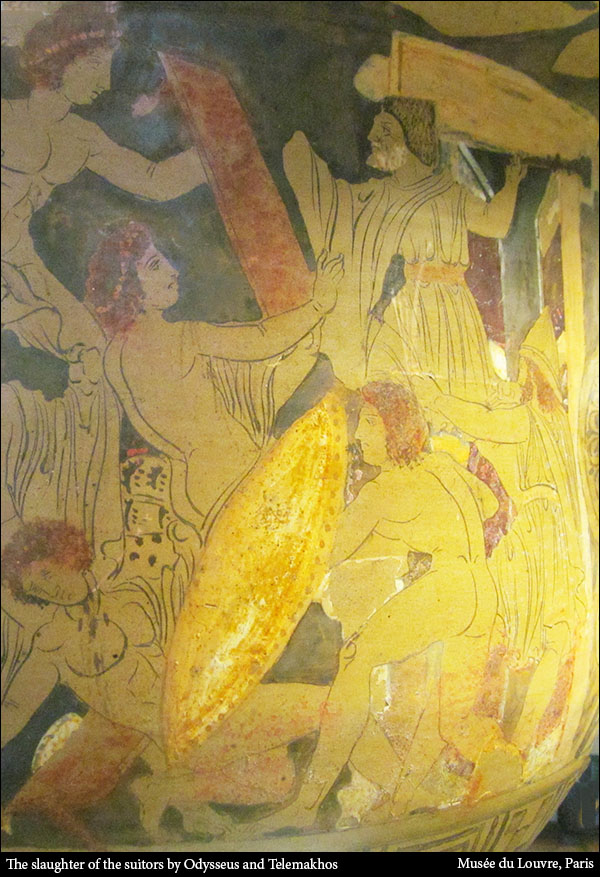
Odysseus had seen enough. He confided in two herdsman who remained faithful to him and devised a plan of attack against the suitors. At Odysseus' prompting, Telemachos had all weapons removed from the Great Hall and invited the suitors to test Odysseus' bow. Telemachos implied that any man who could string the bow and prove his archery skills would be worthy of marrying his mother. After several of the strongest suitors failed to string the bow, Telemachos gave it to Odysseus, who was still disguised as a beggar. He easily strung his bow and turned it on the suitors. The doors of the Great Halls slammed shut and Athene stripped off the disguise from Odysseus. He charged into the astonished suitors like a raging bull.
A herdsman who despised Odysseus retrieved some of the weapons Telemachos had hidden and gave them to the suitors. They banded together and launched their spears at Odysseus and Telemachos in unison. Athene, who had ascended to the rafters to observe the carnage, brushed the spears aside allowing only minor injuries. After the suitors were all dead, a minstrel and a herald remained alive. They begged Odysseus to spare their lives. Odysseus was sympathetic to the minstrel because he was beloved by the Muses. The herald was spared so he could tell the relatives of the suitors of their deserved fate.
Odysseus sent for an older slave woman who had served Odysseus' father King Laertes and had remained faithful to Odysseus' wife Penelope. She told Odysseus that of the fifty household slave girls, only a dozen had consorted with the suitors. Odysseus made the unfaithful slave girls drag the dead bodies from the Great Hall and then clean the blood from the furniture and floors. At Odysseus' bidding, Telemachos took the slave girls into the court yard and dangled them from taught ropes until they slowly died. The herdsman who had assisted the suitors in the final battle was mutilated and finally killed.
Odysseus, Telemachos and the loyal herdsmen retreated to Laertes' country home and awaited the inevitable arrival of the outraged relatives of the dead suitors. The angry mob also blamed Odysseus for the deaths of the men who were killed on their journey home after miraculously surviving the Trojan War.
The sons and husband of Laertes' housekeeper armed themselves and stood ready to fight alongside Odysseus. Athene infused Laertes with strength and valor as he donned his long neglected armor. As the angry mob advanced on the small group of defenders, Odysseus and Laertes threw their spears and killed several men in the mob. Zeus resounded from the heavens and Athene stepped forth to stand between the combatants. The mob accepted the divine judgment and wisely retreated.
After ten years of fighting at Troy and an additional ten years of valiantly struggling to overcome Poseidon's wrath, Odysseus finally regained his family and kingship.
The Iliad
The Odyssey
Theogony
Kypria
Little Iliad
Sack of Ilion
Returns
Telegony
Contest of Homer and Hesiod
Library of History by Diodorus of Sicily
Description of Greece by Pausanias
Apollodorus Library