
| The Lovable Monster |
| Egyptian Pan |
| Pan and Nymphs |
| Sacred Places |
| Encounters With Pan |
| Pan Lyterios |
| Bibliography |
| Previous Page |
| Homepage |
| Site Search |
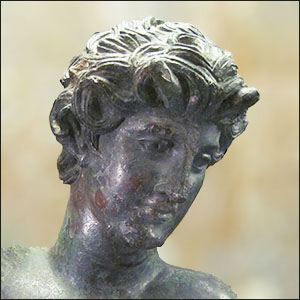
The birth of Pan was somewhat mysterious ... he was the son of the god Hermes and an unnamed mortal woman but Pan's countenance was not godlike or human.
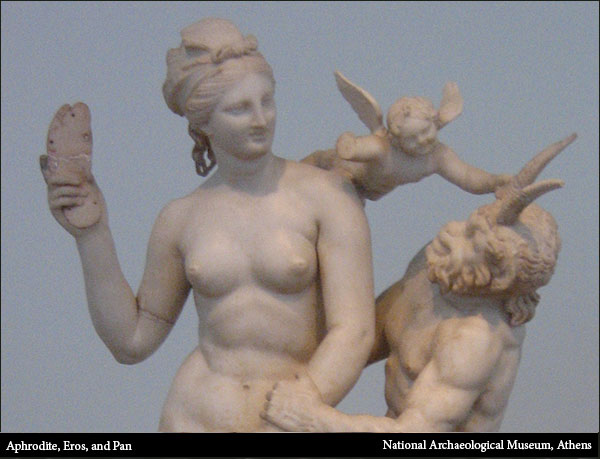
While the messenger god Hermes was tending the flocks of a man named Dryops, he fell in love with Dryops's daughter. Hermes seduced the young woman and Pan was born ... Pan had goat ears, horns on his head and goat-hooves for feet. When the young mother and the attending nurse saw the infant, they fled in fear but Hermes was proud of his new son.
Hermes wrapped the baby in the warm skins of mountain hares and showed him to Zeus and the other the Immortals. The gods and goddesses were delighted with the strange child ... especially Zeus's son, Dionysos. The name Pan, which literally means All, was appropriate because the Immortals all adored him.
When the war with the Titans erupted, Pan fought alongside Zeus because he was so appreciative of the kindly reception he received from Zeus and the Immortals of Mount Olympos.
The Egyptians knew Pan as Mendes and considered him to be one of the original eight gods. In the Egyptian pantheon, eight gods preceded the second ranked twelve gods (such as Herakles) who in turn preceded the third ranked gods (such as Dionysos). In other words, the Egyptians considered Pan to be a very ancient god.
The historian Herodotos made an important point when he said there must have been a very ancient god named Pan and then several extraordinary mortal men who were also named Pan. Because of the antiquity of the immortal Pan, we know nothing of his youth or early travels. The antiquity of Pan's presence in Egypt is attested to by the fact that he accompanied the god Osiris on his military campaigns ... Osiris was one of the original god-kings of Egypt.
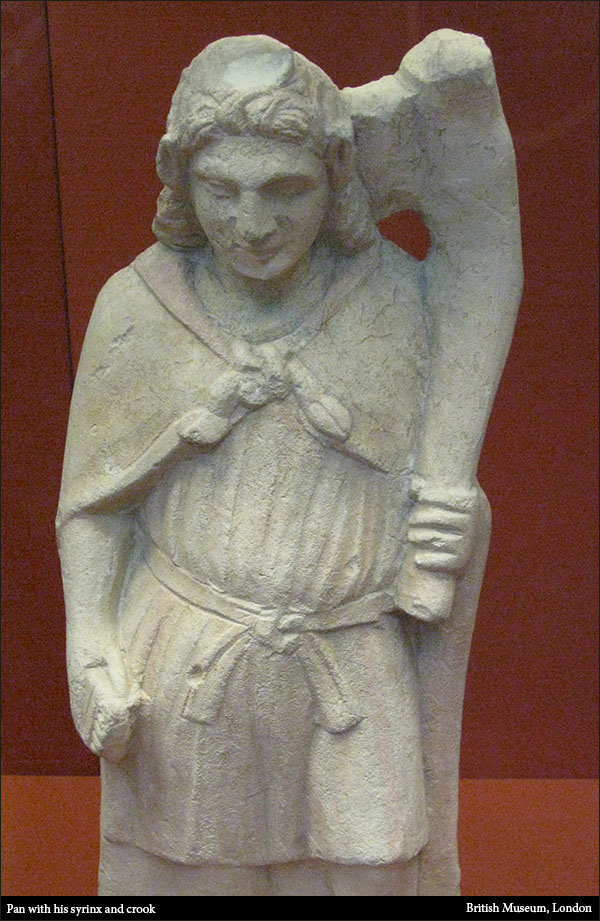
In deference to Pan's divinity, the Egyptians did not sacrifice goats. Furthermore, goat herders had greater social status than other herdsmen. The Egyptian artistic representations of Pan clearly showed him with a goat's face and legs but insisted his actual appearance was otherwise. We are not told how Pan appeared to the Egyptians nor are we given an explanation as to why they would not elaborate on this subject.
The Egyptian city of Khemmo (City of Pan or Panopolis) was dedicated to Pan. The Egyptians had a very high regard for Pan and displayed images of him in most temples ... the images of Pan were worshiped alongside images of Satyrs because both were considered to be figures of unquestioned virility ... Pan was often shown with an erect goat-like phallus.
The Nymphs who cavort with Pan are young beautiful female spirits who personify the natural world. Nymphs can take various forms as they give life and spender to their habitats. The name Nymph literally means Bride ... there are several specific types of Nymphs:
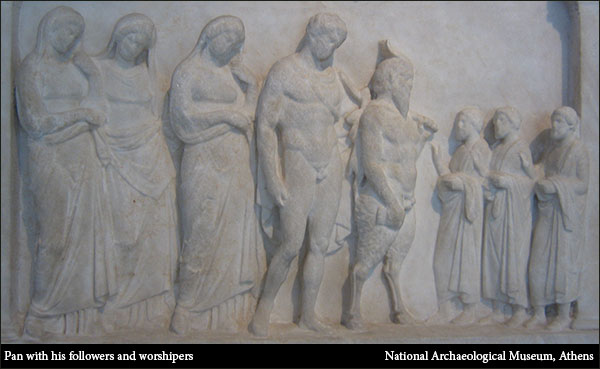
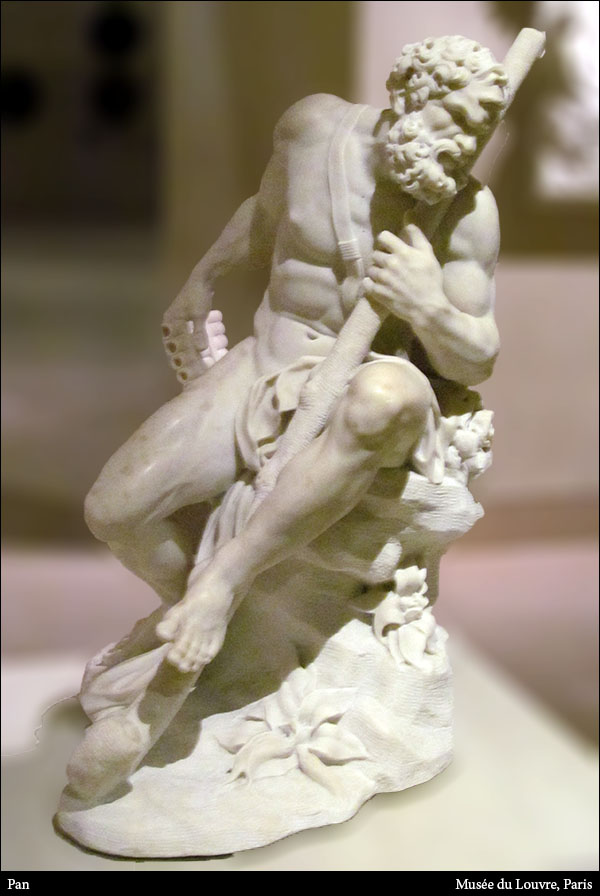
Pan was rarely mentioned in the early myths but later stories recounted his amorous pursuits of the Nymphs Ekho, Syrinx and Pitys. To avoid the unwanted advances of the lusty Pan, the Nymphs were transformed into various forms to escape the relentless Goat-God. Ekho was made invisible and only capable of repeating the last words spoken to her ... Syrinx was turned into a reed from which Pan made a flute, which was named after her (the syrinx is also simply called a pan-pipe) ... Pitys was transformed into a pine tree.
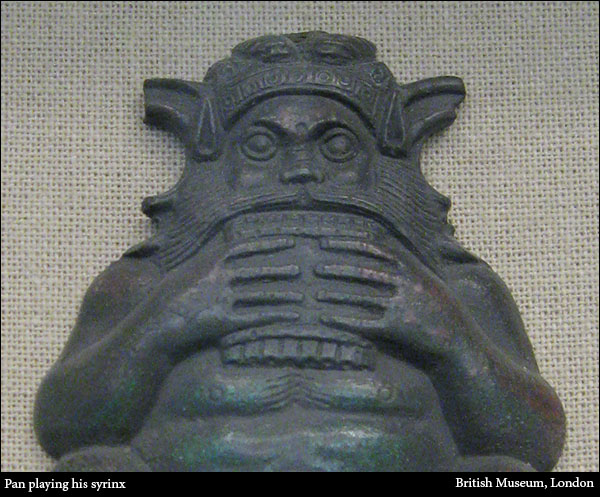
By day Pan hunts and kills predator animals that menace flocks. He then retreats to his lofty mountain abode by night where he plays the syrinx with such skill the tune is more beautiful than the songs of birds ... the mountain Nymphs dance and sing while Pan plays and capers on the rocky crags.
Mount Parnassos is especially sacred to Pan. The proximity of Parnassos to the Oracle of Apollon at Delphi as well as the presence of the Korykian Nymphs makes Parnassos particularly holy. Before they became known as the Korykian Nymphs, the Nymphs of Parnassos would cavort with Pan on the slopes of the mountain. When Apollon arrived to establish the Oracle at Delphi, he took one of the Nymphs as his consort ... her name was Korykia. From that time onward, the Nymphs of Parnassos became known as the Korykian Nymphs.
Pan is worshiped as Nomian Pan in the Nomian Mountains in Arkadia. It is believed that Pan pastured his flocks on the mountainside and first discovered the music of the pipes there. The name Nomian was either taken from the word νομαῑος (nomaios—the cry of a shepherd) or derived from the name of a Nymph native of those mountains.
The Erymanthus River in Arkadia has its source on Mount Lampeia, which is sacred to Pan. Also in Arkadia, Mount Maenalus is especially sacred to Pan because those who dwell around it say they can actually hear him playing his pipes.
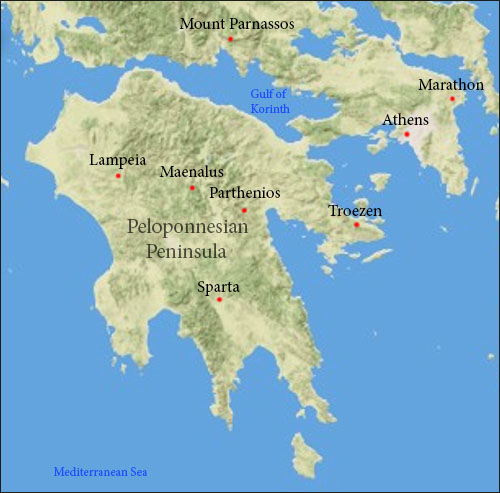
The most important site for the worship on Pan in Arkadia is Mount Parthenios because that was where the Athenian messenger Phidippides encountered Pan before the battle of Marathon.
One of the most notable historical accounts of an encounter with Pan was documented by two historians—Herodotos and Diodorus of Sicily.
In 490 BCE King Darius of Persia was marching his army down the eastern coast of the Greek mainland with the intention of conquering all of Greece. The Athenians were making preparations for the inevitable attack on their city and sent a messenger to Sparta to ask for help. They chose a man named Phidippides to deliver their request to the Spartans because he was a herald as well as a professional runner.
Phidippides ran as far as Mount Parthenios, which is above Tegea, and stopped when he heard someone calling his name ... he was standing face-to-face with Pan. The Goat-God told Phidippides that he had always been well disposed towards the Athenians and had helped them on many occasions and would continue to do so. But Pan was perplexed as to why the Athenians did not venerate him.
The encounter with Pan was significant but Phidippides was on an important mission and had to continue on to Sparta to deliver his message. Phidippides asked the Spartans to join the Athenians in their fight against the Barbarians. The Spartans were sympathetic but they were bound by their laws and could not leave Sparta "until the circle of the moon should be full" ... it was their custom not to go out to fight before the moon was full.
Phidippides returned to Athens and reported the Spartan response and also of his encounter with Pan. In his book Library of History, Diodorus of Sicily wrote that Pan promised to fight with the Athenians at Marathon but The Histories by Herodotos makes no mention of such a promise. After the Athenian victory over the Persians, a temple of Pan was built under the Acropolis of Athens and a yearly sacrifice and torch race were instituted and dedicated to Pan.
The Cave of Pan on the south face of the Acropolis of Athens.
Near Marathon there are several places sacred to Pan. A little beyond the plain of Marathon is the Hill of Pan and a remarkable Cave of Pan. The entrance to the cave is narrow, but inside are chambers and baths and the so-called "Pan's herd of goats," which are rocks shaped in most respects like goats.
Circa 279 BCE, the Gauls invaded Greece and made their way towards the temple of Apollon at Delphi and Mount Parnassos. The Gauls were in retreat when they made camp for the night ... Pan invaded the dreams of the Gauls and caused them to hear imaginary cavalry charging their camp ... terror turned into panic until the entire Gaul encampment was mired in delusion.
Circa 400 BCE, a mysterious plague ravaged Athens and other parts of southern Greece, including Troezen. Although modern speculation runs high, the actual cause of the plague remains unknown. The plague finally ended when Pan interceded.
Below the citadel of Troezen the traveler-historian Pausanias observed a sanctuary of Pan Lyterios (Releasing). The sanctuary was built after Pan entered the dreams of the magistrates of Troezen and instructed them as to how they could cure the epidemic that was devastating Troezen and Athens.
Hymn to Pan XIX
The Histories by Herodotos
Description of Greece by Pausanias
Library of History by Diodorus of Sicily