Previous Page Homepage Site Search
Copyrighted Material—All Rights Reserved

| The Eleusinian Mysteries |
| The Underworld |
| The Holy One |
| Persephone and Timoleon |
| Bibliography |
| Previous Page |
| Homepage |
| Site Search |
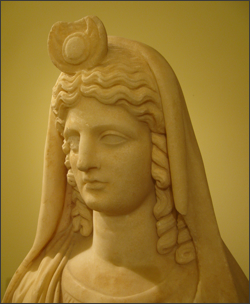
Persephone is the beautiful daughter of Demeter and Zeus. Persephone and Demeter are called the Holy Twain and usually worshipped together even though their divine duties are quite opposite from one another. Classical texts often refer to Persephone as the Maid or the Maiden.
Demeter is the goddess of the harvest ... she is responsible for the nourishment of all life-giving plants growing on the earth ... the wellbeing of every mortal is inextricably linked to Demeter and her blessings.
Persephone is not a goddess of life and prosperity ... she is the queen of the dead ... the bride of Hades.
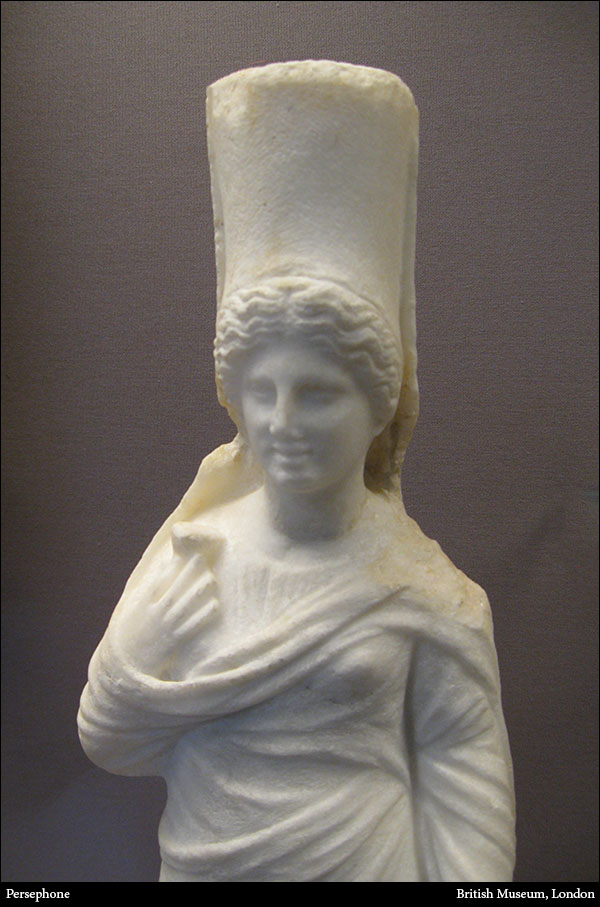
Persephone became Hades' bride completely against her will, but she eventually accepted her fate and now spends one-third of each year in the House of Hades and the other two-thirds with her mother. This arrangement came about after Persephone was kidnapped and Demeter's rage brought the world to the brink of destruction.
Hades was smitten with love for stunning young Persephone and plotted with Zeus to have her as his wife. Hades did not woo Persephone in any type of traditional way ... he did not ask Demeter's permission, but he did receive Zeus' help in underhandedly possessing the young goddess ... Hades abducted Persephone and took her to his Underworld kingdom against her will.
While at play with several daughters of Okeanos (Ocean) as well as other goddesses, Persephone was picking flowers ... but these weren't earthly flowers ... these flowers were the work of Zeus and put there for "a girl with a flower's beauty." The flowers were there to ensnare Persephone in a trap, a beautiful, divine trap. The trigger for the trap was an irresistible flower with one hundred stems of fragrant blossoms. When Persephone reached out with both hands to pluck the flower, the earth opened at her feet and Hades roared forth in his golden chariot and seized her before an alarm could be raised. The place where Hades emerged from the earth to take Persephone was on the island of Sicily near Syracuse.
No mortal on the earth heard Persephone's cries for help before she vanished into the Underworld. Her goddess playmates were unaware of what had happened to Persephone and only two Immortals heard the faint cries of the abducted girl ... the Roaring Goddess Hekate and Helios (Sun).
Demeter became frantic when she realized Persephone was missing ... she began an exhaustive search, but all efforts were in vain. Her sorrow was so great she denied herself food, drink, and comfort for nine days. When Eos (Dawn) took to the skies on the tenth day, Hekate came to Demeter and told her she had heard a voice but had not actually seen the abduction of Persephone. The two goddesses went to Helios because he sees all mortal and Immortal actions. Helios, indeed, knew the plot and the players. He told Demeter the abduction was the work of Zeus and Hades. He further advised her to accept the situation because Hades was the Lord of Many and "not an unseemly bridegroom." Demeter did not like his advice and choose instead a long, brooding path to regain her precious daughter.
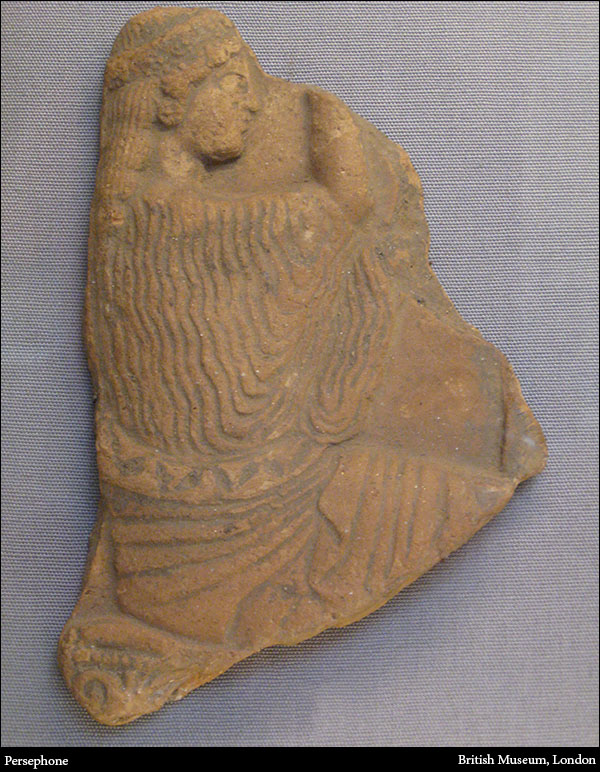
In a strange act of revenge, Demeter, disguised as a mature woman, settled in the city of Eleusis and became the nanny of Demophoon, the infant son of King Keleos and Queen Metaneira. The boy was being raised to be noble and pure, but Demeter seemed to be stealing the boy's affection and loyalty away from his parents ... just as her daughter had been stolen from her. One night she was caught transforming the young boy into an Immortal by placing him in the fireplace and cleansing him with fire but before Demeter (still in disguise) could make Demophoon immortal, Queen Metaneira recognized Demeter for the goddess she was and stopped the ceremony.
When Demeter cast off her disguise and revealed her divinity, King Keleos and the other nobles of Eleusis were glad to oblige when Demeter demanded that a temple be built in her honor. After it was completed, she retreated into the temple and her brooding took on a deadly turn. The following year, no seed sprouted on the earth ... no barley grew in the plowed fields ... the mortals of the earth were doomed to famine and eventual destruction if Demeter did not lift her curse.
Zeus sent the goddess Iris to dissuade Demeter from her destructive course, but Demeter was unmoved. In turn, Zeus sent a procession of Immortals to Demeter's temple to beg the goddess to change her mind and give life back to the earth. She refused them all.
Zeus realized that he would have to negotiate a suitable agreement between Hades and Demeter before the earth became a barren wasteland. He sent his son Hermes to the House of Hades to speak with Hades and Persephone. He also sent Rhea, Demeter's mother, to Eleusis to offer Demeter honors if she would only return to Mount Olympos. Demeter was moved by her mother's plea and Zeus' promises ... she was open for some sort of compromise.
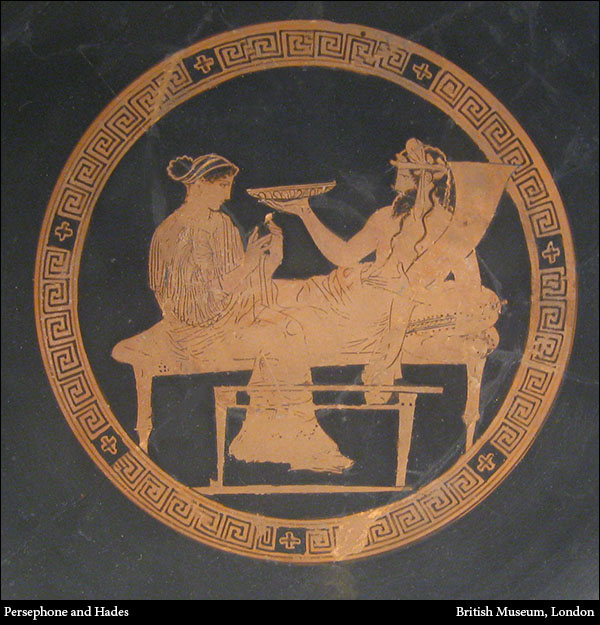
Hades agreed to allow Persephone to return to her mother but before Persephone left the Underworld, Hades gave her a pomegranate seed to eat. By doing this he bound her to himself and his kingdom. When Demeter found out about the trickery, she was angry but she was also resigned to the fact that there was nothing she could do ... her loving daughter was bound to the lord of the dead forever. With no alternative, it was agreed that Persephone would spend part of the year with her husband and part of the year in the sunlight with her mother. When Persephone is with Hades the earth is wracked by the sorrow of Demeter but when Persephone returns from the House of Hades to walk the earth again, Demeter pours forth the blessings of Spring to welcome her beloved daughter home.
The Eleusinian Mysteries were established to celebrate the return of Persephone to Demeter from the Underworld. The festival of the Greater Mysteries was celebrated at the city of Eleusis, which is 15 miles (24 kilometers) northwest of Athens. The ceremonies and procession for the sacred event began in Athens on the fifteenth day of Boedromion (approximately the second week of September by our calendar) and lasted from seven to nine days.
The Eleusinian Mysteries included the worship of Demeter, Persephone, and Iakchos as Bakchus (a.k.a. Dionysos). Most of the ceremonies were public but only initiates were allowed to participate in the final rituals. The rites are called Mysteries because the Greek word Mystes (Μύστῑς) means One Initiated.
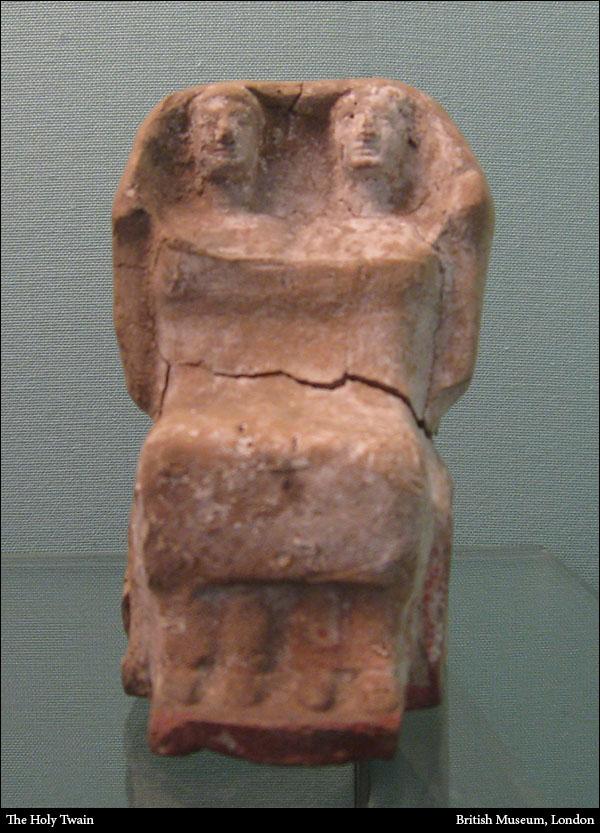
There were several stages of initiation. The rites of the Lesser Mysteries were held in the spring and dedicated to Persephone. The Lesser Mysteries involved the ritual purification of the candidates for initiation. The Greater Mysteries were held in the fall and dedicated to Demeter. The initiates were called Epoptes, i.e. One Who Has Seen. The only Greek citizens who were excluded from the ceremonies were people with Blood Guilt, i.e. those who had killed. Men, women, and slaves were allowed to take part in the ceremonies. All Greek cities honored the sanctity of the celebration of the Eleusinian Mysteries by instituting a truce that would temporarily halt wars and conflicts. This would allow participants to travel to and from Athens and Eleusis without worrying about local and national disputes.
The rituals of the Greater Mysteries were scrupulously guarded, and all sincere initiates honored the secrets of the ceremonies ... ancient writers who dared to expound on the subject were probably not initiates and were just guessing as to the actual rites performed at Eleusis. The rites performed in Athens were called the City Eleusinion ... this ceremony was public and conducted at the temple for Demeter and Persephone located between the Acropolis and the Agora. In preparation for the procession to Eleusis, sacred ritual objects were brought from the temple at Eleusis and stored in the Eleusinion.
After a ritual cleansing and purification, participants would gather at the Sacred Gates near the Kerameikos cemetery and then walk from Athens to Eleusis on what was called the Sacred Way. The priests and priestesses of Demeter would lead the procession carrying a wooden statue of Iakchos and other sacred objects hidden in wooden boxes destined for the Telesterion in Eleusis where the final and most secret rites were performed. The members of the procession chanted the name of Iakchos as they walked and would stop briefly at shrines of Apollon and Aphrodite along the road. Masked men were stationed along the Sacred Way to insult the participants in order to humble them before they reached Eleusis.
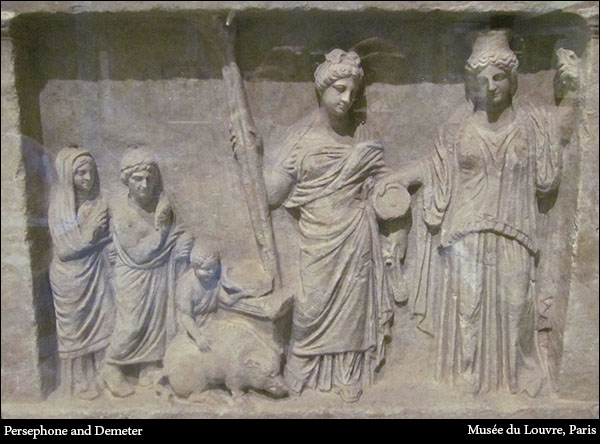
Upon reaching Eleusis, the participants would fast until the following morning. The initiates were then permitted to enter the Telesterion where the sacred objects were revealed. All that the initiates were permitted to say about the ceremonies was that things were spoken, seen, and performed. Once the final rites were complete, a night of feasting and revelry began. A bull was sacrificed, and libations were poured honoring the dead.
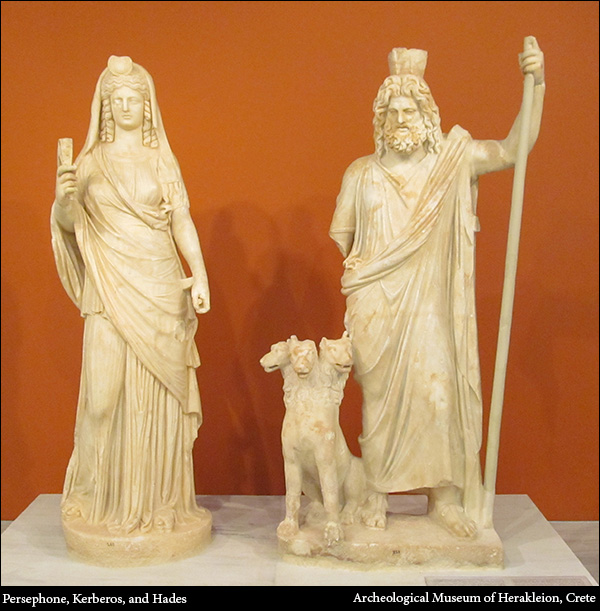
Persephone and Hades preside over the dead in the Underworld. It has been reported that there are several entrances to the Underworld but the only hint as to their locations is that they are near the dwelling of Nyx (Night), which is beneath the earth in the murky gloom of Tartaros (the Pit).
At the entrance to Hades' echoing halls, the ever vigilant, three-headed dog Kerberos stands guard. As fierce as he seems, he does not prevent anyone from entering the House of Hades ... in fact, he fawns and wags his tail to welcome those who enter. His real countenance comes forth when someone tries to leave the Underworld without Lord Hades' permission.
Persephone reigns over the dead souls of the Underworld in a way that compliments Hades' ultimate authority. When the seer Tiresias died, Persephone granted him wisdom and everlasting vision while the remainder of the dead souls were doomed to be nothing but "empty, flitting shades."
The adventurer Odysseus was required to go to the entrance to the Underworld to consult with Tiresias. Odysseus performed a series of blood-rituals to call forth the shades of the dead. Persephone's supervision of the shades that were allowed to speak to Odysseus was readily apparent ... it seemed to Odysseus that Persephone controlled the dead with absolute fear ... she drove the masses of souls to and fro ... their mournful cries chilled Odysseus' blood ... he finally fled in terror because he felt sure Persephone would send some hideous Gorgon's head after him.
As dark and foreboding as Persephone might seem, she also has genuine sympathy for the dead souls she supervises. There are three instances that deserve mentioning:
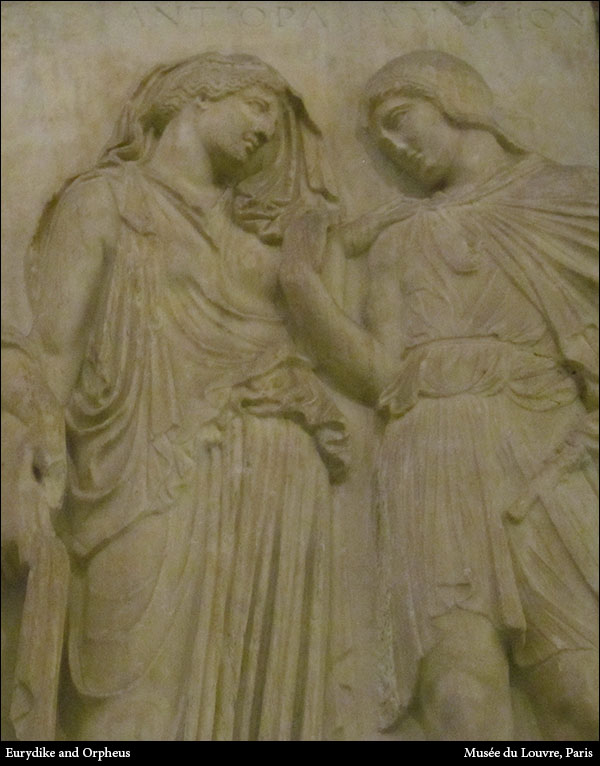
When Eurydike died, her husband Orpheus was so grieved and distracted by his loss, he decided to go to the Underworld to retrieve his beloved wife. Orpheus was without doubt, the greatest musician who ever lived ... he could charm any living thing with his music. When he reached the Underworld, he played his lyre for Persephone and she was enchanted ... she persuaded the reluctant Hades to release Eurydike and allow her to go back to the land of the living. Hades placed one condition on Eurydike's freedom ... he told Orpheus that he must walk ahead of Eurydike and not look back to see if she was following him ... if he looked back, Eurydike would return to the Underworld.
Eurydike left the House of Hades and began to follow Orpheus to the surface of the earth. Orpheus tried to resist the urge to look back, but his doubt overcame his faith ... he turned around and saw Eurydike behind him ... to his horror, her body, which was beginning to substantialize, evaporated and Eurydike was returned into the House of Hades as a phantom.
Herakles led an army against the female warriors known as the Amazons. Herakles had been tasked with Twelve Labors ... Retrieving the Belt of Hippolyte, the Amazon queen, was his Ninth Labor. Sthenelos was part of Herakles' army. During the battle with the Amazons, Sthenelos was killed ... Herakles buried Sthenelos on the shores of the Black Sea.
On their Quest for the Golden Fleece, Ieson (Jason) and the Argonauts sailed past the tomb of Sthenelos ... when they paused to honor the fallen hero, Persephone allowed Sthenelos to rise from his barrow and look upon the Argonauts and their ship because he had once been such a soldier and sailed in such a ship.
The importance of Pindar as a poet cannot be overstressed ... he was a man of far reaching fame and afforded genuine respect by all Greeks. When Alexander the Great destroyed the city of Thebes in 335 BCE, Pindar had been dead for one hundred years. Because Pindar had been a Theban, Alexander gave specific instructions that no relative of Pindar was to be harmed nor their property damaged.
Ten days before Pindar died he had a dream sent by Persephone ... she scolded the poet for never composing an ode for her ... in the dream, she told him that when he came to her in the Underworld, he would honor her with one of his poems ... he died within ten days after having the dream. After his death, an old woman who was related to Pindar had a dream ... in the dream Pindar stood beside her and sang a song for Persephone ... the woman wrote down the song which contained a clear reference to the goddess. The traveler-historian recorded this story but did not include the lyrics to the poem.
For those of you who mistakenly believe Persephone is somehow "mythological" or imaginary, the case of Timoleon and the invasion of Sicily should serve to dissuade you of such naïve notions.
The historian Diodorus of Sicily relates an interesting story concerning the intervention of Persephone and Demeter with the future of Sicily. Circa 337 BCE, the Athenians mounted an invasion of Sicily to oust the tyrant Dionysius II. A man named Timoleon was selected to lead an army against Dionysius but the number of troops at his disposal was barely adequate to do the job. Before Timoleon sailed for Sicily, he stopped in Korinth to consult the priestesses of Demeter and Persephone and seek their blessings. The priestesses told him the goddesses had told them of his coming and that they had received favorable dreams during the night concerning him and his expedition to Sicily ... the priestesses informed Timoleon that the goddesses would guide and protect him to insure his victory over Dionysius as well as the Carthaginians on Sicily. As if on cue, a blazing torch appeared in the western sky indicating Timoleon's route to Sicily ... he and his men had no doubt that the goddesses would give them a victory even though they were greatly outnumbered. The blazing torch remained visible until the fleet reached Sicily. The fighting was fierce but Timoleon was victorious on land and sea.
The island of Sicily has always been sacred to Demeter and Persephone ... it's no wonder the goddesses would lend their protection to Timoleon ... he was a pious man trying to free the islanders from an indulgent tyrant ... the Holy Twain approved of the man and his quest.
This event was witnessed by nearly a thousand individuals ... the only element of this story that is disputed is whether one of Timoleon's ships was named The Sacred Ship of Demeter and Persephone before or after his visit to the temple of the goddesses.
The Iliad by Homer
The Odyssey by Homer
Theogony by Hesiod
Catalogues of Women by Hesiod
Hymn to Demeter II
Hymn to Demeter XIII
The Argonautika by Apollonius of Rhodes
Library of History by Diodorus of Sicily
Description of Greece by Pausanias