
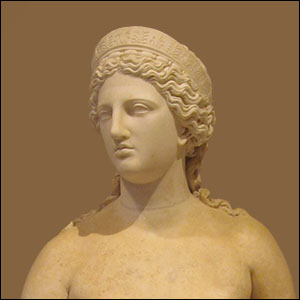
Thetis is one of the many daughters of Nereus and Doris. As a group, Thetis and her sisters are called Nereids.
Nereus is referred to as The Old Man of the Sea and it seems only fitting that his wife Doris would be a sea goddess ... she is an Okeanid ... one of the thousands of daughters of Okeanos (Ocean) and Tethys.
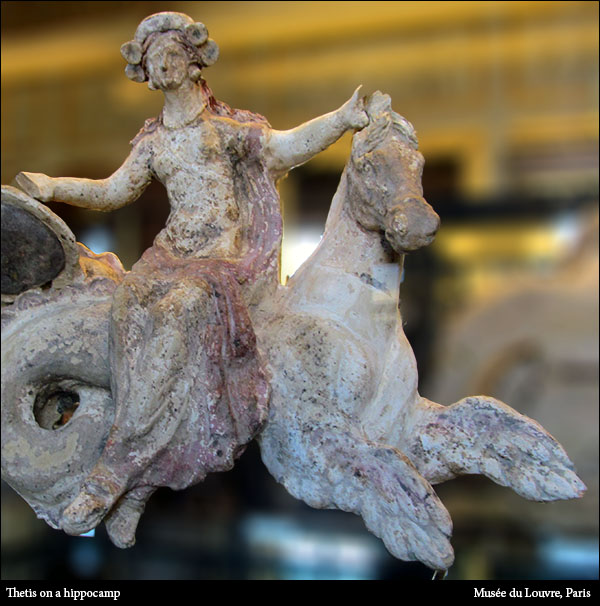
Thetis and her sisters can live comfortably under the sea but they can also walk on the land and fly through the air with speed and agility ... while in the sea, they often ride astride sea creatures such as hippocamps.
Just like Thetis, Eurynome was a sea goddess ... also, like Thetis's mother Doris, Eurynome was an Okeanid. With Zeus as her consort, Eurynome became the mother of the Kharites (Graces).
Thetis and Eurynome inadvertently meddled in the affairs of the Olympian gods when they rescued the lame god Hephaistos after he had been thrown from Mount Olympos. Hephaistos was born with deformed legs ... the fall from Olympos injured him severely but did not make him "lame."
There are two different versions of the story as to who threw Hephaistos from Olympos:
1) In the Iliad by Homer, Hephaistos says that at the climax of an domestic dispute, he stood with his mother in defiance of Zeus. The Olympian Zeus, in his rage, caught Hephaistos by the foot and hurled him from the magic threshold of Mount Olympos;
2) In the Homeric Hymn to Pythian Apollon, Hera says that she, not Zeus, cast Hephaistos into the sea.
After being thrown from Olympos, Hephaistos fell for three days before he reached the earth ... he landed, seriously injured, on the island of Lemnos in the northern Aigean Sea. As if there can be any form of happenstance or coincidence in the affairs of the Immortals, Hephaistos was "found" by Thetis and Eurynome. The two goddesses realized that by helping Hephaistos they were placing themselves in the middle of a dispute between Hera and Zeus but their sympathy for the injured young god overcame their reticence ... they willingly undertook the slow process of nursing Hephaistos back to health.
To protect Hephaistos and themselves, Thetis and Eurynome kept Hephaistos hidden in a cave where he diligently toiled to prefect his metal working skills. After nine years, he returned to Mount Olympos where he was joyously received by the Immortals and declared to be the Artificer of the Olympians ... Hephaistos never forgot the lifesaving assistance Thetis and Eurynome gave him.
Hera finally accepted the fact that Hephaistos had become one of the Olympians but she still cursed Thetis for helping Hephaistos ... she felt that there must have been other services Thetis could have performed for the Immortals without encouraging her lame son.
Thetis came to the notice of Zeus because of her youthful beauty. Although Zeus was married to his sister Hera, he made no secret of his desire for Thetis but she did not share or welcome his amorous desires. Thetis avoided Zeus for two reasons: 1) her respect for Hera; and 2) her fear of Hera. Zeus finally became disinterested in Thetis when he was advised that one of his immortal sons would dethrone him ... he then arranged for Thetis to marry a mortal man.
Thetis was given to a mortal man named Peleus because of his undying devotion to the gods on Mount Olympos. Thetis was not a willing bride. Peleus had to wrestle with her as she manifested a variety of vicious animal-personas to frighten him into releasing her ... in the end, she was forced to submit.
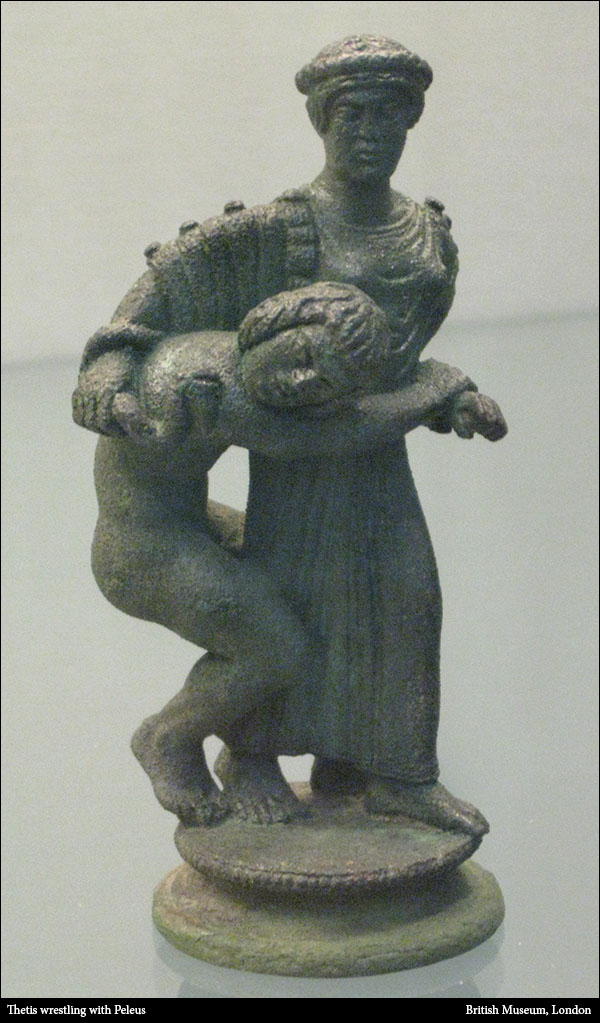
In the above image, when Peleus tried to force Thetis to come with him, she manifested snakes and other animals to frighten him.
The wedding of Thetis and Peleus was the backdrop for a defining event that set the stage for the Trojan War. This event has come to be known as The Judgment of Paris ... it was simply one element of an orchestrated series of events Zeus contrived to rid the earth of demigods, i.e. sons of Immortals and mortals ... a glorious war seemed to be the best way to achieve that end.
The goddess Hera invited all the Immortals to the wedding on Mount Pelion. Eris, the goddess of discord and strife, was in attendance but she did not come to celebrate ... she came to do what she does best ... cause trouble. Eris tossed a golden apple into the midst of the assembled Immortals with the inscription, 'For the most beautiful one.'
Hera, Athene, and Aphrodite all assumed the prize was for them because they were all very beautiful and, meaning no disrespect, they were all very vain. Just as Eris intended, a conflict erupted ... the messenger god Hermes escorted the goddesses to Mount Ida where the Trojan Prince Alexandros (Paris) was asked to make the final decision as to which goddess deserved the golden apple. Aphrodite promised Alexandros the hand of Helen of Argos ... Helen was the daughter of Zeus and without doubt, the most desirable woman in the civilized world. Alexandros could not refuse such a prize ... he chose Aphrodite as the most beautiful goddess even though it meant that Helen had to be kidnapped from her rightful husband and war between the Greeks and Troy would be inevitable.
Hera and Athene knew Aphrodite had bewitched Alexandros but they still harbored an intense personal resentment for him and by extension, all Trojans ... they made it their mission to make sure the walls of Troy were toppled and the Trojan people were either killed or enslaved.
In retrospect, the marriage of Thetis and Peleus became a very sad historical landmark.
A generation before the Trojan War, Hera enlisted the assistance of Thetis to protect Ieson (Jason) and the Argonauts during their Quest for the Golden Fleece. By the time of the Quest for the Golden Fleece began, Thetis and Peleus had been married and then separated ... their son Achilles was still an infant and in the care of Kheiron the Centaur. Like all Centaurs, Kheiron had the body of a horse with the torso and head of a man. Unlike other Centaurs, Kheiron was benevolent and renowned for his intelligence. Peleus was included as one of the Argonauts ... Kheiron took young Achilles to watch the Argonauts set sail on their epic journey.
The Golden Fleece was from a flying ram the god Hermes had created to save Helle and Phrixus from being harmed by their stepmother, Ino. Helle died when she fell from the back of the flying ram but Phrixus managed to fly all the way to Kolkhis where he sacrificed the ram and hung its Golden Fleece in the Garden of Ares.
Ieson was guided by his own good sense and the omens of the Immortals during the perilous journey. King Aietes of Kolkhis welcomed the Argonauts but plotted their doom so they would not be able to claim the Golden Fleece or return to Greece. The king's daughter Princess Medeia helped Ieson steal the Golden Fleece and escape but when he and Medeia murdered King Aietes's son Apsyrtos, they incurred the enmity of Zeus ... from that moment on, Ieson's fate became very dark.
Zeus was intent on punishing Ieson and Medeia but Hera was equally intent on saving them. She devised a plan where Ieson and Medeia might be absolved of their blood-guilt by Medeia's aunt, the Dread-Goddess Kirke (Circe). In order to reach Kirke's island, Ieson had to sail the Argo past the six-headed Skylla and the whirlpool Kharybdis ... Skylla would swoop down from her rocky perch and snatch sailors from the decks of their ships ... Kharybdis was a vicious whirlpool that would suck and spew torrents of water to sink passing ships. If he survived Skylla and Kharybdis, Ieson would then have navigate the waters of the forbidding Planktae, also known as the Wandering Rocks or the Rovers. The Planktae were giant stone islands that clashed together to destroy anyone and anything caught between them ... they were so notorious and dangerous that doves carrying ambrosia to Zeus were killed when they ventured too close.
In order to put her plans into motion, Hera sent the wind-footed goddess Iris to summon Thetis to Mount Olympos. Iris found Thetis at her father's house under the sea ... Iris explained Ieson's peril to Thetis and asked her to come to Olympos and meet with Hera. Thetis flew to Mount Olympos without hesitation.
With kind words and a certain amount of urgency, Hera explained that the Quest for the Golden Fleece was within "a hair's breath" of failure. She asked Thetis to enlist the help of her sisters and calm the seas so Ieson and the Argonauts could sail past the dreaded monsters Skylla and Kharybdis without incident ... Thetis replied that if Hephaistos would not vent his fires into the sea and if Aeolus, master of the Winds, would keep his charges in check, the Nereids would lend their protection to Ieson and his crew.
The Nereids swam to the Argonauts and a truly amazing spectacle took place. On one side of the sea passage was the steep rock of Skylla and on the other side Kharybdis spouted and roared ... further on, the Planktae boomed beneath the sea surge. As the Argo drew near the Planktae, the Nereids surrounded the vessel as Thetis grasped the rudder-blade under the ship. In a way reminiscent of dolphins, the Nereids darted upward and circled around the ship while Thetis guided its course.
After passing Skylla and Kharybdis, the Argo reached the Tyrrhenian Sea and put ashore on the western coast of Italy. Thetis rose from the sea and spoke to her estranged husband Peleus. It's never clearly stated but perhaps one of the reasons Thetis was willing to help Ieson was that Peleus was one of the Argonauts. Regardless, she told Peleus to rouse the Argonauts and proceed with all haste to the Planktae where, at the bidding of Hera, the Nereids would draw the Argo safely through the dangerous straits. Peleus was temporarily bewildered at the sight of Thetis but quickly regained senses ... he called to the Argonauts and convinced them that his divine encounter was genuine and their survival depended upon their immediate departure.
When the Argo was about to smash against the Planktae, the Nereids immediately raised the edge of their garments and darted up on the rocky cliffs above the waves and then jumped from one side to the other. As the ship was raised aloft by the waves, the Nereids caught it and toss it to and fro like young girls throwing a ball for sport. The waves rose like towering crags and then plummeted to the depths of the sea ... water poured over the Argo in floods. When Hera saw the ship being bounced and swamped by the waves, she was seized by fear and threw her arms around Athene for comfort. The frenzy continued until the Argo was clear of the Planktae and the Argonauts could catch the wind and sail on.
We know Achilles was born before the Quest for the Golden Fleece because in order to win Thetis's favor, Hera made allusions to a possible marriage between Achilles and Princess Medeia of Kolkhis. As to whether Hera was sincere or not was never called into question because Thetis did not desire such a union for her son ... besides, it was obvious that Ieson's marriage to Medeia was inevitable considering the fact that she betrayed her family and willingly assisted Ieson when he murdered her step-brother ... Ieson and Medeia were very much in love ... thanks to the love-enchantments of Aphrodite. Also, when the Argo sailed from Iolkos, the Centaur Kheiron took the infant Achilles to Mount Pelion so he could see his father Peleus sail away.
Before the birth of Achilles, Thetis and Peleus had several children that did not survive. Thetis was equally at home in the sea and on the land so she assumed her children would be able to breathe underwater just as she could. She tested this assumption by placing the infants underwater to see if they were amphibious ... they all drowned.
Thetis and Peleus had a magnificent son and named him Achilles. Peleus tried to be a good husband and father but he was ignorant of the ways of the Immortals ... knowing the fate of his other children, Peleus refused to allow Thetis put Achilles in a water-filled caldron ... Thetis decided to try a different tactic ... she put the infant Achilles in the fireplace. When Peleus caught Thetis putting their son in the fire, he became enraged and ordered Thetis from his house ... Thetis threw Achilles to the floor and returned to the sea without telling Peleus that the baptism of fire would have made Achilles immortal.
The ultimate fate of Achilles was only partially known to Thetis, but the Trojan War brought his life-course to the proverbial crossroads ... one road led to a long and fruitful life where he could inherit his father's kingdom and die a happy yet forgotten man ... the other road led to Troy, certain death and virtual immortality.
When it became obvious that Achilles was going to die at Troy, Thetis went to Zeus to beg, not for her son's life, but for his glory. Hera saw Thetis clutching the knees of Zeus and misunderstood what was happening. She suspected Thetis's motives and even though Thetis had been particularly helpful to Hera during the Quest for the Golden Fleece, the relationship between the two goddesses became cautionary. They both wanted the Achaian Greeks to win the war but they did not work together to assure that victory.
In the tenth year of the Trojan War, Achilles was angered by the Greek commander Agamemnon and refused to fight. Even when the Trojans seemed destined to win the war, Achilles still refused to enter the fray. The Greeks were being driven back to their encampment because the Trojans, knowing Achilles was not in the fighting, were determined to burn the Greek ships.
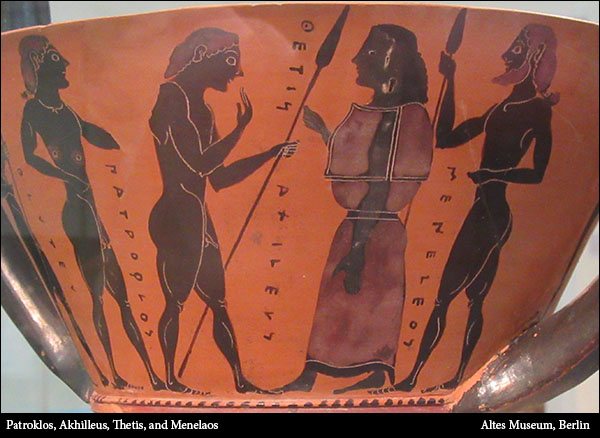
Achilles's companion Patroklos begged him to put his anger aside but when he saw that Achilles would not change his mind, he asked if he could don Achilles's distinctive armor and enter the battle. He wanted to make the Trojans think Achilles had returned to the fighting ranks ... he also wanted the Greeks to see the blazing armor and regain their courage. Achilles agreed but on the condition that Patroklos not venture too close to the walls of Troy.
The ruse worked ... the Trojans began to retreat and the Greeks were filled with new enthusiasm. Patroklos became over-bold in his Achilles-persona ... he felt invincible but after he killed Sarpedon, a son of Zeus, his fate was sealed. The god Apollon hit Patroklos and knocked him off balance ... Prince Hektor delivered the killing blow ... Hektor then took Achilles's armor from Patroklos's dead body. Hektor put on the magnificent armor but it was too large ... Zeus fitted the armor to Hektor's body ... at that moment, Hektor's fate was sealed as well as that of Achilles.
Thetis rose from the depths of the sea to comfort Achilles ... she consoled him as best she could and made him promise that he would wait for her to get him new armor before he went after Hektor, the killer of Patroklos.
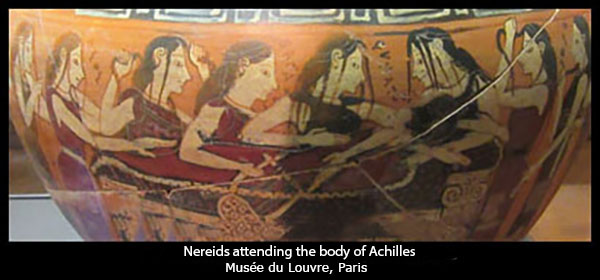
Thetis led a procession of her sisters up from the depths to openly morn and cast a divine protective mist over the body of Patroklos.
Thetis and Hephaistos had been close friends since she and Eurynome had saved him when he was thrown from Mount Olympos. After his return to Olympos, Hephaistos became know as the undisputed master of all things artistically mechanical ... he was the perfect choice to make a suit of armor worthy of Achilles.
Thetis left Troy and flew to the home of Hephaistos on Mount Olympos. Hephaistos's wife Kharis warmly greeted Thetis and escorted her into their home. Kharis called to Hephaistos and when he saw Thetis, he said he was honored to have the goddess in his home. Hephaistos's robot helper-women stood by as he recounted to Kharis the way in which Thetis and Eurynome had saved his life when he was ejected from Olympos.
With tears in her eyes, Thetis explained how Achilles had lost his armor and begged the lame smith to forge new armor for her son. Without hesitation Hephaistos went to his forge and crafted the most magnificent armor the world had ever seen. Like a hawk, Thetis flew from Mount Olympos to take the new god-made armor to Achilles at Troy even though she knew full well he would die in that glorious armor.
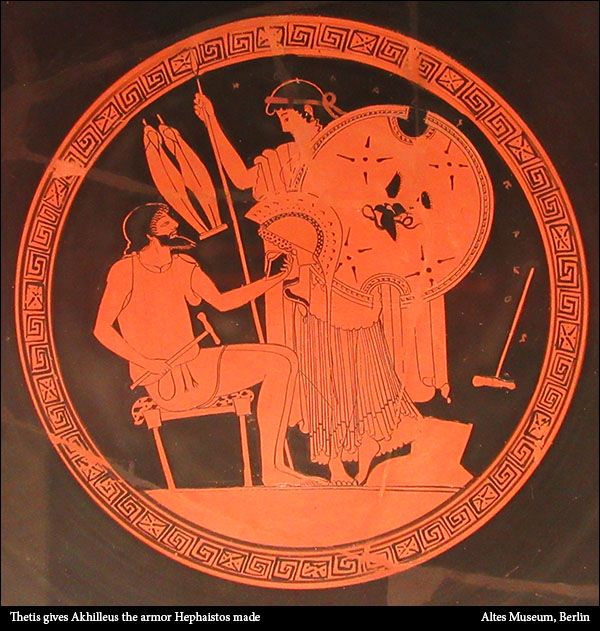
When Achilles strode into battle with his new armor, the Trojans fled in terror ... the blazing armor combined with his beauty and enormous strength made him truly formidable. The Trojans, who did not have the good sense or swift feet to run away, were killed. After Achilles had his revenge by killing Prince Hektor, he returned to the Greek encampment dragging the body of Hektor behind his chariot.
Zeus sent Iris to bring Thetis to Mount Olympos. Iris plunged into the sea between the islands of Samos and Imbros ... she found Thetis with her sisters, the Nereids, in an underwater cave. Even before Iris arrived, Thetis knew Achilles's fate and was mourning the impending death of her only child. Iris told Thetis to rise up and obey the summons of Zeus ... Thetis donned a black veil and followed Iris up through the waves to Mount Olympos.
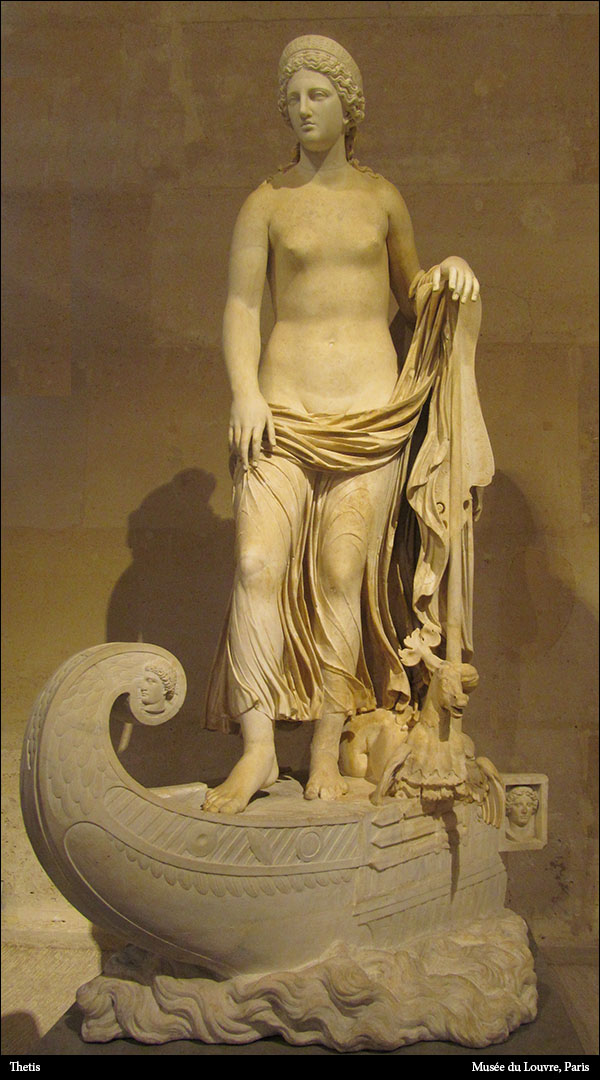
Athene and Hera comforted Thetis as she sat beside Zeus and awaited his command. Zeus was adamant ... Thetis was to force Achilles to surrender the body of Hektor to King Priam ... there was no room for negotiation or quibbling. Thetis did as she was told and descended to Troy.
Thetis relayed Zeus's will to Achilles ... she told him to accept a ransom for Hektor's body and that King Priam was not to be harmed when he came to the Greek camp to reclaim the body of his son.
Zeus sent the messenger god Hermes to escort King Priam to Achilles's elaborate living quarters. The god and king passed through the Greek sentries without being seen. Priam kissed the hands of Achilles and begged for the body of his son ... Achilles was unemotional ... he told King Priam he was returning the body of Hektor only because Zeus and his mother had demanded it.
During the final assault on Troy, Achilles was killed by the god Apollon and Trojan Prince Alexandros ... there was nothing Thetis could do to prevent it. Achilles body was taken back to the Greek camp where they intended to burn his body on a funeral pyre. At that point, there were two different perceptions as to what happened.
1) The mortals who witnessed the event believed that Achilles body was burned and his bones, as well as the bones of Patroklos, were placed in golden urn that had been made by Hephaistos and given to Thetis by the god Dionysos.
2) What actually happened was that Thetis arrived at the Greek encampment with the Muses and the other Nereids to morn Achilles and Patroklos. After his body was placed on the pyre, Thetis invisibly took Achilles's body and transported it to White Island (Leuke) where he could reside with other fallen heroes of the Trojan War. White Island has been identified as a small island in the Black Sea near the mouth of the Danube River. Other inhabitants of White Island include Patroklos, Aias (son of Telamon), Aias (son of Oileus), Helen, Antilokhos (son of Nestor), and perhaps Princess Medeia (daughter of Aietes).
The brothers Briareos, Kottos, and Gyes are by far the most monstrous creatures ever produced by Ge (Earth) and Ouranos (Heavens) ... they have fifty heads and fifty arms sprouting from their massive shoulders.
The brothers were imprisoned by Kronos but freed by Zeus when he forcefully took the Throne of Eternity from Kronos. Although Zeus is considered to be the Father of Gods and Men, he is often opposed and threatened by other Immortals. When Zeus's wife Hera, his daughter Athene, and his brother Poseidon were plotting to overpower Zeus and put him in shackles, Thetis summoned Briareos to Mount Olympos where he sat down beside Zeus ... his imposing presence quelled all thoughts of rebellion.
There was a brutish man named Lykurgos who had proven his fighting skills and strategy but he made a tragic mistake when he attacked the Nymphs of Mount Nysos. Lykurgos raged down the slopes of Nysos with an ox-goad and scourged the Nymphs who cared for young Dionysos, a son of Zeus. The Nymphs dropped their wands to the ground and fled for their lives. Dionysos was so terrified he jumped into the sea to escape the murderous brute. The Thetis rescued Dionysos and took the frightened infant to her breast. Lykurgos's assault was not unnoticed or forgiven by the other Immortals. Zeus blinded Lykurgos but the brute did not live long with his affliction because all the Immortals hated him for what he had done to Dionysos and the Nymphs of Nysos.
Neoptolemos was the son of Achilles and thus the grandson of Thetis. He was summoned to Troy to participate in the final battles for the city. After the walls of Troy were toppled and prisoners were taken, Neoptolemos took Andromakhe as a slave ... she was the widow of Prince Hektor and a very prized possession.
Knowing the impending fate of the some of the victors of the Trojan War, Thetis advised Neoptolemos to take an overland route home ... Neoptolemos wisely did as he was told and unlike many of the Greek heroes, survived to live a long and prosperous life.
During the Trojan War, Thetis worked with Aphrodite on one occasion. Thetis was clearly on the side of the Greeks because of Achilles ... Aphrodite actively supported the Trojans because her son Aineias was a Trojan.
Thetis and Aphrodite arranged for Achilles to meet with Helen. We are not told any details but the meeting was important for several reasons. Either the goddesses brought Helen to Achilles outside the walls of Troy or they transported Achilles into Troy. This indicates that the Immortals could have stopped the Trojan War at any time ... if Helen had been returned to her legal husband Menelaos the war would have ended ... if Achilles had been allowed to secretly enter the city, he could have opened the gates for the Greek army. Either way, the war could have ended at any time if the Immortals had wished it.
Prior to 615 BCE, King Anaxandros of Sparta invaded Messenia to quell a revolt. Among the women prisoners was a woman named Kleo, priestess of Thetis. Kleo made arrangements with Anaxandros's wife to establish a sanctuary of Thetis in which they placed a wooden image of the goddess ... the wooden image of Thetis was guarded in secret.
Epeigeus, the son of Agakles, killed his cousin and was exiled ... Peleus and Thetis took him into their home. When the Trojan War began, Epeigeus was in the Greek army ... he was killed by Prince Hektor and no doubt his death added to the fury Achilles nurtured for the Trojan prince.
Thetis is a very old goddess and for that reason, putting an exact date to her birth is impossible. We can however use the rescue of Hephaistos after he had been thrown from Mount Olympos as a reference point.
Hephaistos was born to Hera soon after Athene was born to Metis and Zeus. Athene was responsible for founding the city of Athens ... the original Athens ... the Athens that was destroyed by the same cataclysms that destroyed Atlantis circa 11000 BCE ... that would mean Hephaistos was born some time before 11000 BCE and Thetis was already an adult goddess at that time.
As for Thetis's involvement in the Quest for the Golden Fleece and the Trojan War, the dates of those events are well within historical times ... the Quest for the Golden Fleece occurred circa 1285 BCE and the Trojan War began circa 1250 BCE.
The Iliad
The Odyssey
Theogony
Catalogue of Women
Kypria
Aegimius
Little Iliad
Returns
Hymn to Pythian Apollon
The Argonautika by Apollonius of Rhodes
Description of Greece by Pausanias