Homepage Site Search
Copyrighted Material—All Rights Reserved

Geography Index
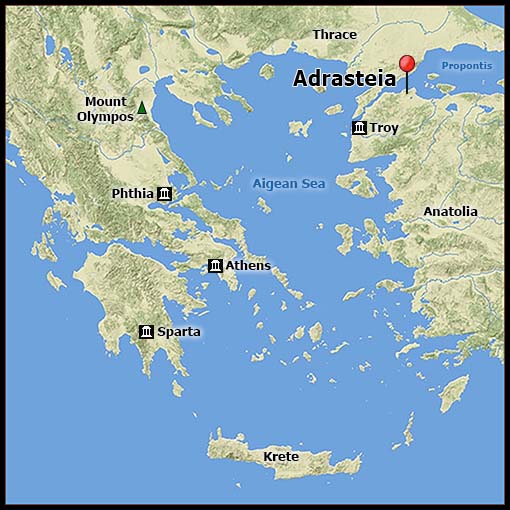
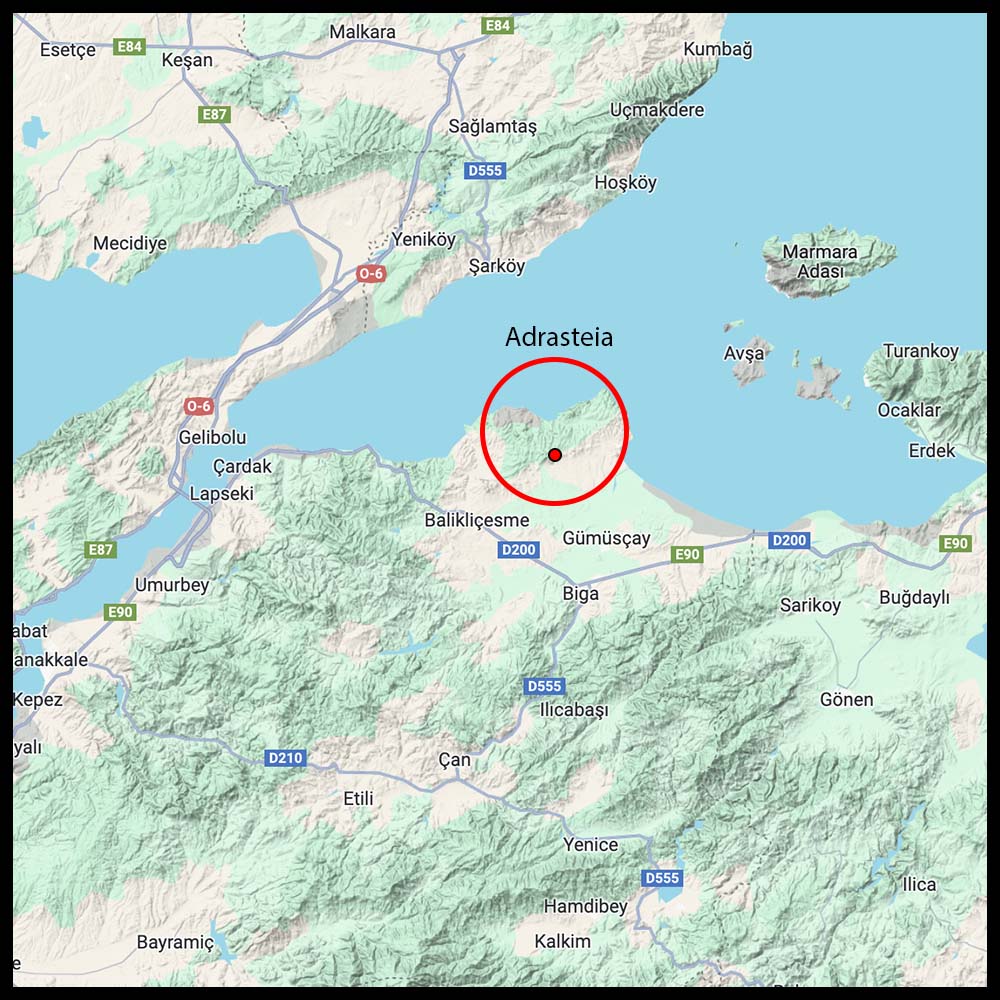
A city northeast of Troy.
During the Trojan War, Adrestos (Adrastus) and his brother Amphios (Amphius) commanded an undisclosed number of Trojan soldiers from Adrasteia, Paisos (Apaisos), Pityeia, and Tereia.
Trojan King Priam's kingdom included the territories of the Hellespont.1 Inhabitants of Adrasteia were considered to be Trojans.
According to the geographers Callisthenes and Strabo, Adrasteia was named after King Adrastos (Adrastus), who was credited with founding the first temple of the goddess of divine retribution, Nemesis. Consequently, Adrasteia became an epithet for Nemesis.
Entering the Propontis on their Quest for the Golden Fleece, the Argonauts made landfall on the Plain of Adrasteia (Adrastia). At dawn, Ieson (Jason) ascended Mount Dindymon (Dindymun) to get a view of the surrounding land and sea. The natives of the area, referred to as Earthborn, started throwing boulders into the narrow outlet to the harbor where the Argonauts had moored the Argo. Herakles (Heracles) initiated an attack on the Earthborn savages and forced them to retreat.
Storm winds would not permit the Argo to go to sea. Prophetic signs indicated that Ieson should ascend Mount Dindymon again and propitiate the Mother of the Gods (presumably the Olympian goddess, Rhea, known locally as Kybele (Cybele). An altar was built and appropriate sacrifices were made. The goddess permitted Ieson and the Argonauts to continue their mission. This would have been circa 1300 BCE, i.e. one generation before the Trojan War.
The Romans referred to the city of Adrasteia as Parium.
1. Hellespont (Helle’s Sea)—the modern Dardanelles but was undoubtably considered to be much larger in antiquity.
Latitude North, Longitude East
40.3836, 27.1912
| References: Homer, Iliad book 2, line 828 Strabo, Geography book 13.1 Pliny the Elder, Natural History book 5, XL Apollonius of Rhodes, Argonautica book 1, line 1116 |