Homepage Site Search
Copyrighted Material—All Rights Reserved

Geography Index
An island sacred to the god, Apollon.
Delos is one of the most unique islands in all the world. Some islands are the result of geologic upheavals, others are formed by volcanic activity. Delos was a divine being named Asteria who embedded herself on the sea floor and thus became the island of Delos.
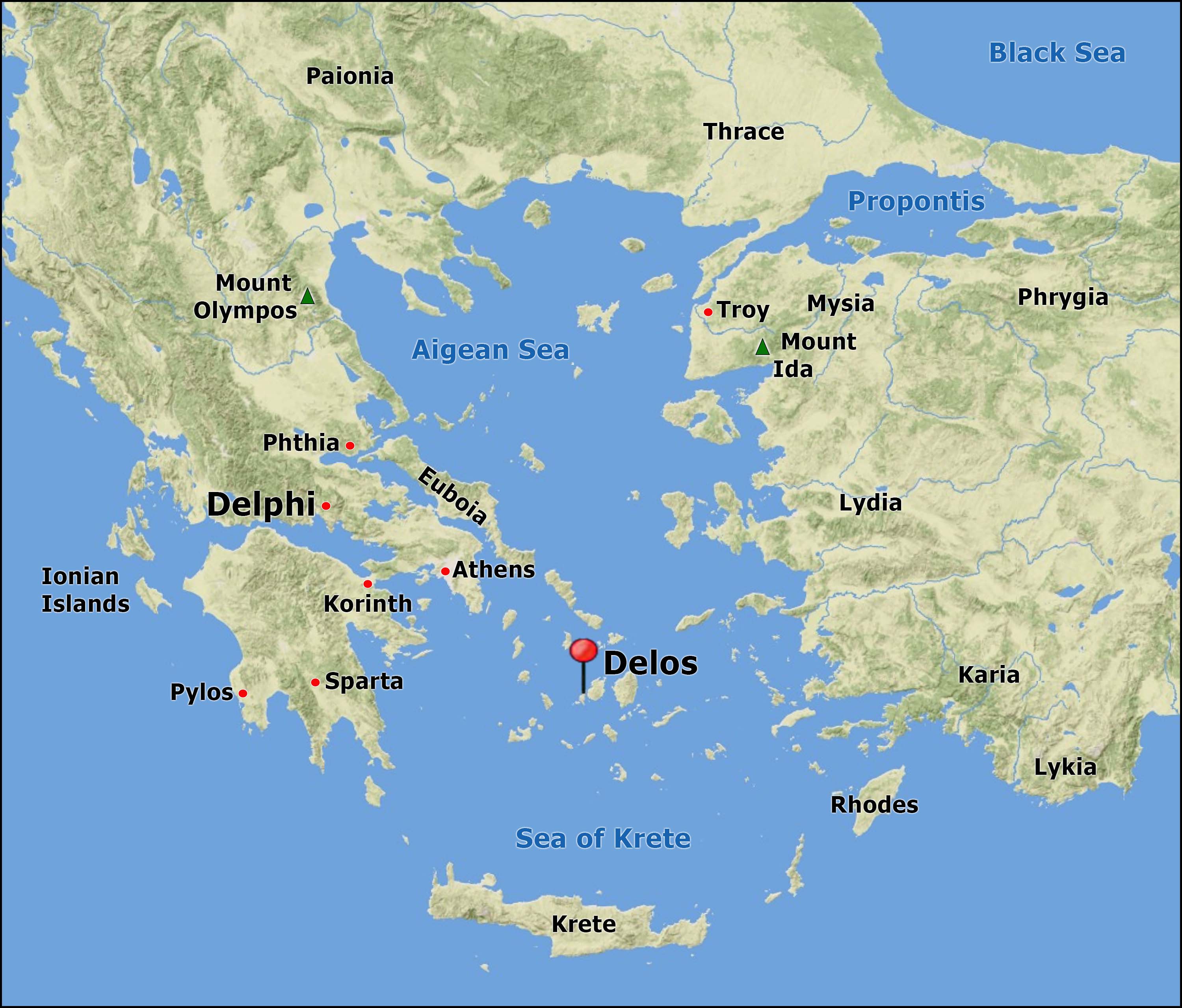
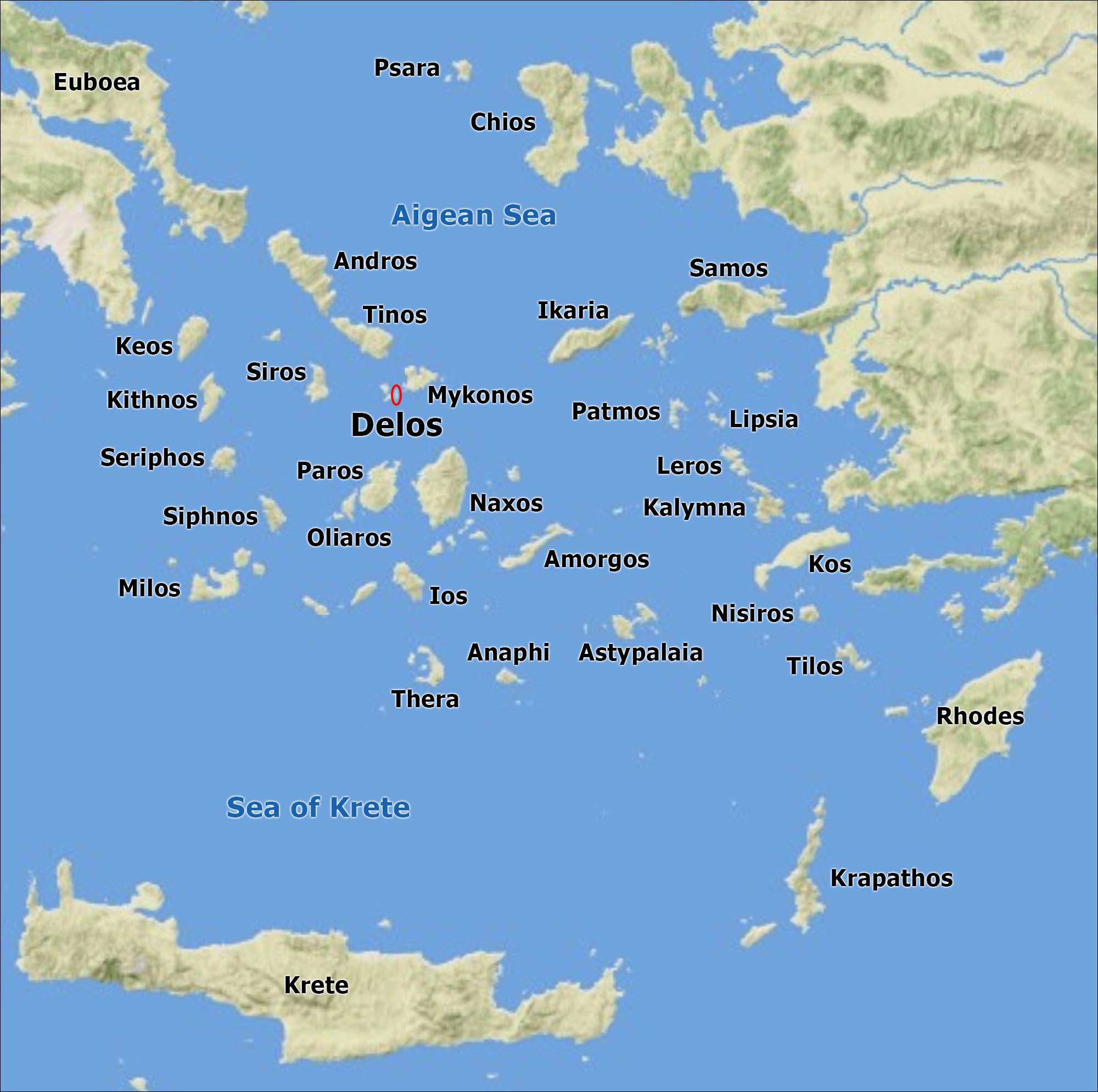
The location Delos chose to anchor herself was not arbitrary, she chose a place where she could be at the center of the existing islands in the southern Aigean (Aegean) Sea. The islands are called Cyclades, meaning "centered around" the sacred island of Delos.
Latitude North, Longitude East
37.3948, 25.2740
The goddess Asteria resisted the amorous advances of the god Zeus. To escape Zeus' relentless pursuit, Asteria jumped into the sea and took on the appearance of a floating rock. Sailors who encountered Asteria named her Ortygia. Asteria's guise as a free-floating rock remained unchanged until her sister Leto asked Asteria to become the birthplace for her son, Apollon. Asteria agreed on the condition that Apollon never abandon his birthplace and always keep his temple on the island. Asteria anchored herself to the sea floor and became Delos.
Delos welcomed notable goddesses to her island to witness the birth of Apollon—Rhea (Rheia), Dione, Themis, Aphrodite (goddess of love), and of course Eileithyia (goddess of childbirth). Two Hyperborean maidens also attended Apollon's birth because Leto had a special relationship with the Hyperboreans, the mysterious denizens of the extreme north. It became a tradition for the Hyperboreans to periodically send gifts to Delos.
Delos became rich and beautiful with the presence of Apollon and Leto. The mountains bloomed with flowers and people came from all regions to make generous donations to the shrine of Apollon. Games and dancing inspired the worshipers but the handmaidens of Apollon were the most amazing attraction on the island. They had the ability to sing in such a way that each person heard them in his or her native tongue.
Although Apollon's sister Artemis was not born on Delos, she had a temple there and was noted for at least one deadly intrigue on the island. The hunter Orion was a strangely compelling man with the ability to inspire or infuriate those he encountered. At the instigation of Aphrodite, goddess of love, Eos, goddess of the dawn, fell in love with Orion and took him to Delos where he quickly became despised. He was accused of killing one of the Hyperborean maidens. To further his condemnation, he challenged Artemis to a game of quoits (throwing a ring to encircle a peg). The insult cost him his life.
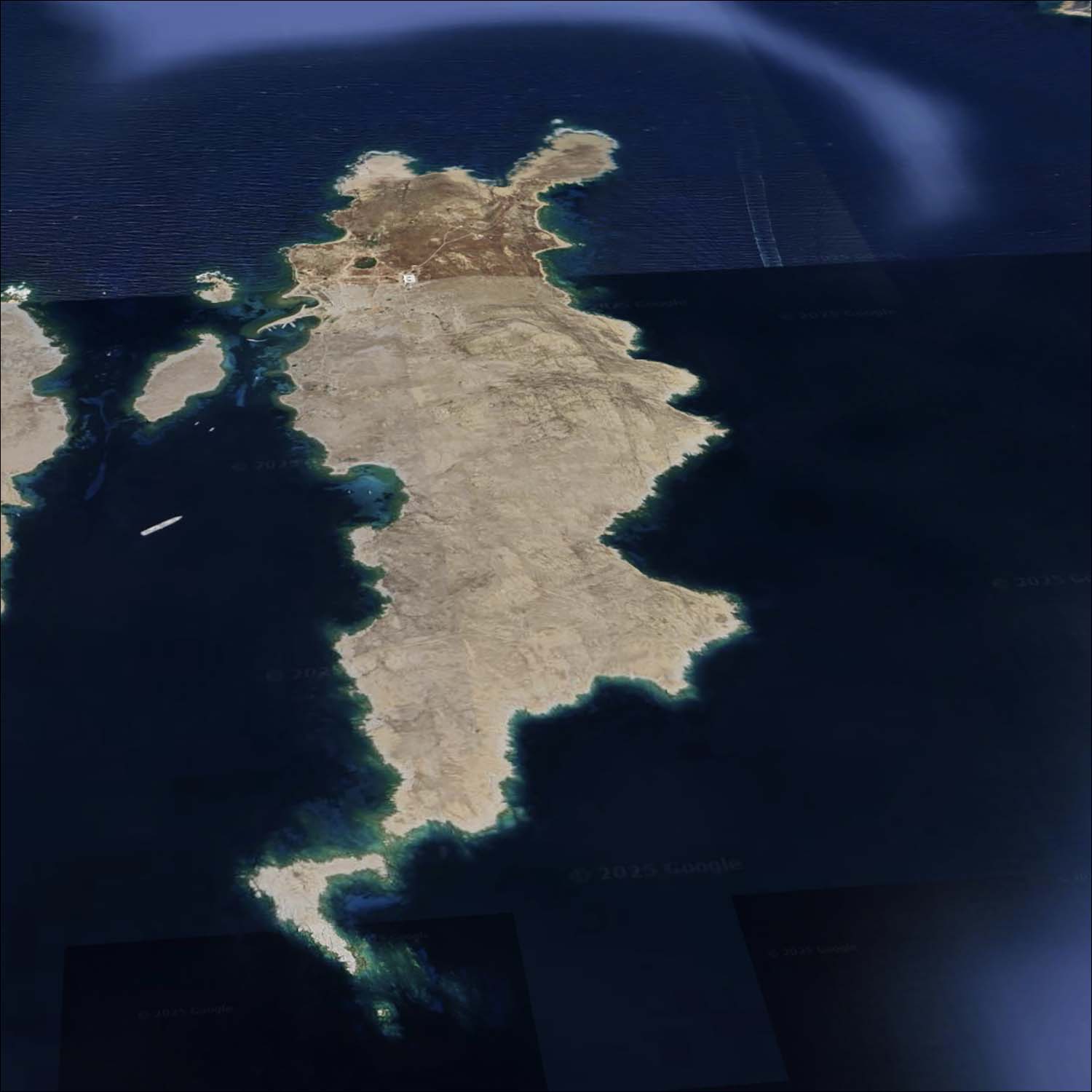
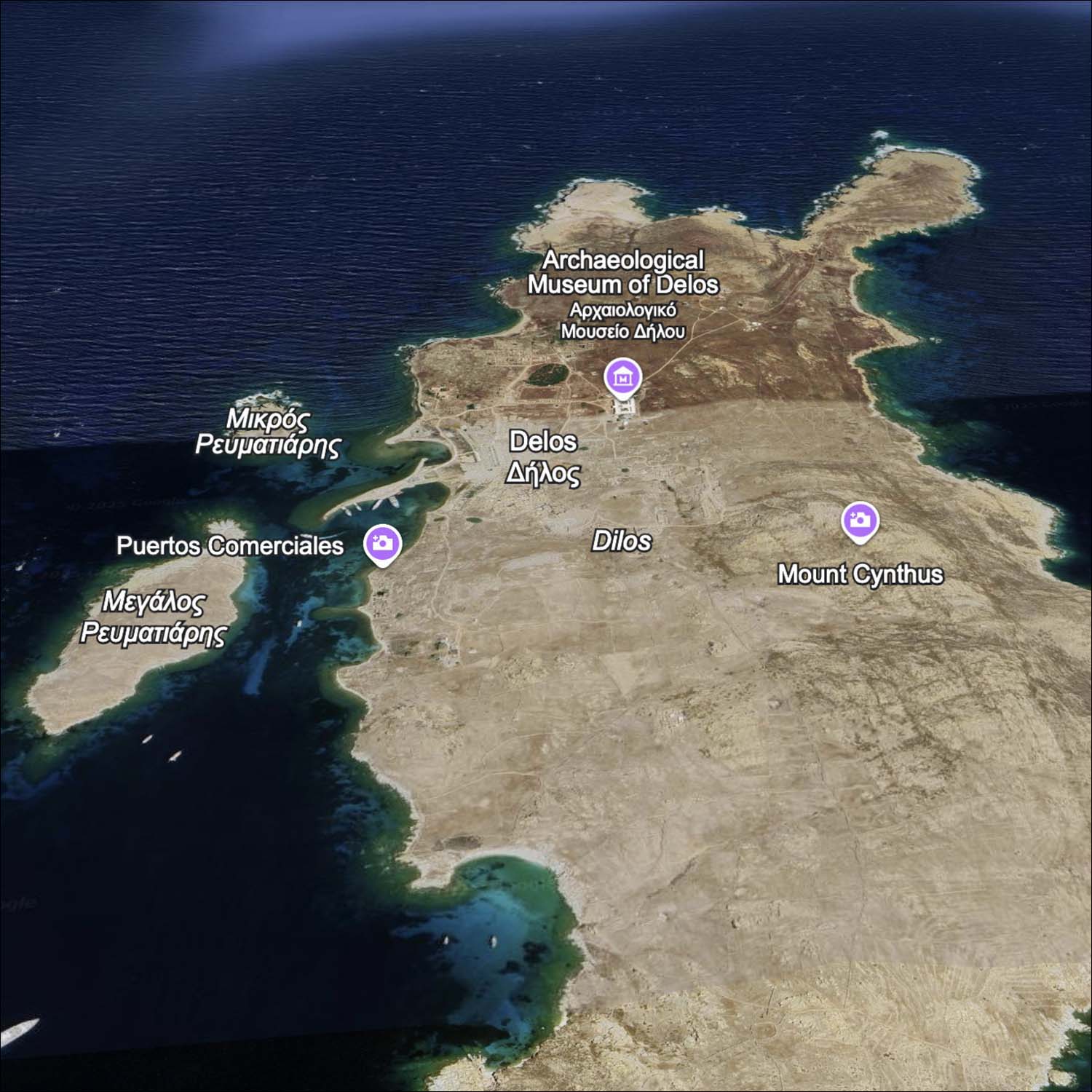
The structures and shrines on Delos were situated on the northwestern portion of the island. The primary landmarks on Delos were the temples of Apollon and Artemis, the shrine of Leto (the Leotum) and the Terrace of the Lions, all of which were situated on the plain adjacent to Mount Kynthos (Cynthus). The Inopos (Inopus) River flows across the island and was thought to be an upwelling of the Nile River of Egypt. Dogs were not allowed on the island and after circa 425 BCE it was unlawful to bury or burn bodies on Delos. The nearby island of Rheneia was used as the cemetery for Delos.
Barbarian pirates eventually invaded Delos and defiled the sacred island. When the Romans became masters of the Mediterranean Sea, they restored the temples and shrines but also used the island as a shipping hub for merchandise and slaves. The island never regained its previous glory.
| References: Homer, Odyssey book 6, 162 Apollondorus, The Library book 1.4.1; book 1.4.3–5 Strabo, Geography book 10.5.2 Diodorus of Sicily, The Library of History book 12.58 |