Homepage Site Search
Copyrighted Material—All Rights Reserved

Geography Index
The island home of the goddess, Kalypso (Calypso).
The overall consensus of modern and classical scholars has been that Ogygia is an imaginary island invented by the poet Homer for dramatic effect. Even so, there were classical authors who did not want to dismiss Homer's geography as pure fiction. They sincerely believed Homer had a realistic grasp of ancient geography and would not arbitrarily incorporate fictitious islands into his poetry. With that in mind it's not unreasonable to consider the possibility that Homer's inclusion of Ogygia had a basis in fact.
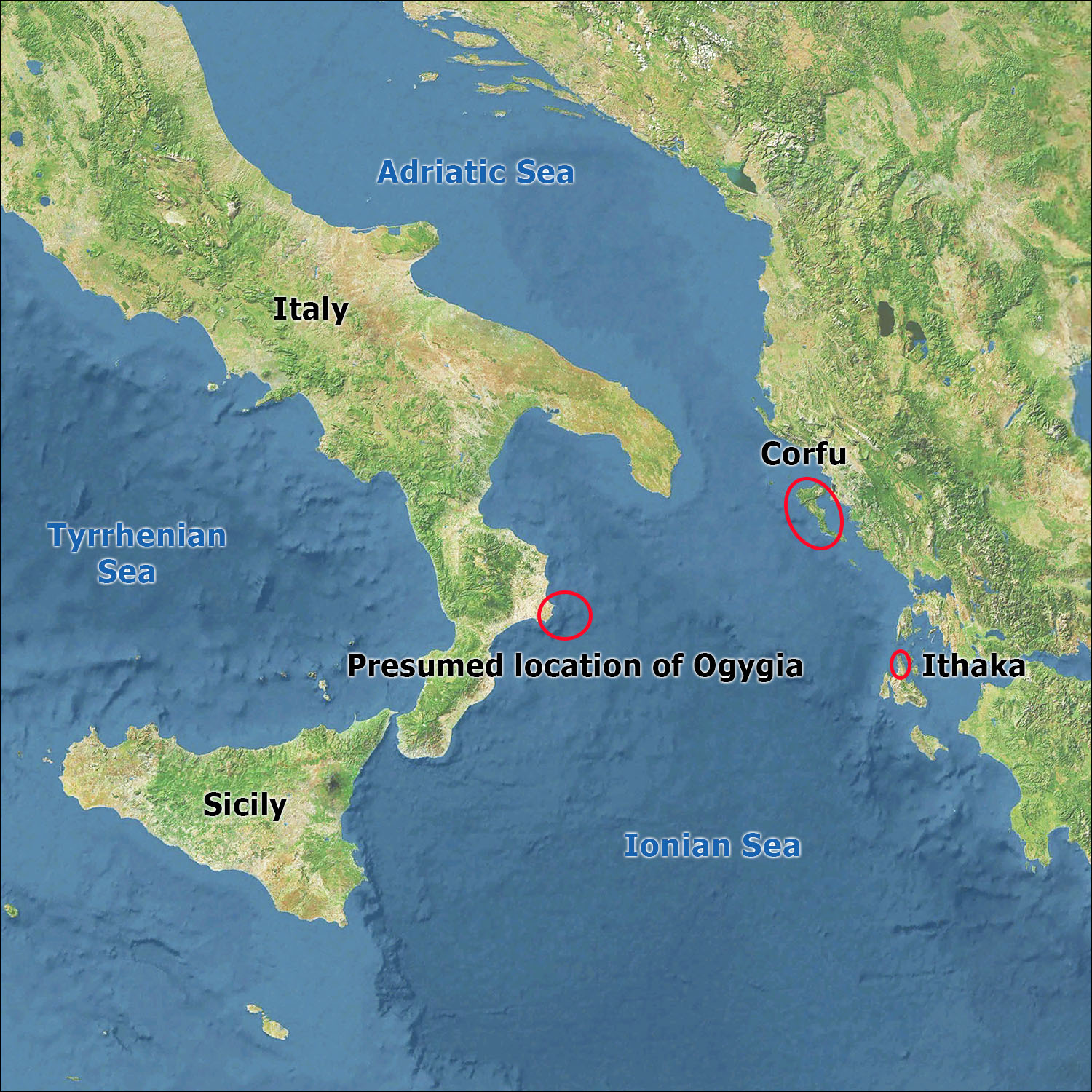
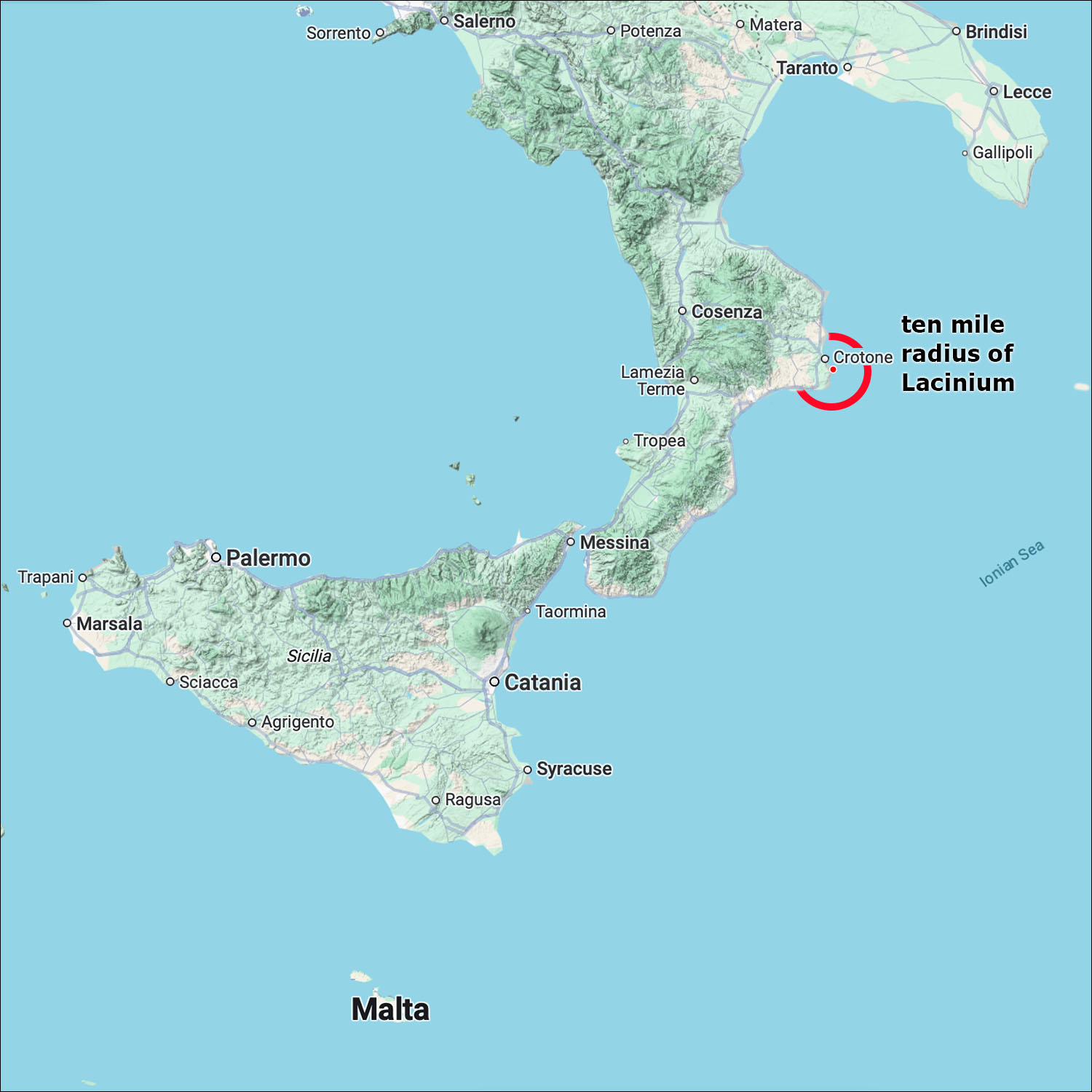
The Roman author Pliny the Elder stated that there was in fact an island off the eastern coast of southern Italy called Kalypso's Island, presumably the island of Ogygia. He placed it ten miles from the promontory of Lacinium (Capo delle Colonne).
After leaving Troy, Odysseus incurred the wrath of the god, Poseidon. By the time Odysseus reached Ogygia he had lost his ships and all his companions had been killed.
Odysseus was utterly without hope when Kalypso (She Who Conceals) found him washed ashore on her island. His rugged good looks and noble character soon affected the lonely goddess and she fell in love. Odysseus stayed with Kalypso for seven years, but they were long, sad years for Odysseus. He resigned himself to the fact that there was no escape from the island, but he still constantly longed for his wife and son, Penelope and Telemachos. Kalypso offered Odysseus immortality and eternal youth if he would stay with her but he refused ... he wanted to go home.
During their time together, Kalypso and Odysseus had two sons—Nausithoos and Nausinoos. Perhaps they had a third son named Telegonos but he might have been the son of the goddess Kirke and not Kalypso.
Just as Poseidon was determined to punish Odysseus, the goddess Athene (Athena) was always looking for ways to help the intrepid hero. When she reminded Zeus that Odysseus had been on Ogygia for seven years, Zeus sent his son Hermes with a message for Kalypso ... she was to allow Odysseus to leave ... furthermore, she was to give him the assistance he needed to build a seaworthy craft.
Hermes arrived on Kalypso's island and was given a warm welcome ... he and Kalypso drank nectar and ate ambrosia. Finally, he told her of his mission and gave her Zeus' command. At first Kalypso was indignant ... she reminded Hermes of the many gods and goddesses who had taken mortal lovers and wondered why she could not keep Odysseus. Hermes told her that Zeus was adamant ... she must help Odysseus leave Ogygia and she was not permitted to use her charms to detain him.
Kalypso accepted her fate and agreed to let Odysseus leave unhindered. Odysseus was a cautious man because he had endured so much trickery at the hands of the Immortals ... he did not believe Kalypso would actually help him. To insure her sincerity, Odysseus made Kalypso swear a great oath on the waters of Styx that she meant what she said and was not trying to deceive him. Styx was called the Oath River because swearing on her waters was the most binding oath an Immortal could make. Kalypso swore the oath and gave Odysseus the tools he needed to build a seaworthy raft. When it came time for him to leave Kalypso, true to her loving nature, gave Odysseus provisions and sent him on his way with a fair wind to speed him to his island home of Ithaka.
Poseidon's wrath was not complete. The raft Kalypso helped Odysseus make was dashed to pieces in a storm and Odysseus was once again at the mercy of the sea. He finally washed ashore on the island of the Phaiakians, presumed to be modern Corfu.
Approximate:
Latitude North, Longitude East
39.037150, 17.311865
| References: Homer, Odyssey book 1, line 85 book 6, line 172 book 7, lines 244 and 254 book 12, line 448 book 23, line 333 Strabo, Geography book 1.2.18 Apollodorus, Epitome line 23 Pliny the Elder, Natural History book 3.10 |