Homepage Site Search
Copyrighted Material—All Rights Reserved

Geography Index
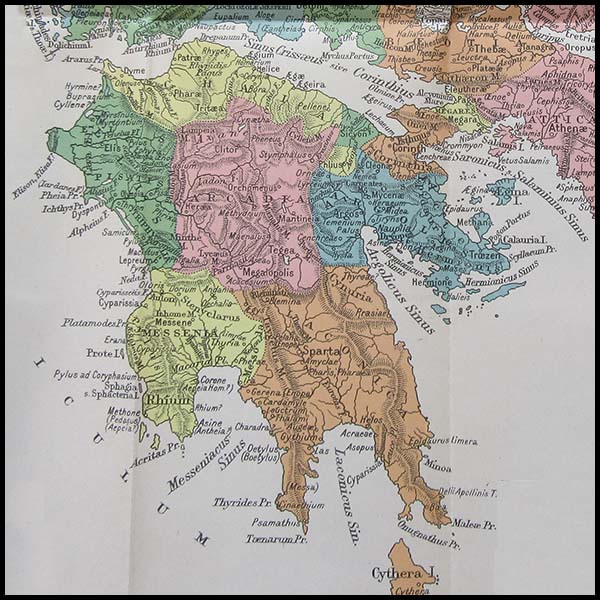
The distinctive peninsula south of mainland Greece.
Approximate geographic center:
Latitude North, Longitude East
37.6746, 22.2275
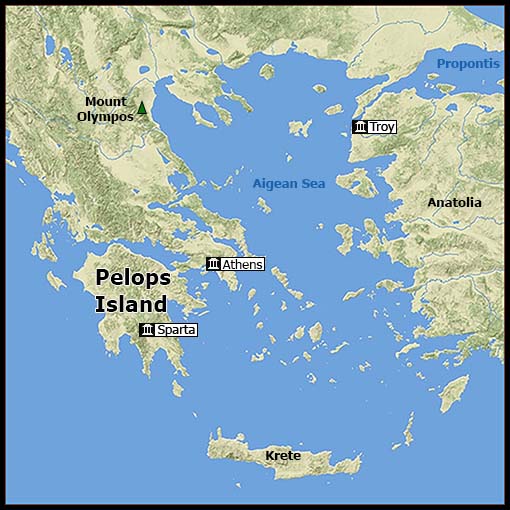
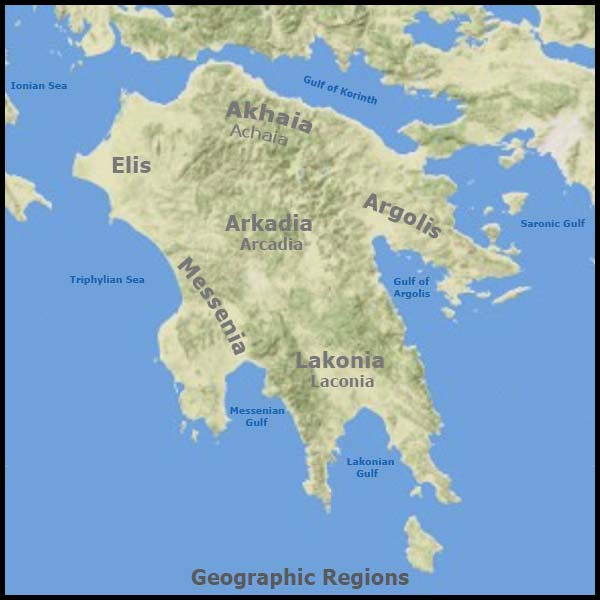
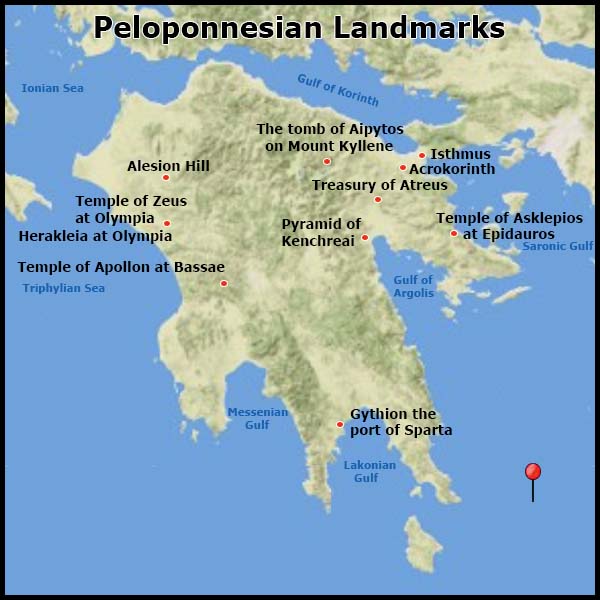
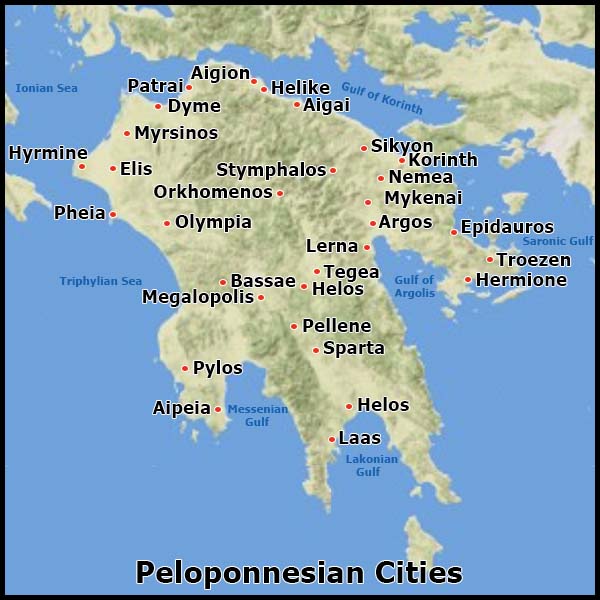
The Peloponnese, representing approximately 16% of Greece, is connected to the mainland by a narrow isthmus near the city of Korinth (Corinth). The peninsula has been called Peloponnese since circa 1420 BCE, approximately three generations before the Trojan War. Prior to that time, it was called Apia1 after the dominate ruler of the northern portion of the peninsula, Apis.
Approximately ten generations after Apis, a remarkable man named Pelops immigrated to the peninsula from Lydia in Asia Minor. He was an energetic and dynamic man—the son of Tantalos (Tantalus) and grandson of the god Zeus.
In the city of Pisa, Ares, god of war, mated with Harpine, a daughter of the river-god Asopos (Asopus). They named their son Oinomaos (Oenomaus), who in turn had only one child, a daughter named Hippodameia. Oinomaos consulted an oracle about the end of his life and was told that when Hippodameia married, he would die. Mistakenly believing he could thwart the prophecy, Oinomaos devised a way to make sure Hippodameia would never marry.
Oinomaos announced that anyone wanting to marry Hippodameia would have to defeat him in a chariot race. The race would be across the peninsula from Pisa to the altar of Poseidon on the Isthmus. Oinomaos would give the suitors a head start and then pursue them. Oinomaos, with his superior four-horse team and superb charioteer Myrtilus, would inevitably overtake the suitors and then kill then with his spear. Many young men accepted the challenge—Oinomaos killed them all.
Pelops was determined to marry Hippodameia and accepted the challenge. He corrupted Myrtilus, Oinomaos' charioteer, and succeeded in winning the race and the hand of Hippodameia in marriage. Myrtilus' reward for betraying Oinomaos was to be murdered by Pelops. Accepting the inevitable, Oinomaos took his own life thus fulfilling the oracle's prediction.
Pelops became ruler of Pisa and used his wits and courage to eventually dominate the entire peninsula, which from that time onward has been called Peloponnese (Pelops' Island) after him. He was the first person to establish a temple for the god Hermes on the peninsula, presumably to assuage his guilt in the murder of Myrtilus.
Tidbits:
The city of Olympia became the home of one of the greatest sports events in history. The Olympic Games were established in honor of the god Zeus circa 776 BCE and were celebrated every four years, a period known as an Olympiad. The ancient Greeks used the games to date historical events until the Roman emperor Theodosius abolished the games in AD 393 as part of a program to eradicate pagan religious practices.
Six of the Twelve Labors of Herakles (Heracles) were performed on the Peloponnese. Herakles, a son of the god Zeus, was required to perform twelve "labors" for King Eurystheus of Sparta because Zeus was tricked by his sister-wife, Hera.
The walls of Tiryns and Mykenai (Mycenae) were so massive they were said to have been built by the Cyclopes, from which we get the term "cyclopean architecture." The Cyclopes were multi-armed, one-eyed giants who were the servants of the god Zeus.
The traveler-historian Pausanias reported that the shell-fish harvested off the coast of Lakonia (Laconia) produced a purple dye second only to that of the Phoenician Sea.
1. The bloodline of Apis, the eponymous founder of Apia:
Thelxion, son of Apis
Aegyrus, son of Thelxion
Thurimachos (Thurimachus), son of Aegyrus
Leukippus (Leucippus), son of Thurimachos
Kalchinia (Calchinia), daughter of Leukippus
Peratus, son of Kalchinia and the god Poseidon
Plemnaeus, son of Peratus
Orthopolis, son of Plemnaeus
Chrysorthe, daughter of Plemnaeus
Korax (Corax) and Lamedon, sons of Chrysorthe and the god Apollon