Homepage Site Search
Copyrighted Material—All Rights Reserved

Geography Index
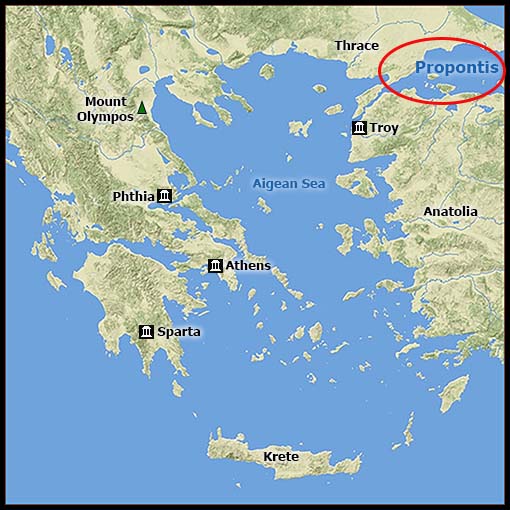
An inland sea connecting Pontus (the Black Sea) with the Aigean (Aegean) Sea.
The name Propontis means "fore-sea." Ancient travelers sailing from the Aigean Sea to Pontus would pass through the Propontis "before" they reached Pontus. The Romans called Propontis the Sea of Marmara, relating to the island Marmora, which was a rich source of marble (marmor).
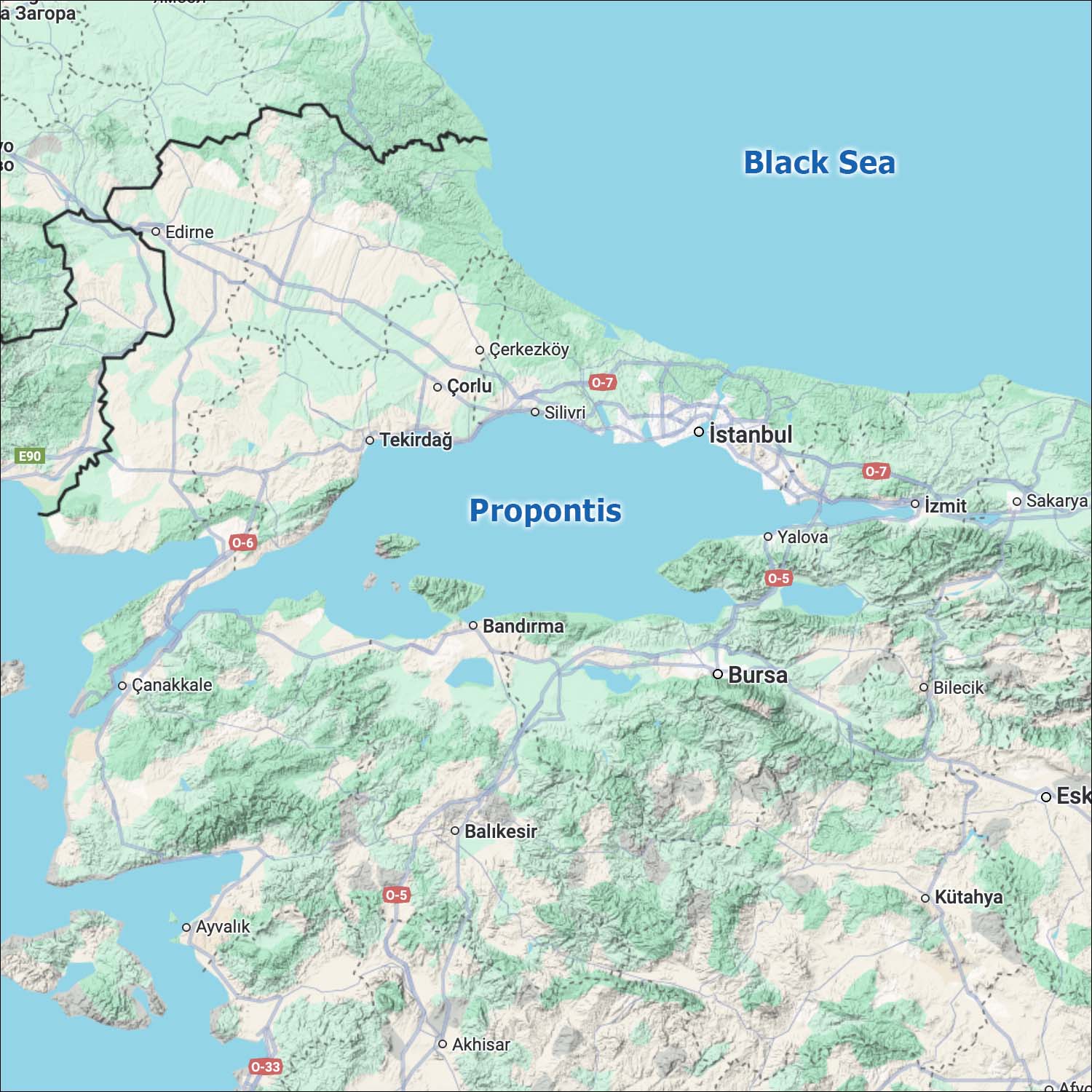
The Propontis covers an area of approximately 4,380 sq mi (11,350 sq km). The outlet to Pontus is through the 20 mile (32 kilometer) Bosporus (or Bosphorus) Straits and the southern outlet passes through the 40 mile (64 kilometer) straights of the Hellespont1 into the Aigean Sea. The distance across the open waters of Propontis from the Hellespont to the Bosporus Straits is approximately 126 miles (203 kilometers).
Prior to the Roman era, the Greeks called the island Marmora Prokonnesos (Proconnesus) but it was also known as Elaphonnesos (Elaphonnesus) and Neuris. The most distinctive "island" in Propontis is a peninsula named Kyzikos (Cyzicus). At one time, Kyzikos was an island, but it has been connected to the mainland since at least 1300 BCE by a narrow isthmus. The rugged shoreline and rugged interior of Kyzikos gives it a fortress-like aspect.
The Sea of Marmara lies entirely in Turkey and separates Europe from Asia. It's interesting to note that the Black Sea was so named by the Ottoman Turks sometime after 1300 CE. They used the name Karadeniz (Black Sea) to designate the northern sea whereas the Mediterranean Sea, lying to the southwest, was named Akdeniz (White Sea).
1. The Hellespont (Helle's Sea) in antiquity was undoubtably much larger and probably included the Propontis and a large portion of the northern Aigean Sea.
Approximate geographic center:
Latitude North, Longitude East
40.8160, 28.1659
| References: Strabo, Geography book 1.3.5 book 2.1.5 book 2.5.23 book 7.1.1 book 7.6.1 book 7.7.4 book 13.1.1 book 13.1.2 Hesiod, Catalogue of Women 103 Pseudo-Apollodorus, Library book 1, line 983 Apollonius of Rhodes, Argonautica book 1, line 936 book 1, line 983 Apollodorus, The Library book 1.21 Herodotos, Histories book 4.85 book 5.122 Diodorus of Sicily, Library of History book 2.3 book 12.34 book 18.72 book 19.7 book 32.35 |