Homepage Site Search
Copyrighted Material—All Rights Reserved

Geography Index
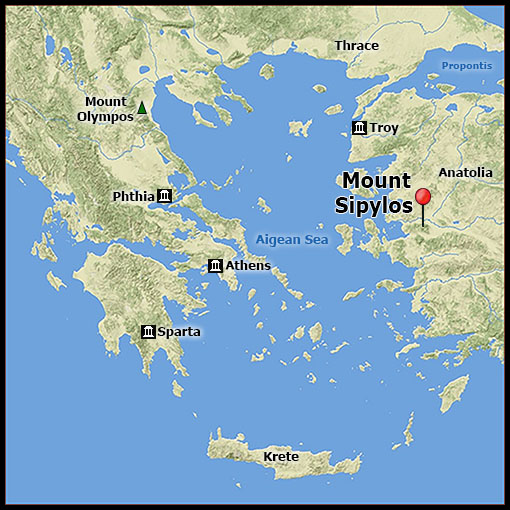
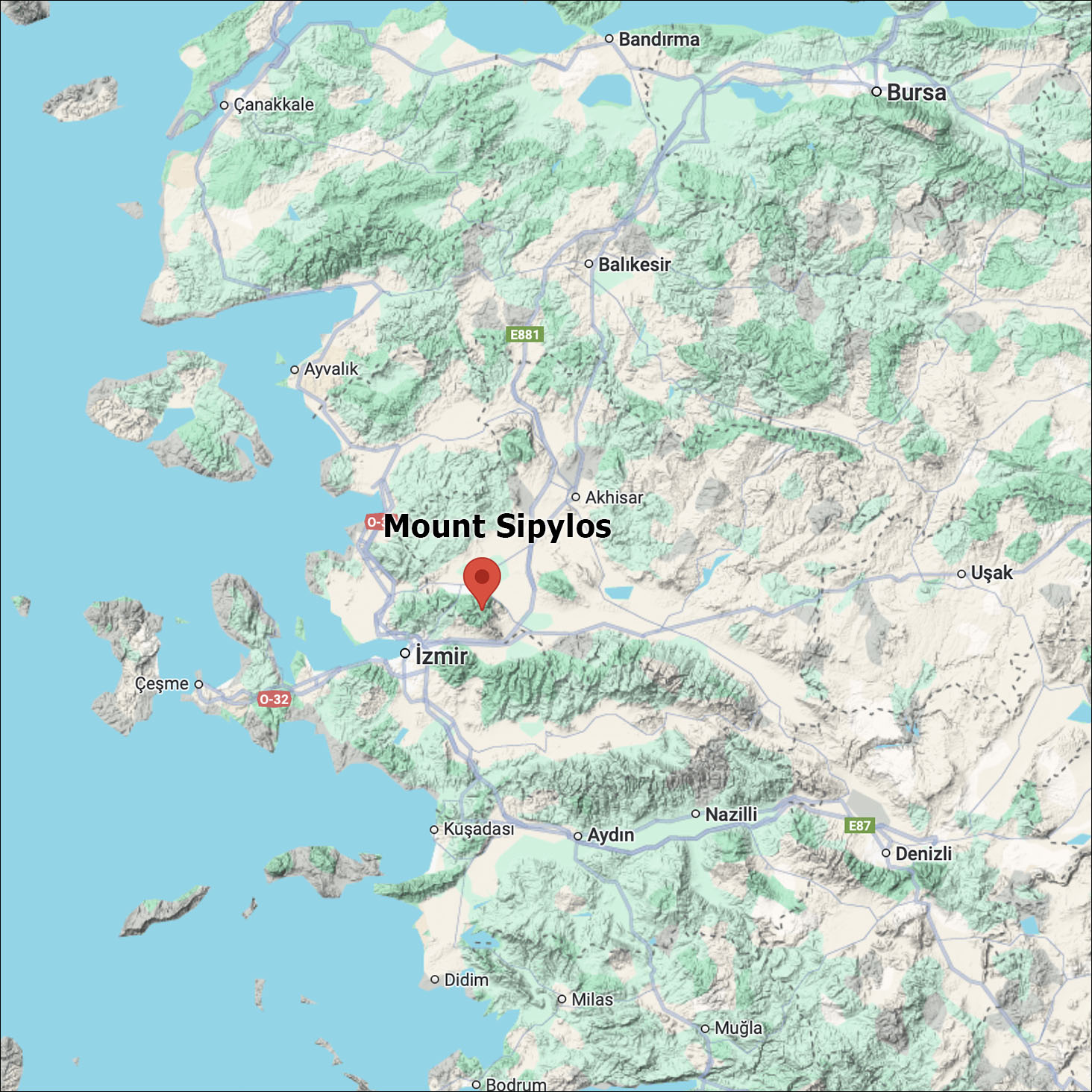
A mountain in Lydia.
During the Trojan War, Achilles told Trojan King Priam the story of a woman named Niobe who sat on Mount Sipylos where the nymphs1 rested after dancing beside the Acheloios (Achelous) River.
The first mortal woman with whom the god Zeus had an affair was Niobe and the last was Alkmene—Niobe was an ancestor of Alkmene from sixteen generations previous. As to why Zeus would chose to begin and end his relations with mortal women in the same bloodline is a matter for speculation but we might assume that Herakles was the last demigod conceived by Zeus and because Herakles was so perfect in every way, Zeus did not want to have his best child followed by inferior children.
Niobe was the daughter of Tantalos (Tantalus) and the sister Pelops, eponymous founder of the Peloponnesian Peninsula. She was the mother of seven sons and seven daughters, of which she was very proud ... perhaps, too proud. She would frequently boast that she was more blessed with children than the goddess Leto ... after all, Niobe had fourteen children and Leto had only two.
Leto became weary of Niobe's arrogant boasting and sent her children Apollon and Artemis to kill Niobe's children. Apollon and Artemis did as their mother commanded but it seems that only twelve of the children were slain. One daughter and one son survived because of their prayers to Leto—their names were Meliboea and Amyklas (Amyclas). Meliboea was struck ghostly white from the frightening experience and was afterwards called Chloris (Pale).
Niobe was supposedly turned to stone and placed on Mount Sipylos to eternally weep for her children. When the traveler-historian Pausanias was on Mount Sipylos, he observed, "When you are near, it is a beetling crag with not the slightest resemblance to a woman, mourning or otherwise; but if you go further away you will think you see a woman in tears, with head bowed down."
1. Nymphs—goddesses with symbiotic relationships with aspects of the natural world.
Approximate
Latitude North, Longitude East
38.5793, 27.4479
| References: Homer,Iliad book 24, lines 602 and 606 Apollodorus, The Library book 2.1.1 book 3.5.6 book 3.8.1 Ovid, Metamorphoses book 6, lines 148, 156 and 273 Pausanias, Description of Greece Arcadia—2.5; 11.3; 39.10 Elis 1—1.3; 14.4 Diodorus of Sicily, Library of History book 4.14 book 4.74 Strabo, Geograaphu book 12.8.2 book 12.8.21 |