Homepage Site Search
Copyrighted Material—All Rights Reserved

Geography Index
A city in Boiotia (Boeotia); the city of seven gates.
During the Trojan War, Peneleos and Leitos (Leitus) commanded the Achaian (Achaean) soldiers from Thebes and 28 other cities in Boiotia. Arkesilaos (Arcesilaus), Prothoenor, and Klonios (Clonius) served as co-commanders.
Latitude North, Longitude East
38.3199, 23.3176
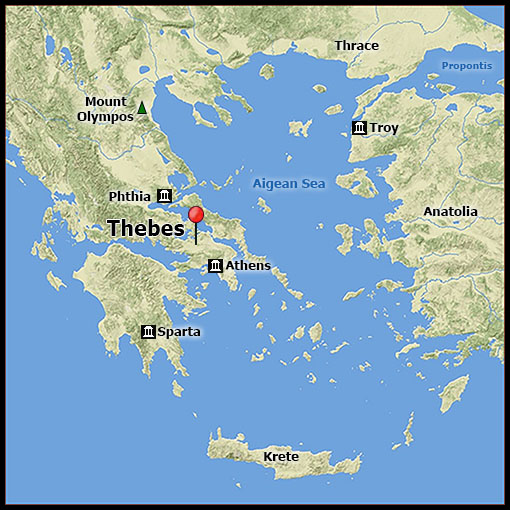
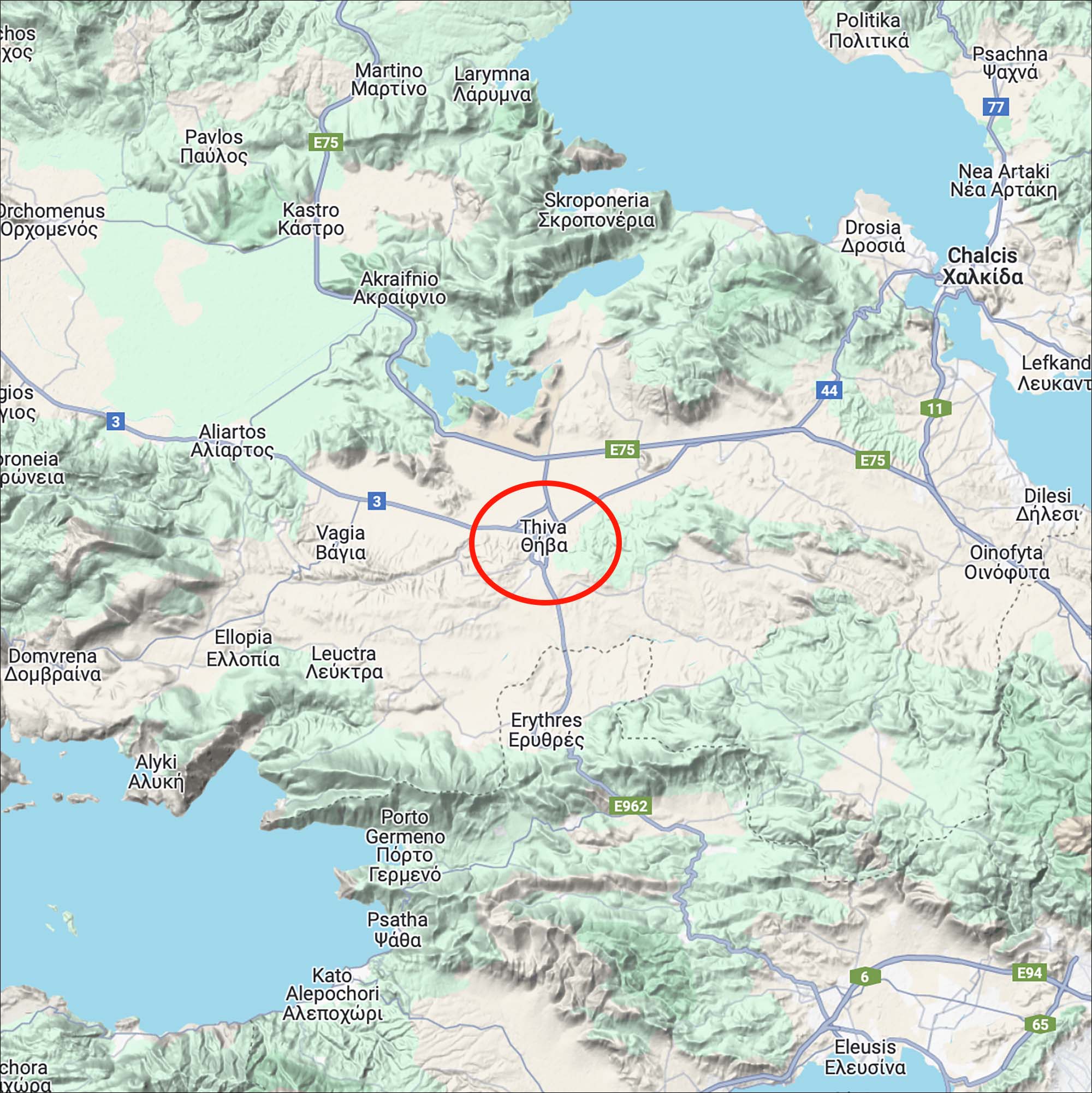
Thebes was founded by a legendary Phoenician prince named Kadmus (Cadmus) while searching for his sister, Europa. In the guise of a bull, the god Zeus abducted Europa and carried her to the island of Krete (Crete). At the insistence of his father King Agenor, Kadmus conducted an exhaustive search for his sister. His efforts were unsuccessful. Finally, in desperation, Kadmus went to Delphi for divine assistance. The Pythia (a priestess of Apollon) instructed Kadmus to follow a cow from Delphi and build a city on the spot where the cow laid down to rest. Kadmus did as he was instructed and built the Kadmea (Cadmea) as the first structure of the new city.
As the city's precincts expanded, the newer parts were called Thebes, after a nymph1 named Thebe, the consort of one of the men who built the foundations and battlements of the new city. The soldiers from Thebes who fought in the Trojan War were referred to as Thebans, not Kadmeians.
To insure the permanence of his newly founded city, Kadmus went to a nearby spring and was forced to kill the dragon guarding the spring. He took the teeth of the dragon and, on the advice of the goddess Athene (Athena), sowed them in the earth. A crop of warriors called Sparti sprang from the dragon’s teeth. Kadmus threw a stone in their midst and the Sparti fought amongst themselves until only five remained. These remaining five warriors became the founding fathers of Thebes.
Kadmus was given the honor of marrying Harmonia, a daughter of Aphrodite, goddess of love. Aphrodite gave Harmonia a necklace as a wedding gift, a necklace that was passed down through Harmonia's bloodline to become vitally important in subsequent generations.
Three generations before the Trojan War, Thebes was ruled by King Laius and Queen Iokaste (Jocasta). Laius, at that time childless, was given a prophesy that his son would kill him and take his throne. When Laius and Iokaste had a son, they made one of their servants take the infant to Mount Kithaeron (Cithaeron), pierce and bind his ankles, and leave him for the beasts and elements to devour.
The servant they chose to murder the boy could not carry out the shameful act. He gave the child to a shepherd from a neighboring province who in turn gave the injured child to the king of the city of Korinth (Corinth). The child was dubbed Oedipus (Oidipous) and raised as part of the royal household. The name Oedipus means "swollen foot" and was derived from the injury to the boy's ankles.
King Polybos (Polybus) and Queen Merope of Korinth raised Oedipus as their son but when he became an adult he was told by the Oracle at Delphi that he would be the murderer of his father. Oedipus loved Polybos, who he assumed to be his natural father, and fled Korinth so the prophecy could not be fulfilled.
Despondent and homeless, Oedipus wandered aimlessly until he happened to encounter an exceedingly arrogant man on the road to Thebes. An argument ensued and Oedipus killed the man and all but one of his bodyguards. The arrogant man was of course his father, Laius.
Positioned on the outskirts of Thebes was a Sphinx, a fierce, birdlike creature who posed riddles to travelers and killed them if they did not answer correctly. Oedipus outsmarted the Sphinx and killed it. The citizens of Thebes were ecstatic. The Sphinx and their despot king were both dead. They made Oedipus king and allowed him to marry Laius' wife, Queen Iokaste. Oedipus and Iokaste had four children before he realized she was his mother.
Oedipus blinded himself and went into exile. Iokaste hanged herself. Their sons, Eteokles (Eteocles) and Polydoros (Polydorus), vied for kingship. Eteokles tricked Polydoros and took the throne. Polydoros went to Argos and recruited commanders with armies to help him regain the throne of Thebes. They became known as the Seven Against Thebes because each army was to attack one of the seven city gates.
In preparation for the attack on Thebes, KIng Tydeus of Argos ventured into the city and challenged the finest young Kadmeians to athletic competitions. He defeated them all in every event. To assuage their humiliation, fifty Kadmeians ambushed Tydeus as he was leaving the city. Tydeus killed all but one. He let one man live to report the slaughter to the other Kadmeians.
Despite Tydeus' stunning display of prowess and bravery, the Seven Against Thebes were utterly defeated, Eteokles and Polydoros died fighting one another. A generation later, the sons of the defeated commanders banded together and conquered Thebes. They were called the Epigone, the 'after born.'
During and after the Trojan War the Thebans were considered to be fierce soldiers. The battle of Thermopylae is usually associated with the 300 Spartans who died fighting the overwhelming Persian invaders but the Thebans were also involved. When it became obvious that the Persians were going to breach the Greek defenses, Spartan King Leonidas dismissed the non-Spartan defenders who were unwilling to fight a hopeless battle. The Thebans stayed with Leonidas and shared his fate but not necessarily his glory.
There was an oracle of Ismenian Apollon at Thebes that was briefly mentioned in the ancient texts. The historian Herodotus wrote: "there one may consult just as at Olympia with victims (animal sacrifices)."
1. Nymphs—goddesses with symbiotic relationships with aspects of the natural world.
| References: Homer, Iliad book 2, line 505 (Lower Thebes) book 4, lines 378, 406 book 5, line 804 book 6, line 223 book 10, line 286 book 14, lines 114, 323 book 19, line 99 book 23, line 679 Homer, Odyssey book 11, lines 263, 265, 275 book 15, line 247 Pausanias, Description of Greece book 9.5.2 Apollodorus, The Library book 3.5.6 Herodotus, The Histories book 1.52 book 5.59 book 8.134 |