Homepage Site Search
Copyrighted Material—All Rights Reserved

Geography Index
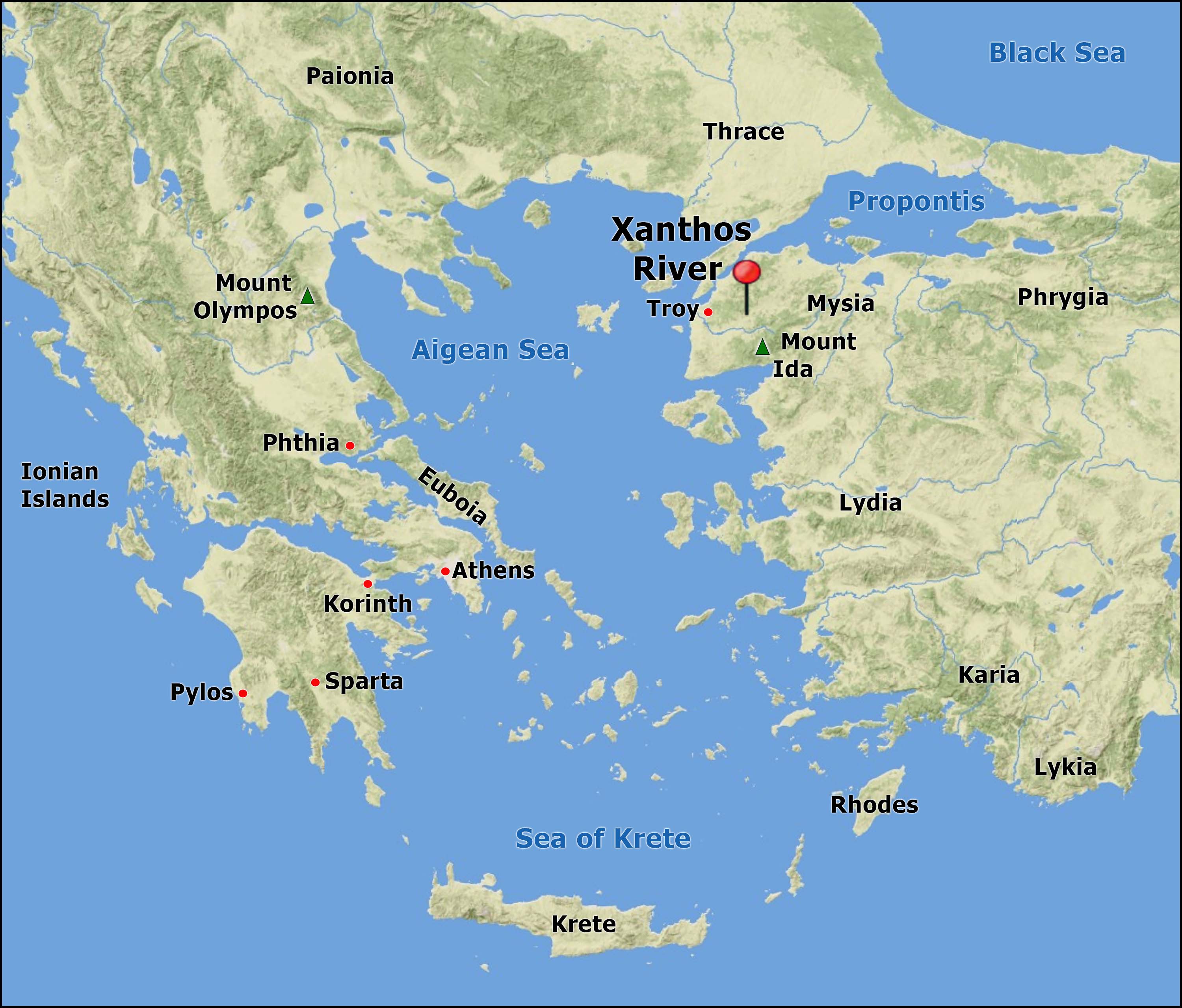
The primary river on the Troad.1
The river and the river-god were called Xanthos by the gods and goddesses, and Skamandros (Scamander) by mortals.
The Xanthos River and its tributary, the Simoeis (Simois), flowed across the battlefield at Troy. Several pitched battles took place on the no man's land between the Xanthos and Simoeis Rivers.
Achilles was enraged at the death of his companion Patroklos (Patroclus) and attacked the Trojans on the banks of the Xanthos. Achilles threw the bodies of men and horses into the river until the waters ceased to flow. The river-god Xanthos rose from the depths and hurled wave after wave at Achilles, trying to drown him. The goddess Hera urged her son Hephaistos (Hephaestus) to help Achilles by burning Xanthos. Hephaistos set the entire battlefield around the river ablaze. Xanthos retreated and begged for mercy. With Hera's approval, Hephaistos quenched the fires, allowing Achilles to resume his slaughter of the Trojans.
The war ended with Troy in ruins. The gods deemed it necessary to wash away the wall the Achaians built to protect their ships. Guided by the hand of Apollon, the Xanthos and other rivers2 on the Troad were diverted from their natural courses to form a unified body of water, which flowed across the plain between Mount Ida and the sea for nine days. The god Zeus augmented the river torrents with constant rain. Poseidon, lord of the sea, used his trident to hurl the bastions of the wall into the surging water. No trace of the wall remained. Satisfied with their handiwork, the gods returned the rivers to their original channels.
1. Troad—the extensive area surrounding Troy.
2. Rivers on the Troad—Aisepos (Aesepus), Grenikos (Granicus), Heptaporos (Heptaporus), Karesos (Caresus), Rhesos (Rhesus), Rhodios (Rhodius), Simoeis (Simois), and Skamandros (Scamander) a.k.a. Xanthos (Xanthus).
| References: Homer, Iliad book 6, line 4; book 8, line 560; book 21, lines 15, 337 |